


Best PayPerQ Alternatives 5 apps
Compare the top alternatives to PayPerQ — pricing, features, and ratings.
PayPerQ is a pay-per-query AI chat service that lets users tap into multiple large language models from a single credit-based balance, charging only for the questions they actually ask. It appeals to developers, researchers, and casual users who want model flexibility without a fixed monthly subscription. This guide walks through the leading PayPerQ alternatives on HyperStore and the situations where each one is a better fit, because familiar triggers include unpredictable cost on heavy workloads, missing enterprise features, or simply wanting a platform that bundles chat with widgets, CRMs, or analytics in one place.
Why look for a PayPerQ alternative?
PayPerQ's strength is its lightweight, usage-based pricing, and that model works well when query volume is low or unpredictable. The flip side is that costs can climb quickly on workloads like long-running customer support or high-traffic website widgets, where a flat subscription often works out cheaper. Some users also want features PayPerQ is not built around: visual chatbot builders, grounded answers with citations, lead capture forms, CRM sync, or 24/7 agent availability for end customers. If you need any of those capabilities out of the box rather than wiring them together yourself, exploring PayPerQ alternatives is likely worth your time.
What to look for in a PayPerQ alternative
Pricing model that matches your workload
If your usage is spiky or low-volume, pure pay-per-query pricing still makes sense. If you expect consistent traffic, for example embedded chat on a marketing site, a flat monthly tier with generous message caps is usually more predictable. Look closely at what counts as a message and whether retrieval, vision, or long context carries a surcharge before you commit.
Built-in channels and integrations
The biggest gap between raw API access and a finished user-facing product is the surrounding scaffolding: website widgets, WhatsApp or Messenger connectors, CRM sync, and human handoff. Tools that bundle these natively save weeks of integration work compared with a pure AI endpoint, and they tend to be where PayPerQ alternative tools differentiate most.
Answer quality, citations, and guardrails
For any customer-facing deployment, hallucination is a real risk. The broader trend in LLM accuracy and evaluation is tracked annually in the Stanford HAI AI Index, which is useful context when setting internal confidence thresholds. Platforms that surface source citations, confidence scores, or domain-specific grounding let you ship a chatbot you can actually defend in front of legal or support teams.
Hosting, data, and model flexibility
Where does inference run, where is data stored, and can you swap model providers later? Vendors that lock you into one model or one region are harder to migrate away from, which matters for any long-term choice. Enterprise buyers typically anchor on frameworks like the NIST AI Risk Management Framework when reviewing those answers.
The best PayPerQ alternatives
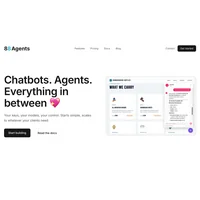
88Agents is a chatbot platform aimed at businesses that want to deploy the same agent across multiple channels rather than just a web playground. Compared with PayPerQ, the value sits in the multi-channel build, deploy, and management layer, while still letting teams select different underlying models per use case. It is best suited to product or marketing teams standardising on one platform for several brands or surfaces, where PayPerQ's single-window chat experience is overkill.

AccuChats focuses on accuracy rather than breadth of channels. Its standout feature is cited responses with confidence scoring, which PayPerQ does not provide natively, useful when the chatbot must answer from your own knowledge base and you need to show users the source. Pick AccuChats if your priority is trustworthy, source-backed answers on a business website and you are willing to trade some multi-channel flexibility for that guarantee.

Chattitude is an AI chat agent designed for always-on customer support and lead capture, the operational use case PayPerQ was not built for. Where PayPerQ is a pay-as-you-go console for individuals asking questions, Chattitude behaves like a frontline support rep that qualifies leads around the clock. It suits small and mid-sized businesses that want a set-and-forget website agent without building the workflow themselves.

OC Maker sits in a completely different lane: it is an AI character and artwork generator rather than a chat business tool. Compared with PayPerQ's text-only model access, OC Maker turns written descriptions into visual artwork across multiple artistic styles. Consider it only if your alternative need is actually about generating images or character designs, not replacing a chat API.

Site2CRM is a lead capture and CRM automation platform that uses AI to qualify and route contacts from your website directly into your CRM. Against PayPerQ, the appeal is operational: rather than paying per question answered by an LLM, you convert that traffic into structured, synced records your sales team can work. It fits B2B sites and agencies that already live inside a CRM and want to stop losing form-fill conversions.
How to choose
If your main pain is raw API cost, stay close to PayPerQ's model and benchmark against another usage-based competitor. If you are putting chat in front of customers, Chattitude or 88Agents give you the widget, hosting, and channels in one package. If answer trust is the blocker, AccuChats' citations and confidence scores are the deciding factor. If the real job is turning traffic into pipeline, Site2CRM reframes the workflow entirely. OC Maker only enters the conversation if your alternative need is image generation, not chat.