


Best Readdy Alternatives 7 apps
Compare the top alternatives to Readdy — pricing, features, and ratings.
Readdy is an AI-assisted website builder that helps turn a brief into a working digital experience. People explore Readdy alternatives when they need a different project scope, deployment model, platform focus, or budget. Some want a functional application rather than a primarily web-focused build, while others need a specialized website, social, or analytics tool. The comparison below keeps Readdy in the picture and matches each option to the situation where it may fit better.
Why look for a Readdy alternative?
Switching is often about fit, not a verdict on Readdy. A builder may be convenient for getting from idea to launch, yet a different product can make more sense if you need a narrower workflow, more explicit control over the generated output, a different hosting path, or a tool aimed at an existing channel.
Budget and ownership can matter just as much as generation speed. Before moving, identify what Readdy already does well for your project, then test whether an alternative improves the specific constraint that prompted the search. Accessibility should be part of that check; use W3C's WCAG guidance as a quality reference rather than assuming generated pages are ready without review.
What to look for in a Readdy alternative
Build type and scope
First decide whether you are creating a public-facing website, a broader functional application, or a supporting tool for an existing audience. Readdy may remain the simplest choice when its general workflow matches the brief; an alternative is more compelling when its stated purpose lines up closely with the project.
Output and deployment
Compare the form of the result and the path to launch. Clean static HTML, integrated backend and database capabilities, built-in hosting, or domain integration can each matter in different situations, so check which of those outcomes the candidate explicitly promises rather than treating every AI builder as interchangeable.
Search visibility
If the site needs organic discovery, review how the tool approaches page structure and production output, then assess the result against Google's SEO Starter Guide. A fast first draft is useful, but it should not replace checking titles, content, links, and the pages' actual usefulness to visitors.
Accessibility, cost, and maintenance
Look beyond the first publish: check the available cost tier, how easy it is to revise the project, and whether the finished experience can be reviewed for accessibility and quality. HyperStore's free and paid labels are useful starting points, but confirm the current terms and make sure the output can be maintained as content changes.
The best Readdy alternatives
Base44 is a closer alternative when the goal is a functional application rather than only a website: it turns natural-language descriptions into working applications. Compared with Readdy, it suits people who want to describe the product in plain language and explore a broader app-development workflow. HyperStore lists Base44 as free, making it a practical place to test that direction.
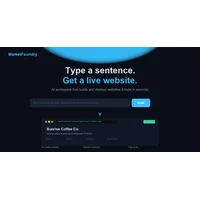
MarketFoundry AI Workspace is a better fit when the project is centered on a professional website or broader digital presence without coding or design skills. Compared with Readdy, its emphasis is more clearly on quickly producing that outward-facing presence, so it may suit a small business or individual building a web presence. HyperStore lists it as free, which lowers the barrier to trying it alongside Readdy.

Pagesmith.ai focuses on SEO-optimized, production-ready websites built as clean static HTML, with an emphasis on instant load times. Compared with Readdy, it is a strong choice when search visibility, simple output, and site speed are the priority rather than a more general build workflow. HyperStore lists Pagesmith.ai as free, so it can be tested for content-led or performance-conscious projects.

Rocket is aimed at turning a single prompt into a fully functional, production-ready application with an integrated backend and database. Compared with Readdy, it is the better fit when the project needs application behavior and data support, not just a polished front end. HyperStore lists Rocket as free, making it useful for comparing a prompt-first app workflow.

RYPL is not a like-for-like website builder: it automates Facebook Page management with AI-powered replies, sentiment analysis, and smart moderation. Compared with Readdy, it makes more sense when the real need is ongoing audience engagement and moderation on Facebook rather than creating a new digital experience. HyperStore lists RYPL as free, so it can be a low-friction alternative when the switching goal is social management.

Sleek Analytics takes a specialized route, offering lightweight, privacy-first visitor tracking without cookies or consent banners. Compared with Readdy, it is a better fit when the missing piece is web measurement and privacy-conscious analytics, not app or site generation. HyperStore lists Sleek Analytics as paid, so evaluate its fit against the value of the analytics workflow you need.

WebZum focuses on taking AI-generated website concepts through to fully deployed, production-ready sites, with built-in hosting and domain integration. Compared with Readdy, it suits users who want the path from concept to a hosted site to be part of the same workflow. HyperStore lists WebZum as free, making it a useful option to test when deployment simplicity is the main reason to compare.
How to choose
Choose Base44 or Rocket when you want a functional application; choose MarketFoundry AI Workspace or WebZum when the priority is a professional, deployed website; choose Pagesmith.ai for SEO-focused static output; and choose RYPL or Sleek Analytics when your need has shifted to Facebook engagement or privacy-first visitor tracking. Stay with Readdy if its current workflow covers the requirement without adding unnecessary complexity.