


Best Spooky AI Alternatives 5 apps
Compare the top alternatives to Spooky AI — pricing, features, and ratings.
If you've been evaluating Spooky AI as a chatbot or AI agent platform, you've probably noticed it is one entry in a much larger field. Spooky AI helps teams build conversational agents for websites and operational workflows, but it isn't the only option worth considering, and the strongest competitor for your situation depends on channels, integrations, response style, and budget. This guide walks through the top Spooky AI alternatives on HyperStore and where each one earns its place.
Why look for a Spooky AI alternative?
Most teams that compare chatbot platforms aren't running from a bad product. They are matching fit to requirements. Spooky AI covers a sensible feature set for many SMB and mid-market use cases, but common reasons people switch include pricing tiers that don't scale smoothly with message volume, missing support for a messaging channel the team relies on (WhatsApp, Instagram, SMS), limited confidence scoring or citation on responses, and gaps in CRM and helpdesk integrations. Evaluating alternatives lets you confirm Spooky AI really is the best pick for your stack rather than the first one you tried.
Chatbot needs also evolve quickly. A platform that was perfect for FAQ deflection in month one can feel underbuilt when you want richer analytics, agent handoff, or the ability to plug in a different underlying large language model. IBM's overview of chatbot architectures is a useful primer on which features tend to matter most as deployments mature.
What to look for in a Spooky AI alternative
Channel and deployment coverage
Decide upfront where the chatbot needs to live. A website widget is table stakes; if your customers spend time on WhatsApp, Instagram, Messenger, or SMS, you'll want native channel support rather than bolted-on connectors. Tooling that ships with multi-channel parity usually saves the most engineering time.
Response quality, citations, and guardrails
Accuracy is not optional in customer-facing contexts. Look for confidence scoring, source citations on answers, fallback handling, and clear escalation paths to a human agent. Platforms that surface certainty to admins help you tune prompts and retrieval without guessing, and many practical guides on chatbot strategy treat these as core requirements rather than nice-to-haves.
Pricing model and free tier
Pay-per-message, pay-per-seat, and flat-tier pricing produce very different bills at scale. Confirm whether the published price already includes the model or API cost, the number of allowed conversations or messages, and what counts as "overage." Generous free tiers are useful for proof-of-concept, but watch for feature gates that appear only after a paid upgrade.
Integration ecosystem and data export
Chatbots rarely live alone. Native connectors for CRMs (HubSpot, Salesforce, Pipedrive), helpdesks (Zendesk, Intercom, Freshdesk), and data warehouses matter more than the chatbot itself once you are past the first few weeks. Open APIs and clean data export also keep you portable if your needs change again later.
The best Spooky AI alternatives
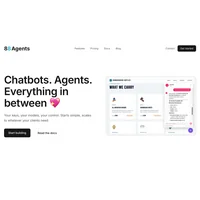
88Agents enables businesses to build and deploy AI chatbots across multiple channels with flexible model selection. Compared to Spooky AI, the standout difference is the breadth of channel support and the ability to swap underlying models per agent, which is useful if you want a cheaper model for FAQ deflection and a stronger one for nuanced queries. It suits teams running the same bot across web, social, and messaging channels who want model choice without building custom middleware.

AccuChats is an AI chatbot platform that delivers accurate, cited responses with confidence scoring for business websites. Where Spooky AI focuses on the conversation flow, AccuChats leans into answer provenance, with every reply able to carry a citation and a confidence score, which is valuable in regulated or research-heavy contexts. It is a strong fit if your customers, or your compliance team, need to see where answers come from rather than just read them.

Chattitude is an AI chat agent that delivers 24/7 customer support and automates lead capture for businesses. Versus Spooky AI, Chattitude is more opinionated about pairing support with lead capture, with routing and CRM handoff baked in rather than configured from scratch. Small businesses that want always-on support that also fills the pipeline with minimal setup will find this the most turnkey option on the list.

OC Maker is an AI character generator that transforms descriptions into unique visual artwork across multiple artistic styles. It sits in a different category from Spooky AI, focused on visual generation rather than conversation, so it is only relevant if your broader AI workflow includes character art, avatars, or branded mascots alongside chat. Consider it as a complementary tool in a creative or marketing toolkit rather than a like-for-like chatbot replacement.

Site2CRM automates lead capture and CRM synchronization with AI-powered intelligence for effortless contact management. Where Spooky AI centers on the conversation itself, Site2CRM's edge is the back office: every captured lead is enriched, deduplicated, and pushed into your CRM without manual triage. It is the right pick if your real pain point is that the bot captures leads, but the CRM never ends up with clean data.
How to choose
Map your switching reason to the platform that handles it best. Choose 88Agents if you need multi-channel reach and model flexibility, AccuChats if cited answers and confidence scores are non-negotiable, Chattitude if you want the most turnkey 24/7 support plus lead capture combo, OC Maker if your project also needs AI-generated visual assets, and Site2CRM if downstream lead quality in your CRM is the real bottleneck. If none of those match your blocker, Spooky AI is probably still the right call. The alternatives earn their place when they remove a specific friction, not when they replace a tool that is already working.