Guru is a knowledge management platform that uses AI to capture, organize, and surface trusted information across teams, functioning as an enterprise wiki with browser overlays and in-context answers. Many teams start with Guru and then start looking for alternatives when pricing scales up faster than expected, when they need lighter-weight tooling, or when their use case turns out to be more about research, news monitoring, or customer-facing help docs than internal knowledge sharing. If you are evaluating your options, this guide compares the strongest Guru alternatives currently listed on HyperStore and the situations where each one fits best.
Why look for a Guru alternative?
Guru's strength is delivering verified answers inside the apps your team already uses, but that strength comes with trade-offs. Pricing tiers can climb quickly as you add seats and unlock features like expert verification flows, browser extensions, and integrations. Some teams find the admin overhead heavier than they need; others realize their actual problem is not internal knowledge management but something adjacent, such as keeping up with news, transcribing meetings, or building a customer-facing help center. A meaningful number of users also look for tools that handle the upstream capture step better, whether that means automated meeting notes, curated web monitoring, or AI-driven document research. None of these are criticisms of Guru; they are simply different jobs, and picking the right tool starts with naming the job clearly.
It is also worth noting that the AI knowledge space has matured quickly. According to Gartner's research on knowledge management, organizations are increasingly blending dedicated knowledge bases with AI research assistants and real-time monitoring tools, which means the "alternative" to Guru may not be a direct clone at all.
What to look for in a Guru alternative
Fit between capture and delivery
Decide whether your bottleneck is capturing knowledge in the first place or delivering it to people in the flow of work. Guru is heavily optimized for the latter, with browser overlays and Slack integrations. If your real problem is capture, a meeting transcription tool or an AI research assistant will move the needle more than swapping wiki platforms. Match the tool to the gap.
Pricing transparency and seat economics
Look for clear per-seat, per-hour, or flat pricing rather than usage-based tiers that can balloon. The alternatives below include free tools, a $0.25/hour metered option, and freemium products, which gives you a wide range of cost profiles to benchmark against your current Guru spend.
Audience orientation
Guru is built primarily for internal teams. If your knowledge needs to reach external readers, such as customers searching a help center, you will want a tool designed for that audience. Conversely, if you need purely internal research rather than a polished knowledge base, lighter-weight AI tools may serve you better.
Trust, verification, and source transparency
Any AI-powered knowledge tool should make it easy to see where answers come from. Look for source citations, expert review workflows, and the ability to audit content. This is especially important in regulated industries or when the knowledge base feeds customer-facing experiences.
The best Guru alternatives
DailyScope.ai
DailyScope.ai is a free AI tool that tracks global news trends by analyzing which countries and themes are receiving the most coverage across multiple sources. Compared to Guru, which focuses on capturing and delivering your team's internal knowledge, DailyScope.ai solves the opposite problem: keeping up with what is happening in the world outside your organization. It is a strong fit for analysts, comms teams, and executives who need a daily situational briefing without building and maintaining a curated wiki.
Kolva
Kolva captures, transcribes, and summarizes meetings directly in your browser at a flat $0.25 per hour, with a free tier available. Where Guru turns documents and tribal knowledge into searchable answers, Kolva tackles the raw input layer: it produces the meeting notes that would later feed a knowledge base. Teams that find Guru's capture workflows too manual will appreciate Kolva's plug-in-and-go approach to turning conversations into written records.
NBot AI
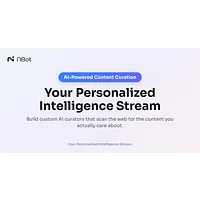
NBot AI lets you build personalized AI curators that monitor the web for topics you specify and surface relevant content over time. Guru organizes the knowledge you already have; NBot AI curates the knowledge you do not yet have. It is well suited to researchers, marketers, and individual professionals who want a hands-off way to track industries, competitors, or technical developments without manually maintaining feed lists.
Observe Earth
Observe.Earth is a free real-time monitoring platform for global events, including natural disasters, social movements, and economic trends. The comparison to Guru is more about scope: Guru answers questions about your own organization, while Observe.Earth answers questions about the external world as it changes hour by hour. For risk teams, journalists, NGOs, and operations leaders, it functions as a live situational awareness layer that a static knowledge base cannot match.
Paperbook
Paperbook is a freemium AI-powered help center builder that automates customer support documentation. This is the closest "same job, different tool" alternative in this list: like Guru, it structures knowledge into searchable articles, but it is aimed at customers rather than employees. Teams that adopted Guru for external support use cases often find a dedicated help center builder more appropriate for SEO, branding, and deflection goals.
SurfSense
SurfSense is a freemium AI research assistant that turns documents into collaborative workspaces with intelligent search and knowledge management. It overlaps with Guru on the internal knowledge side but leans further into research workflows, such as ingesting PDFs, papers, and long-form sources and querying them conversationally. Research-heavy teams in legal, academia, or product may find SurfSense a better match than a wiki-first tool.
How to choose
If your team struggles to keep documentation current, start with Paperbook for customer-facing knowledge or SurfSense for internal research. If the problem is that meetings end with no written record, Kolva plugs into that capture gap immediately. If you need a constant feed of outside information rather than internal answers, DailyScope.ai and Observe.Earth handle world-events monitoring while NBot AI covers interest-based web curation. The right pick depends less on replacing Guru feature-for-feature and more on which side of the knowledge flow your team is actually losing time.
Frequently asked questions
Is there a free Guru alternative?
Yes. Several alternatives in this list offer free tiers or are entirely free, including DailyScope.ai, Kolva, NBot AI, and Observe.Earth, while Paperbook and SurfSense use a freemium model. If budget is the primary driver, you have credible options that cost nothing to evaluate.
What is the best Guru alternative for internal teams?
For internal knowledge sharing, SurfSense is the closest match because it blends document ingestion, AI search, and collaborative workspaces. Kolva is the better choice if your real friction point is capturing meeting content rather than retrieving existing knowledge.
What is the best Guru alternative for customer-facing documentation?
Paperbook is purpose-built for AI-powered customer help centers, with documentation automation and SEO-friendly structure that an internal wiki like Guru is not optimized for.
Can AI tools fully replace a knowledge base like Guru?
Not in every case. AI research and monitoring tools excel at discovery and synthesis, but structured internal knowledge bases still win for verified, governance-heavy content. Many teams end up combining a Guru-like hub with one or more AI assistants rather than fully replacing it.
How do I migrate from Guru without losing context?
Start by exporting your Guru cards and expert verifications, then run a pilot with one alternative on a single team or use case before rolling out broadly. Atlassian's wiki migration guide offers a useful general framework for staged knowledge migrations even when moving outside that ecosystem.
Whichever direction you choose, the goal is to match the tool to the specific kind of knowledge your team is losing time on. Capture, delivery, research, and external monitoring are different jobs, and the best alternative is the one that solves the job you actually have today, not the one with the longest feature checklist.