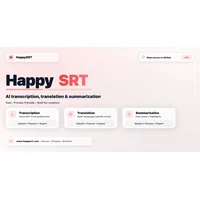
HappySRT is an AI-powered subtitle and transcription tool that converts audio and video files into SRT subtitle files, making it popular with YouTubers, educators, and content creators who need quick captions. The platform focuses on automatic speech-to-text conversion with timestamp alignment so the resulting files drop straight into video editors. Despite its convenience, users commonly look for HappySRT alternatives when they need stronger language support, different export formats, or tools that go beyond subtitle generation into full transcripts, SEO metadata, or live voice workflows. Pricing models, accuracy in noisy audio, and offline capabilities also factor into the decision.
Why look for a HappySRT alternative?
HappySRT does a competent job for straightforward English-language projects, but it isn't the only option. Many creators need multi-language transcription, speaker diarization, or formats beyond SRT, and they discover that other tools have moved further in those directions.
Other reasons include a desire for desktop or offline processing, especially when working with sensitive client material, tighter integration with stock contributor platforms, or simply a free tier that doesn't gate core features. Some users also want a single tool that handles voice-to-text in any application, not just video uploads.
What to look for in a HappySRT alternative
Accuracy and language coverage
Speech recognition quality varies widely between providers, and the gap widens in noisy environments or when speakers have heavy accents. According to NIST's open speech recognition evaluations, error rates can differ by a factor of two or more between engines on identical audio. Look for tools that publish word error rate benchmarks and support the languages you actually work in.
Output formats and integration
SRT files are great for video, but many workflows also need plain transcripts, VTT for web players, or JSON for further processing. If you publish to YouTube, Vimeo, or stock libraries, check whether the tool can export directly to those destinations or at least produce timestamped text you can paste in.
Privacy and offline use
Cloud transcription means your audio travels to a server, which matters for confidential interviews, unreleased product demos, or medical and legal recordings. For those cases, an offline desktop app or one with a clear no-retention policy is worth the trade-off in convenience.
Pricing transparency
Per-minute billing adds up fast, and free tiers often cap you at short clips or low priority queues. An FTC primer on subscription pricing reminds consumers to read the fine print on usage limits and renewal terms before committing.
The best HappySRT alternatives
Autokeyworder
Autokeyworder targets a different niche than HappySRT: instead of subtitles, it focuses on generating AI image metadata for stock contributors who want to maximize discoverability and passive income. If your workflow involves both video transcription and stock image optimization, it complements rather than replaces HappySRT. It's a free tool, which makes it easy to add to an existing pipeline.
FastlyConvert
FastlyConvert turns audio and video into text transcripts using AI, much like HappySRT, but with a stronger emphasis on raw text output rather than subtitle files. Users who need transcripts for articles, show notes, or accessibility copy may find its format more convenient. The free tier makes it an easy first stop before committing to a paid workflow.
FastScribeX
FastScribeX differentiates itself with multi-language transcription and speaker identification, two areas where HappySRT users sometimes report limits. It's well suited to podcasts, interviews, and panel recordings where multiple voices need to be labeled. The tool is free to use and produces timestamped text you can convert to SRT with minor editing.
Sleekio
Sleekio is a voice-to-text writing assistant that works across any application, which is a different proposition than HappySRT's file-based subtitle generation. If you want to dictate emails, documents, or chat replies in real time rather than upload finished recordings, Sleekio fills that gap. It's free and ideal for users who spend more time writing than editing video.
Velma Transcribe by Modulate
Velma Transcribe specializes in real-world audio where background noise and overlapping speech are common, areas where generic transcription engines struggle. Compared to HappySRT's clean-studio assumptions, Velma often produces cleaner transcripts from field recordings, calls, or live events. It supports multi-speaker separation and is available as a free tool.
Video to Text.net
Video to Text.net covers 99 languages, which puts it ahead of most competitors including HappySRT for international projects. Output is timestamped text you can reformat into SRT or VTT, and the platform handles both video files and audio uploads. It's a strong fit for global teams, multilingual YouTube channels, and translation agencies.
VoxTap
VoxTap is a Mac-only voice-to-text app that runs entirely offline, so audio never leaves the device. For HappySRT users concerned about uploading sensitive recordings to a cloud server, VoxTap addresses that privacy gap directly. It's free, integrates with any macOS text field, and works well for drafting notes or transcripts on the fly.
How to choose
If you need broader language coverage, Video to Text.net and FastScribeX are the strongest candidates. For privacy-sensitive work, VoxTap's offline Mac app or Velma Transcribe's noise handling are worth a closer look. Stock contributors who also publish images should pair a transcription tool with Autokeyworder, and if your real goal is dictation rather than file transcription, Sleekio is the closest fit.
Frequently asked questions
Is there a free HappySRT alternative?
Yes. Most tools on this list, including FastlyConvert, FastScribeX, Velma Transcribe, Video to Text.net, VoxTap, Sleekio, and Autokeyworder, offer free tiers or are entirely free. Always check the per-minute or per-file limits so you know where the free version ends.
What is the best HappySRT alternative?
It depends on your priority. For overall accuracy on real-world audio, Velma Transcribe by Modulate is hard to beat. For language coverage, Video to Text.net leads. For privacy, VoxTap's offline model is the clearest win, and the right tool is the one that matches your specific audio and output needs.
Which HappySRT alternative supports the most languages?
Video to Text.net explicitly advertises support for 99 languages, which is broader than most single-purpose transcription tools. FastScribeX also handles multiple languages with speaker identification, making it a strong runner-up for multilingual podcasts or international content.
Can I transcribe audio offline instead of using HappySRT?
VoxTap runs entirely on macOS without sending audio to a server, which is the closest fully offline option on this list. For one-off sensitive files, look for tools that document their data retention policy and offer on-device processing, even if they aren't fully offline.
Do HappySRT alternatives export SRT files directly?
Some do, while others export timestamped text that you can convert to SRT in a few seconds with a text editor or free utility. FastlyConvert and Video to Text.net focus on transcripts, so plan a quick reformat step if you need subtitle files specifically.
HappySRT remains a solid choice for quick subtitle generation, but the alternatives above expand your options for languages, privacy, and workflow integration. Try two or three with a sample file from your own work to see which output you actually want to edit.