Landing-Page.io is an AI-assisted landing page builder aimed at marketers and small teams who need to publish conversion-focused pages quickly. Many users start there because it removes the usual friction of design and copywriting, but it isn't the only option worth considering. People typically look for Landing-Page.io alternatives when pricing tiers no longer fit, when they need a more specialized page type (such as book funnels or full product sites), or when they want stronger backend or hosting features baked in.
Why look for a Landing-Page.io alternative?
Landing-Page.io works well for straightforward marketing pages, but it isn't a one-size-fits-all tool. Some teams outgrow it as their funnel strategy becomes more ambitious and they need deeper integrations, A/B testing, or custom domains without extra friction. Others find the generated copy too generic for niche audiences, or they want a tool that specializes in their specific use case — authors, SaaS founders, ecommerce brands, and so on. Pricing is another common trigger: free or freemium tiers elsewhere can be more generous once you're ready to scale past a single campaign.
Switching also makes sense when you want features Landing-Page.io wasn't built for, such as full-stack app generation, built-in hosting, or industry-specific templates for a particular audience.
What to look for in a Landing-Page.io alternative
AI quality and copy control
The whole point of an AI landing page builder is speed, but speed means little if the copy reads like a template. Look for tools that let you guide tone, audience, and structure through prompts rather than locking you into a fixed template library. Some platforms also support SEO-aware generation, which matters if organic traffic is part of your funnel strategy.
Output type and specialization
Landing-Page.io is built around marketing pages. Some alternatives are broader (full websites, even apps), while others are narrower (book funnels, ecommerce product pages, or sales letters). Decide whether you want a generalist tool or one tuned to a specific campaign type, because specialized tools often produce better results in their lane.
Hosting, domains, and backend
How a page gets published matters as much as how it's built. Check whether the alternative handles hosting, custom domains, SSL, and any backend logic (forms, databases, app behavior) for you, or whether you'll need to wire that up separately. A tool that ships a page live in one step saves hours compared to one that exports code you must deploy yourself.
Pricing model and scaling
Free tiers are common in this category, but the limits differ wildly — page count, traffic, custom domains, and team seats are the usual cliffs. Compare what you actually get on the free plan versus what unlocks at the first paid tier, since that's where most teams feel the difference.
The best Landing-Page.io alternatives
Groops.com
Groops.com focuses on a very specific niche: authors who need SEO-optimized landing pages for book launches and lead generation. Where Landing-Page.io targets general marketers, Groops.com builds its AI around author funnels, pre-order pages, and reader magnets. If you're an author or work with one and Landing-Page.io's generic templates feel like a poor fit, Groops.com is the more purpose-built option. It runs on a free pricing model, which makes it easy to test against your existing campaigns.
MarketFoundry AI Workspace
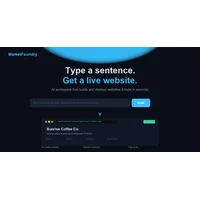
MarketFoundry AI Workspace positions itself as a one-shot digital presence generator rather than just a landing page tool. It produces a full website and brand presence from a prompt, which suits solopreneurs and small businesses who need more than a single page. Compared to Landing-Page.io, it trades some of the page-level conversion focus for a broader "get online fast" workflow. The free tier is generous enough to build and ship a complete first site.
Rocket
Rocket goes further than any pure landing page tool: it turns a prompt into a production-ready application with backend and database included. That's overkill for a simple squeeze page, but powerful if your landing page needs to do real work — capture leads into a structured backend, run logic, or evolve into a full product. Landing-Page.io stays focused on the marketing surface; Rocket is the better choice when the page is just the front door of something bigger. It's available on a free tier to get started.
Tented
Tented is the closest direct competitor to Landing-Page.io in scope: an AI landing page builder that produces conversion-ready pages from a natural language description. The two tools overlap heavily, so the choice usually comes down to copy quality, template style, and how well each handles your specific funnel type. If Landing-Page.io's output isn't landing with your audience, Tented is worth a side-by-side test on the same brief. It runs on a free pricing tier.
WebZum
WebZum sits between a builder and a deployment platform. It takes AI-generated site concepts and ships them as production-ready sites with hosting and domain integration handled. For teams who found Landing-Page.io easy to build on but awkward to publish through, WebZum's end-to-end flow removes a real step. It's also a good fit if you want one tool to cover design, copy, hosting, and domain rather than stitching several together. Free tier available.
How to choose
If you're an author building book funnels, start with Groops.com. If you need a full website, not just a page, MarketFoundry AI Workspace or WebZum will save you the most time. Choose Rocket when the landing page is the front end of a real application. If you want a direct Landing-Page.io replacement with a similar feature set, run Tented through the same brief you gave Landing-Page.io and compare output side by side. Most of these tools offer free tiers, so a real test costs nothing but an afternoon.
Frequently asked questions
Is there a free Landing-Page.io alternative?
Yes. Every alternative listed here — Groops.com, MarketFoundry AI Workspace, Rocket, Tented, and WebZum — offers a free tier, so you can build and publish at least a basic page without paying. Paid tiers typically unlock higher traffic limits, custom domains, and team features.
What is the best Landing-Page.io alternative?
There isn't one winner for everyone. For a direct same-category replacement, Tented is the closest match. For specialized use cases, Groops.com is best for authors and Rocket is best when you need backend logic. For broader site-building, MarketFoundry AI Workspace or WebZum extend well beyond a single landing page.
Can AI landing page builders replace a designer?
For straightforward marketing pages, yes — especially when speed matters more than bespoke branding. For brand-defining design or highly custom layouts, a human designer still adds value. Most teams use AI builders to ship faster and reserve design resources for flagship pages.
Do these tools handle hosting and domains?
Several do. WebZum is the strongest example, with built-in hosting and domain integration. The others vary: some export code you deploy yourself, others host for you on a subdomain. Always check what "published" actually means before committing.
Which alternative is best for SEO?
Look for tools that generate SEO-aware copy and let you edit metadata, headings, and schema. Groops.com explicitly markets SEO-optimized output, which makes it a strong starting point if organic traffic is a priority. Independent guides on landing page SEO, such as the Moz introduction to landing pages, are useful background reading regardless of which builder you pick.
Try one or two alternatives on a real campaign rather than a demo brief — the difference between AI landing page tools shows up most clearly when you measure conversion, not features on a comparison chart. And if you want a refresher on what makes a landing page convert in the first place, HubSpot's landing page guide is a solid, vendor-neutral starting point.