Stackby AI is a no-code work management platform that pairs database-style tables with AI-assisted columns, automations, and API integrations, making it popular with ops, marketing, and research teams. Most users arrive looking for stackby ai alternatives because their needs have outgrown a spreadsheet-database hybrid, because they want a more specialized tool, or because pricing on premium tiers has become hard to justify. The picks below cover different gaps: conversational AI, academic citations, SQL development, and database performance.
Why look for a Stackby AI alternative?
Stackby AI works well as a flexible hub when you want spreadsheets, automations, and a few AI columns under one roof. The trade-off is that it is intentionally generalist. Teams running serious chatbot traffic, managing a SQL codebase, verifying academic sources, or tuning a MySQL instance often find that a purpose-built tool does the job better. Pricing on AI credits and premium seats can also push smaller teams to evaluate lighter or free options.
Sometimes the reason is simpler: the team has settled on a different ecosystem and wants fewer subscriptions, or they need a tool that runs natively on a platform Stackby AI does not fully support. None of this means Stackby AI is a bad choice; it means the right tool depends on the actual job.
What to look for in a Stackby AI alternative
Specialization over generalism
Stackby AI's strength is breadth, so the strongest alternatives tend to win on depth. If you only need one workflow done well, a focused tool will usually offer better defaults, better documentation, and fewer workarounds. Match the tool to the task rather than trying to replace an entire stack with a single platform.
Integration and data portability
Any replacement should slot into your existing tools without forcing a rebuild. Look for native connectors, CSV or API export from Stackby, and a clear import path on the other side. According to Gartner's research on integration strategy, integration friction is one of the top reasons teams abandon a new tool within the first 90 days.
Pricing transparency
AI features are often metered, and credit-based pricing can balloon fast. Compare free tiers, per-seat costs, and any usage caps. The alternatives reviewed below are all marked as free to start, which is useful for evaluation before committing.
Usability for non-technical users
Stackby AI appeals to non-developers, so pay attention to setup time, learning curve, and whether the alternative requires command-line work. A tool that is powerful but invisible to your team is not really an upgrade.
The best Stackby AI alternatives
88Agents
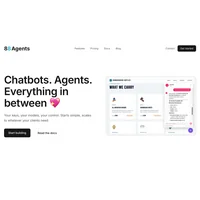
88Agents focuses on building and deploying AI chatbots across multiple channels with flexible model selection. Where Stackby AI treats AI as a column or automation step inside a table, 88Agents treats conversation as the primary surface. It is a better fit for teams whose main goal is customer-facing or internal chat experiences rather than structured data, and the free tier makes it easy to prototype before scaling. Skip it if you still need a robust spreadsheet-database backbone.
CiteTrue
CiteTrue is an AI-powered citation verification tool designed to confirm that academic references are accurate and authentic. It sits far outside Stackby AI's wheelhouse, which is exactly the point: for researchers, students, and editors, citation work is tedious and error-prone. CiteTrue is a strong choice if your "alternative" is really a complementary tool to keep your research database clean. It is less useful for general business operations or marketing workflows.
Jam SQL Studio
Jam SQL Studio is an AI-powered SQL IDE that supports multiple databases, with intelligent coding assistance and schema management built in. Where Stackby AI hides the database layer behind a friendly table UI, Jam SQL Studio is for teams that want to write real SQL and manage schemas directly. It suits data teams, analytics engineers, and product developers who have outgrown no-code tables and need version control, query optimization hints, and multi-database support. For non-technical users it will feel like a step backward.
Releem
Releem is an AI-powered MySQL optimizer that tunes database performance and surfaces issues automatically, without requiring deep backend expertise. It is the narrowest pick on this list and only relevant if your bottleneck is database speed rather than workflows or chat. Releem pairs well with a Stackby-style operational layer: keep your tables and automations where they are, and let Releem handle the underlying MySQL health. As noted in Percona's database performance blog, automated tuning tools are most valuable when they reduce the time engineers spend on routine configuration.
How to choose
If you need richer customer or internal chatbots, start with 88Agents. If your pain point is academic or research citation quality, add CiteTrue alongside whatever you keep. For data and analytics teams that have outgrown a no-code table, Jam SQL Studio is the clearest step up. And if your existing MySQL-backed stack is slow, Releem is a low-risk way to address performance without ripping anything out. None of these tools replicate Stackby AI's generalist hub feel, so for many teams the right answer is a Stackby AI plus one specialist rather than a full switch.
Frequently asked questions
Is there a free Stackby AI alternative?
Yes. All four tools above are available on free tiers, which makes them easy to evaluate before committing. The free plans vary in usage limits, so check the current details on each app's page.
What is the best Stackby AI alternative?
It depends on the job. 88Agents leads for chatbot workflows, Jam SQL Studio for SQL-heavy teams, Releem for MySQL performance, and CiteTrue for academic citation work. There is no single winner because Stackby AI itself spans several use cases.
Can Stackby AI alternatives handle no-code workflows?
Some can, but most specialize. 88Agents offers low-code chatbot building, while Jam SQL Studio and Releem are more technical. If no-code usability is your top requirement, Stackby AI itself may still be the right base, supplemented by a specialist tool.
Do these alternatives integrate with Stackby AI?
Most expose APIs or standard connectors, but deep native integration with Stackby AI is limited. Plan for a short setup phase to connect APIs or schedule data syncs.
Is it hard to migrate data away from Stackby AI?
Not usually. Stackby supports CSV and API exports, and most alternatives can ingest structured data with a small amount of formatting work. Expect a few hours of cleanup rather than a full rebuild.
Use this guide as a starting point: identify the single workflow you want to improve, pick the specialist that fits, and keep Stackby AI in place for everything it already does well. That pragmatic mix tends to outperform any forced full-stack replacement.