Tinker is an AI experimentation and prototyping environment aimed at developers and creators who want to tinker with models, prompts, and lightweight workflows in a low-friction space. People often search for Tinker alternatives when they need a tool that is more focused on a specific output (like transcripts, videos, or research) rather than a general sandbox, or when pricing, integrations, or platform fit push them to look elsewhere.
Why look for a Tinker alternative?
General-purpose tinkering environments are useful for exploration, but they rarely excel at any single production task. Users typically leave Tinker when they outgrow the sandbox and need a tool that ships a finished artifact — a transcribed document, an edited video, a research brief, or a running workflow. Cost is another common trigger: freemium or one-off pricing on a focused tool can be easier to justify than a general subscription, especially for solo creators.
Platform and workflow fit matter too. If your real work happens inside a browser tab watching video content, inside a docs folder, or inside a chat-style builder, a general AI playground will feel like an extra step rather than a shortcut.
What to look for in a Tinker alternative
Output focus
The strongest reason to switch is that the alternative does one thing very well. If your end deliverable is a transcript, a short video, a research summary, or a no-code workflow, pick a tool whose primary output matches that artifact. Specialised tools tend to require less prompt engineering and produce more consistent results.
Pricing model
Compare not just sticker price but how usage is metered. Some tools charge per minute of media processed, some per generated asset, and some are flat subscriptions. According to Gartner's coverage of AI tool adoption, unpredictable usage-based pricing is one of the top reasons teams churn out of creative AI products, so look for a model you can forecast.
Collaboration and export
If you work with others, shared workspaces, comments, and version history are non-negotiable. If you work alone, clean export to common formats (Markdown, SRT, MP4, JSON) will save more time than any single AI feature.
Onboarding and learning curve
A tool you actually use beats a powerful tool you abandon. The Nielsen Norman Group's introduction to usability is a useful reminder that for solo creators, time-to-first-meaningful-output often matters more than feature depth.
The best Tinker alternatives
PixScript
PixScript is a purpose-built media-to-text tool that instantly transcribes YouTube, TikTok, and Instagram videos into timestamped text and pairs the transcript with AI summaries and 50+ language translations. Compared to a general Tinker sandbox, it skips prompt crafting entirely — you paste a link and get a usable document back. It suits researchers, journalists, and content teams who need source material in text form rather than an open-ended AI lab, and it runs on a freemium model so light usage is free.
Plot Party
Plot Party is an AI storytelling platform that turns creative ideas into visually compelling narratives and short video content. Where Tinker hands you raw ingredients, Plot Party gives you a finished narrative arc and matching visuals, which makes it a better fit for marketers, educators, and social creators who want output rather than exploration. It is a paid tool, so expect a subscription rather than usage credits.
Prosetta
Prosetta is an AI content creation workspace that generates text, images, and video together in a collaborative environment. It overlaps with Tinker's "many modalities" appeal but adds multiplayer editing and a more opinionated pipeline, which is useful if you are tired of stitching single-purpose tools together. The free pricing tier makes it especially attractive for small teams testing a workflow before committing to a paid suite.
StoryIntoVideo
StoryIntoVideo converts written narratives into professional short videos with AI-generated characters, settings, and voiceovers. It is a narrower tool than Tinker, but that focus is the point: if your bottleneck is turning a script into a watchable video without hiring an editor, this is a more direct path. It is paid, so it fits creators and small studios with a clear content cadence who can absorb the subscription.
SurfSense
SurfSense is an AI research assistant that turns your documents into a collaborative workspace with intelligent search and knowledge management. Tinker can be used for ad-hoc prompting over notes, but SurfSense is built specifically for the "I have too many PDFs and Notion pages" problem, with persistent indexing and shared workspaces. The freemium tier lets you validate the experience before paying, which suits individual researchers and small teams.
VoooAI
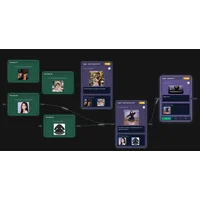
VoooAI's Vibe Flow lets you describe complex AI workflows in natural language and have the system build them, rather than dragging nodes around a canvas. Compared to Tinker, where you assemble prompts by hand, VoooAI removes the manual configuration step entirely, which lowers the barrier for non-technical users. It is free to use, so it is worth trying before investing in a paid workflow builder.
How to choose
Start from the artifact, not the tool. If you need transcripts from video, PixScript is the obvious fit. If your deliverable is a finished narrative or short video, look at Plot Party or StoryIntoVideo. If your pain is fragmented content production across formats, Prosetta's all-in-one workspace will feel more cohesive than a general sandbox. Researchers drowning in documents will get the most leverage from SurfSense, and anyone who wants to automate multi-step AI work without writing glue code should start with VoooAI. Tinker still makes sense when you genuinely want to explore rather than produce.
Frequently asked questions
Is there a free Tinker alternative?
Yes. Both Prosetta and VoooAI are free on HyperStore, and PixScript and SurfSense offer freemium tiers that cover light personal use without a subscription.
What is the best Tinker alternative for video creators?
StoryIntoVideo is the most directly focused option if you already have a script, while Plot Party is a stronger pick if you are starting from a loose idea and want the narrative shaped for you.
Which Tinker alternative is best for transcribing video content?
PixScript is built specifically for transcribing YouTube, TikTok, and Instagram videos with timestamps and translations, so it is the closest match to that single task.
Can I use these Tinker alternatives for team collaboration?
Prosetta and SurfSense both emphasise shared workspaces and collaborative features, making them better suited to small teams than the solo-focused tools on this list.
Do I need coding skills to use these alternatives?
No. Every alternative listed here is designed for non-developers, with natural-language interfaces and visual workflows rather than code.
Whichever direction you take, run one real project through the tool before you commit. A free tier or short trial is usually enough to tell whether the workflow actually saves you time compared to your current Tinker setup.