TransGull is a translation platform that helps individuals and teams move content across languages, from quick text conversion to longer-form localization work. People looking for TransGull alternatives usually aren't unhappy with core quality; they tend to hit one of a few specific walls. Most often it's pricing that doesn't scale with usage, a missing capability in a specific medium (video, audio, subtitles, or APIs), or workflow friction when collaborating across teams. The alternatives below each address a different version of those walls.
Why look for a TransGull alternative?
Most people researching TransGull alternatives aren't unhappy with the core translation quality. They usually hit one of three walls: pricing that doesn't scale with usage, a missing capability in a specific medium (video, audio, subtitles, or APIs), or workflow friction when collaborating across teams. Some want a free tier for occasional personal use; others need an enterprise-grade translation management system with audit trails and reviewer workflows. The language services industry has fragmented accordingly, with tools now specializing heavily in format, language pair, or audience.
The right alternative depends almost entirely on which wall you've hit and which languages, formats, or integrations matter most. A few shoppers also switch because TransGull's specialty, say voice preservation in dubbed video, doesn't match what they actually produce. Translation is no longer one product category; it's a stack of overlapping tools, and the best choice changes dramatically once you specify the medium.
What to look for in a TransGull alternative
Language coverage and specialty
The headline number of supported languages matters less than the depth of support in the languages you actually use. A platform advertising 140+ languages may still struggle with niche locales, RTL scripts, or industry-specific terminology. Look for tools that publish their language list and ideally let you test a sample before committing. If you work in long-tail languages, prioritize platforms with human-in-the-loop review or models aligned with the ISO 17100 translation quality standard.
Format and medium fit
Translation looks very different depending on whether your source material is text, documents, video, audio, or live streams. Some tools excel at preserving formatting in PDFs and Office files. Others specialize in voice cloning for dubbed video, or real-time dual-language subtitles. Match the tool to the medium you produce in; a great document translator may be useless for a YouTube channel, and vice versa.
Pricing model and usage limits
Per-character, per-word, per-minute, and subscription pricing models each penalize different usage patterns. Heavy document translators burn through per-character tiers fast, while video dubbing on a per-minute basis can dwarf any text-based budget. Check whether the free tier actually covers your typical workload, and whether paid plans scale linearly or jump in price at awkward breakpoints.
Collaboration and integration
Solo creators can get by with a web app, but teams usually need shared glossaries, reviewer roles, version history, and integrations with the tools they already use (CMS, TMS, IDE, video editors). If you're evaluating for a team, the collaboration surface area is often the deciding factor, not raw translation quality.
The best TransGull alternatives
Camb.ai
Camb.ai focuses specifically on AI-powered video dubbing with voice preservation across more than 100 languages. Where TransGull handles general translation, Camb.ai is built for creators localizing video content who need the original speaker's tone and timbre to survive translation. It's a paid product aimed at media teams, YouTubers, and e-learning producers rather than document workflows. Choose Camb.ai when your bottleneck is dubbed video, not text.
Doclingo
Doclingo is an AI-powered document translation platform that supports 50+ languages and serves both individual users and enterprises. Compared with TransGull, Doclingo leans harder into document-specific formatting and layout preservation, which matters when you're translating PDFs, contracts, or marketing collateral. It offers a free tier, which makes it a natural first stop for solo translators evaluating options. Pick Doclingo if your primary output is documents and you want a free entry point before committing to a paid plan.
Lyndium
Lyndium positions itself as an all-in-one AI platform for creators and entrepreneurs, bundling website building, visual generation, and instant content translation in a single tool. It is the broadest alternative in this list: TransGull is translation-first, while Lyndium treats translation as one capability among many for content creators. It's free to use, which makes it attractive for solopreneurs who want translation plus landing pages and graphics in one place. Reach for Lyndium when you need a creator toolkit with translation built in, rather than a standalone translation app.
Pairaphrase
Pairaphrase is an AI-powered translation management system aimed at teams that need to translate content faster and more accurately across 140+ languages. Compared with TransGull, Pairaphrase is more enterprise-oriented, with reviewer workflows, shared terminology management, and audit features that TransGull may not match out of the box. It's a paid product positioned for organizations rather than individual translators. Pairaphrase is the right pick when team collaboration, consistency, and reviewer controls outweigh the appeal of a simpler tool.
SonicCaption
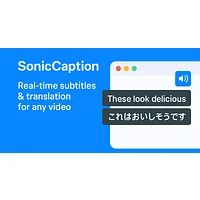
SonicCaption is a browser extension that delivers real-time dual-language subtitles for online video and audio content. This is a fundamentally different use case from TransGull: where TransGull translates text you submit, SonicCaption overlays subtitles on whatever you're already watching in your browser. It's free, which makes it an easy add-on for language learners and bilingual media consumers. SonicCaption is the right choice if your "translation" need is understanding foreign-language media rather than producing translations.
Translation-API.com
Translation-API.com offers machine translation APIs for web and mobile applications, targeting developers who want to embed translation directly into their own products. TransGull is an end-user tool; Translation-API.com is infrastructure. It's a paid API billed by usage, which fits engineers building multilingual SaaS, customer support tools, or content pipelines. Choose Translation-API.com when you need translation as a programmable layer rather than a finished product.
How to choose
Match the alternative to your main medium: Doclingo for documents, Camb.ai for dubbed video, Pairaphrase for team workflows, SonicCaption for browser-based subtitles, Translation-API.com for developer APIs, and Lyndium if you want translation bundled with a broader creator toolkit. If you're still unsure where to start, the free tiers on Doclingo or Lyndium are the lowest-cost way to figure out which direction fits your work.
Frequently asked questions
Is there a free TransGull alternative?
Yes. Doclingo offers a free tier that covers casual document translation needs, and SonicCaption is free for browser-based dual subtitles. Lyndium is also free, though its translation features are bundled into a broader creator toolkit rather than a dedicated translation app.
What is the best TransGull alternative for teams?
Pairaphrase is built specifically for team translation workflows, with reviewer controls and shared terminology management across 140+ languages. It's a paid product, but the collaboration features are what justify the cost for organizations.
Which TransGull alternative is best for video dubbing?
Camb.ai is purpose-built for AI-powered video dubbing with voice preservation in 100+ languages. TransGull and most other text-first tools don't address dubbed video at all, so it's the clear fit for that medium.
Can I get a TransGull alternative as an API?
Translation-API.com offers machine translation APIs for web and mobile applications, billed by usage. It's the right choice if you need translation embedded in your own product rather than accessed through a UI.
Do any TransGull alternatives work as browser extensions?
SonicCaption is a browser extension that overlays real-time dual-language subtitles on online video and audio. It's the only browser-extension option in this list and addresses a different problem from TransGull.
Each of these tools handles a slice of the translation problem better than a generalist platform in its specialty. If your current pain point with TransGull is clear, the matching alternative is usually obvious. If it's vague, a free option like Doclingo or Lyndium is the lowest-cost way to find out what you actually need before committing.