
CensysGPT
CensysGPT simplifies internet reconnaissance by converting natural language into powerful Censys search queries.
Screenshots
About CensysGPT
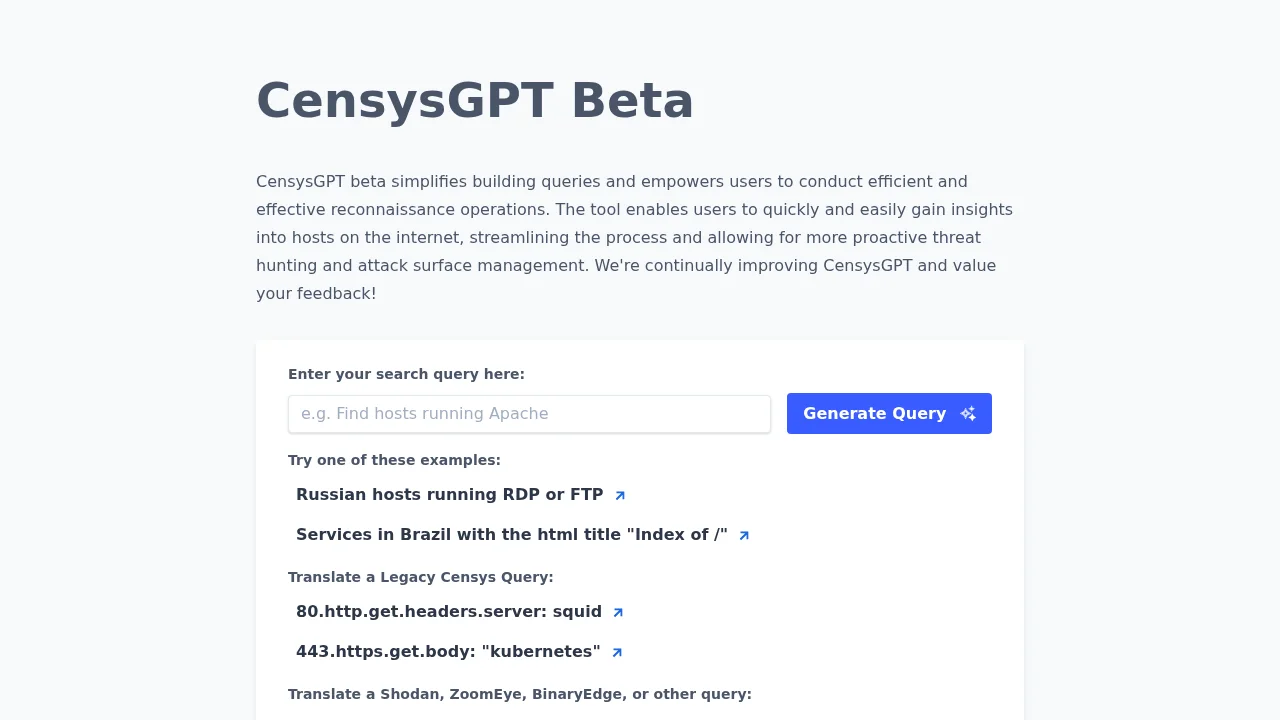
CensysGPT is an AI-powered query builder designed to streamline internet asset discovery and threat reconnaissance. Users can describe their search objectives in plain language, and the tool automatically generates optimized Censys queries without manual syntax learning. This significantly reduces the time spent on query construction, allowing security teams to focus directly on threat hunting and exposure management activities.
The tool supports multiple query conversion capabilities, including translating legacy Censys syntax to current query language formats and converting searches from competing platforms like Shodan, Zoomeye, and BinaryEdge. This flexibility makes it valuable for teams migrating between tools or integrating multiple reconnaissance sources into unified workflows.
CensysGPT leverages OpenAI's GPT technology for natural language processing, enabling intuitive query generation without requiring deep technical expertise. While standard queries deliver reliable results, users can access advanced settings to create custom queries, though more creative formulations may vary in accuracy. The tool requires JavaScript to function and processes query data through OpenAI's infrastructure, though Censys has configured the service to prevent data from being used to train OpenAI models.
Pros
Cons
Alternatives to CensysGPT
CodeRabbit
Kilo | Code Reviewer
Verdent
Base44
Rocket
Pulse Editor: Vibe Code & Automate
Mocha