
Dify
Dify is an open-source platform for building and operating generative AI applications with visual workflows and RAG integration.
Dify at a glance
- Pricing
- Free — from $59/month
- Rating
- ⭐ 5.0/5 · 1 reviews
- Key strengths
- Open-source with visual workflow builder for no-code AI app development · Integrated RAG engine for knowledge-enhanced AI applications · Enterprise LLMOps suite with model fine-tuning and data annotation
Screenshots
About Dify
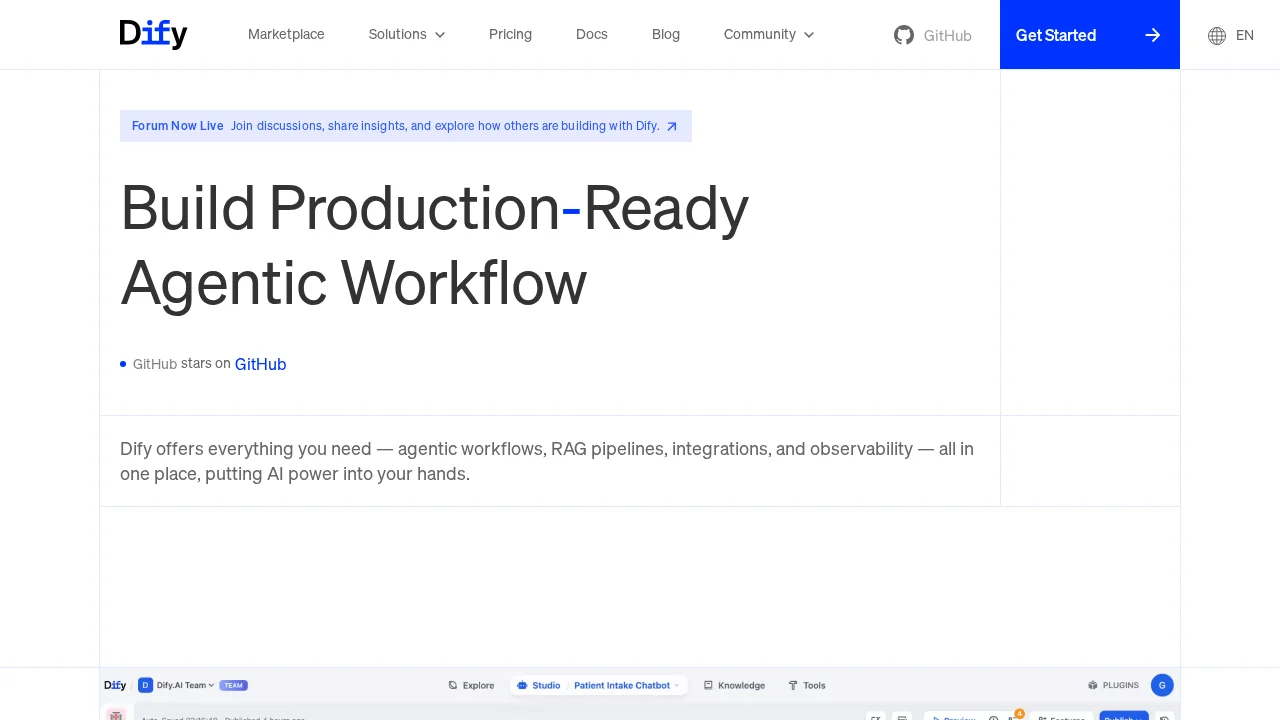
Dify empowers developers and enterprises to create sophisticated AI applications without extensive coding expertise. The platform combines a visual Orchestration Studio with a powerful RAG pipeline, enabling rapid development of AI workflows, custom agents, and LLM-based solutions. Whether you're building conversational AI, automating complex processes, or integrating intelligence into existing products, Dify provides the infrastructure to move from concept to production.
The platform streamlines the entire AI application lifecycle through its Prompt IDE for iterative refinement, enterprise LLMOps for model management, and comprehensive backend APIs. Developers can test and optimize their applications with built-in testing modules before deployment, while the platform handles critical concerns like logging, data annotation, and model fine-tuning. This end-to-end approach reduces development time and improves application reliability.
Dify's scalable architecture supports business growth, offering diverse templates and domain-specific assistants that accelerate implementation. The platform integrates external knowledge sources seamlessly, enabling context-aware responses and deeper insights. Teams can create unlimited-length documents and deploy multiple AI applications across their infrastructure, making Dify suitable for everything from small proof-of-concepts to large-scale enterprise deployments.
Pros
Cons
Alternatives to Dify
AppDeploy
Rocket
biela.dev
Momen | Vibe Architect
Sketchflow.ai
ThinkRoot - The AI Compiler
Atoms