
InfinityFlow
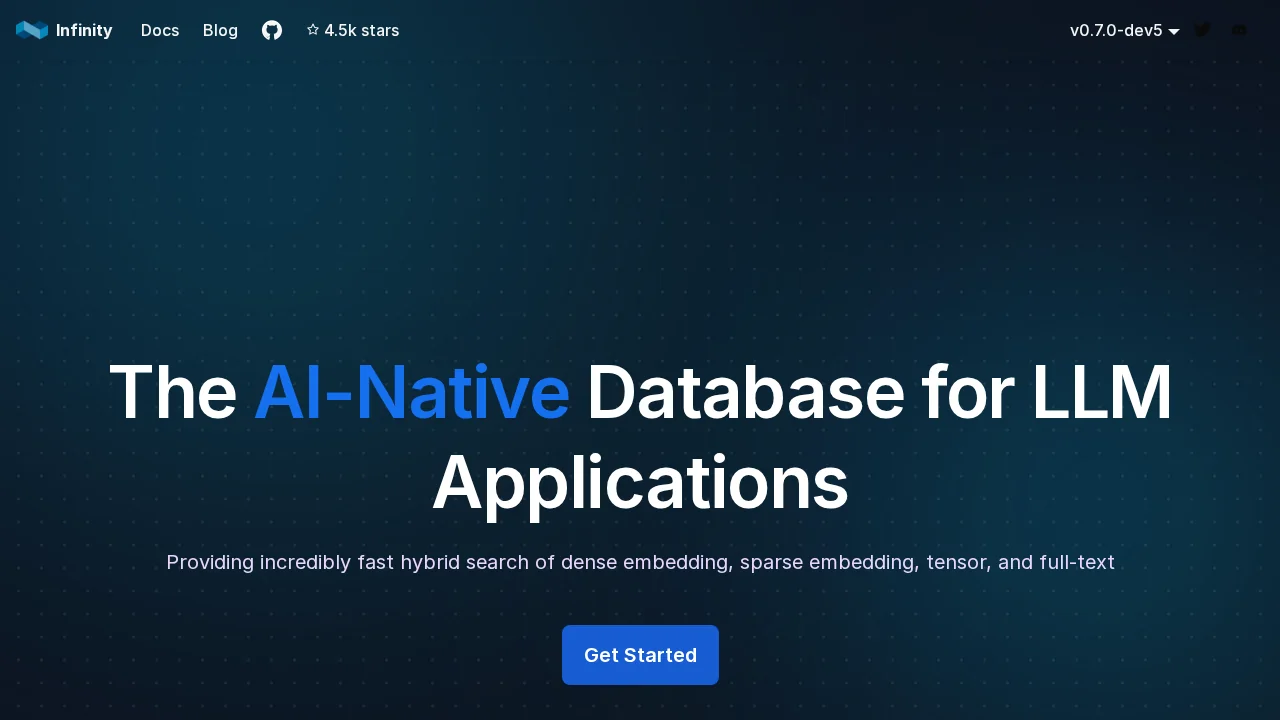
InfinityFlow is an AI-native database engineered for LLM applications with lightning-fast hybrid search across multiple embedding types.
InfinityFlow at a glance
- Pricing
- Free — from Free
- Rating
- ⭐ 5.0/5 · 1 reviews
- Key strengths
- Fast hybrid search across dense, sparse, tensor, and full-text data types · Advanced reranking options including RRF and ColBERT for result refinement · Single-binary deployment with zero external dependencies required
Screenshots
About InfinityFlow
InfinityFlow is purpose-built for modern AI applications, delivering a specialized database that prioritizes both performance and developer experience. The platform excels at hybrid search capabilities, simultaneously processing dense embeddings, sparse embeddings, tensor data, and full-text queries with minimal latency. This multi-modal search approach enables LLM applications to retrieve more relevant context in single queries, reducing the need for multiple round-trips and improving overall application responsiveness.
The system supports advanced reranking strategies including Reciprocal Rank Fusion (RRF), weighted sum aggregation, and ColBERT-based reranking. These sophisticated retrieval refinement techniques allow developers to fine-tune result relevance without building complex custom logic. Combined with intelligent filtering capabilities, InfinityFlow handles nuanced query requirements that go beyond simple vector similarity.
Developer accessibility is central to InfinityFlow's design philosophy. The intuitive Python API reduces implementation complexity, while the single-binary architecture eliminates dependency management headaches and infrastructure overhead. This streamlined approach means you can deploy InfinityFlow quickly without wrestling with configuration or system requirements. The platform gracefully handles million-scale vector datasets while maintaining query performance, making it suitable for both prototype projects and production-scale applications.
InfinityFlow manages diverse data types including strings, numerics, vectors, and beyond, giving you flexibility in how you structure and query your data. This versatility makes it practical for varied AI workloads without forcing data transformation or workarounds.
Pros
Cons
Alternatives to InfinityFlow
remio: Your Personal ChatGPT
Pagesmith.ai
TheLibrarian.io
illumi
Oddsmyth
leania.ai
Komos - AI That Runs Your Repetitive Work