Kanwas
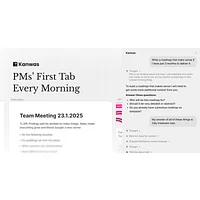
Kanwas centralizes product knowledge, enabling automatic drafting of strategies and PRDs with contextual AI agents.
Kanwas at a glance
- Pricing
- Free
- Key strengths
- Enhances collaboration with real-time editing. · Integrates with over 1,000 existing tools. · Learns from past decisions for better future drafts.
About Kanwas
Kanwas is an innovative platform designed to streamline product management by centralizing product knowledge in one cohesive space. Utilizing context-aware AI agents, Kanwas analyzes boards, notes, tasks, and integrated tools to automatically draft strategies, specifications, and research documents that are closely aligned with the actual product history. This approach ensures that teams have a wealth of insights at their fingertips, allowing for informed decision-making and effective planning.
The platform's unique spatial canvas brings together code, documentation, tickets, and embeds, enhancing collaboration and efficiency. By housing all necessary elements in a single environment, Kanwas eliminates the need to switch between multiple tools, fostering seamless communication and real-time collaboration among team members. This integration is further bolstered by the platform's ability to connect with over 1,000 existing tools, transforming Kanwas into a central hub for all product activity.
Another standout feature of Kanwas is its compounding context graph, which learns from boards, notes, tasks, and decisions to refine future recommendations. This dynamic graph ensures that each automatic draft improves upon its predecessors, making it easier for teams to maintain continuity and relevance in their strategy documentation. With a model-agnostic stack, users can easily integrate various AI models like Claude, GPT, or Gemini while retaining a consistent workflow.
Lastly, Kanwas also emphasizes document integrity through its Git-backed markdown storage, offering version history for every document created. This clarity allows for easy audits, portability, and local editing while maintaining the team's focus on collaboration. By prioritizing real-time teamwork and offering robust integration capabilities, Kanwas is the go-to solution for product teams looking to enhance their strategic planning and documentation processes.
Features
- Context-aware AI agents: Agents read boards, notes, tasks, and connected tools to draft strategies, specs, and research that reflect actual product history.
- Canvas for real work: Code, docs, tickets, embeds, and iframes live together on a spatial board so thinking, discussion, and AI automation happen in one place.
- Compounding context graph: Boards, notes, tasks, and decisions feed a graph that makes future recommendations and drafts progressively better aligned with prior choices.
- Model-agnostic stack: Teams can plug in Claude, GPT, Gemini, and other models while keeping the same workspace, prompts, and workflows.
- Git-backed markdown storage: Every document is a plain .md file with version history, which supports audits, portability, and local editing.
- Real-time collaboration: Multiple teammates and agents can work live on shared boards with fast sharing links and permission controls.
- 1,000+ connections and CLI: Integrations and a CLI bring context in from existing tools, so Kanwas becomes a hub rather than yet another silo.
Pros
Cons
Kanwas Pricing Plans
Open-source edition
$0.00 per month