Keepi
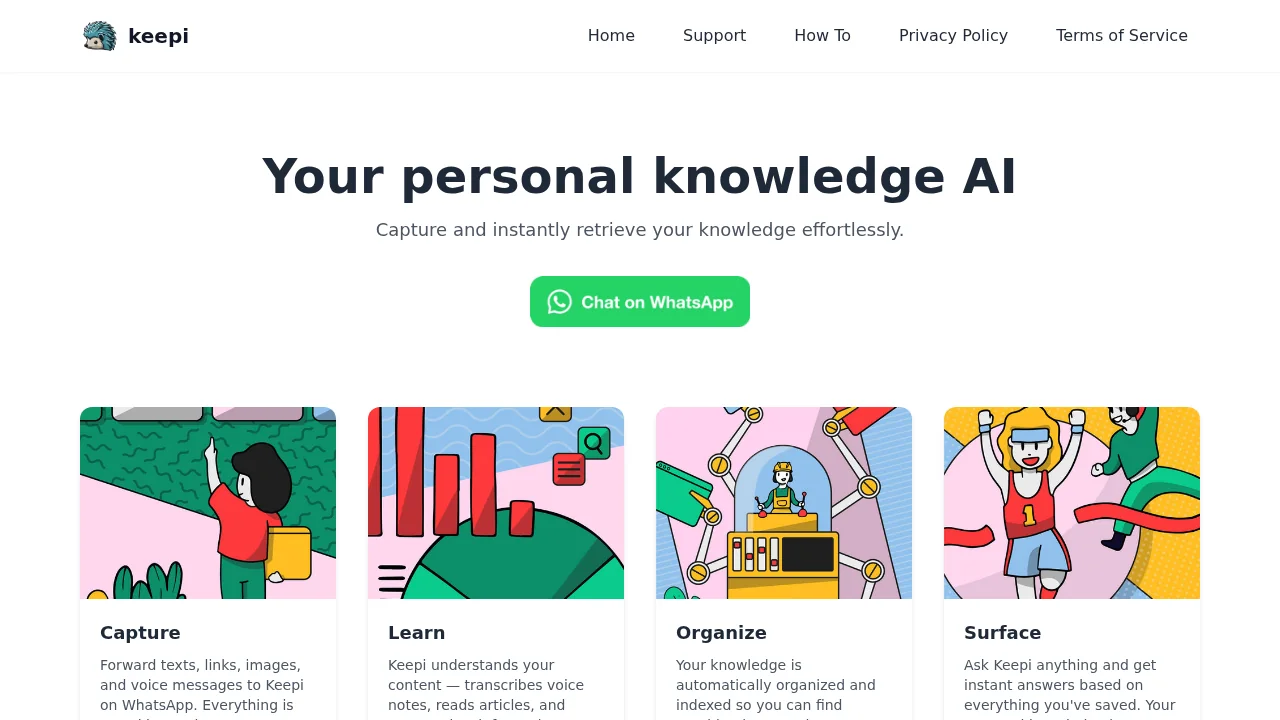
Keepi is a personal knowledge assistant that helps you capture, organize, and share all your ideas and content in one intelligent place.
Keepi at a glance
- Pricing
- Freemium
- Rating
- ⭐ 5.0/5 · 1 reviews
- Key strengths
- Unified storage for diverse content types with intelligent learning · Automatic insights generation from your accumulated knowledge · Seamless sharing and export capabilities for collaboration
Screenshots
About Keepi
Keepi serves as your digital brain, designed to capture and preserve everything that matters to you. Whether you're saving articles, jotting down ideas, collecting lists, bookmarking videos, or storing important messages, Keepi brings all your scattered knowledge into a unified, intelligent system. The platform eliminates the friction of managing information across multiple apps and platforms, giving you a single home for your digital memories and insights.
The tool learns from your behavior and input patterns, automatically identifying connections and patterns within your stored content. This adaptive learning enables Keepi to surface relevant information at the right moment and generate meaningful insights from your accumulated knowledge. Rather than passive storage, Keepi actively helps you discover relationships between ideas and builds contextual understanding of your interests and priorities.
Sharing becomes seamless with Keepi's collaborative features, allowing you to easily export or share curated collections with others. Whether you're building a research archive, managing project notes, or maintaining a personal library, Keepi adapts to your workflow. The platform emphasizes accessibility and simplicity, ensuring you can capture information in the moment without worrying about complex organization schemes or technical overhead.
Keepi transforms how you interact with information by combining intelligent storage with proactive knowledge synthesis. Instead of losing valuable insights or struggling to relocate important content, you maintain a living, evolving knowledge base that works harder for you over time.
Pros
Cons
Alternatives to Keepi
remio: Your Personal ChatGPT
Kolva
Paperbook
DailyScope.ai
NBot AI
SurfSense
Observe Earth