Livedocs
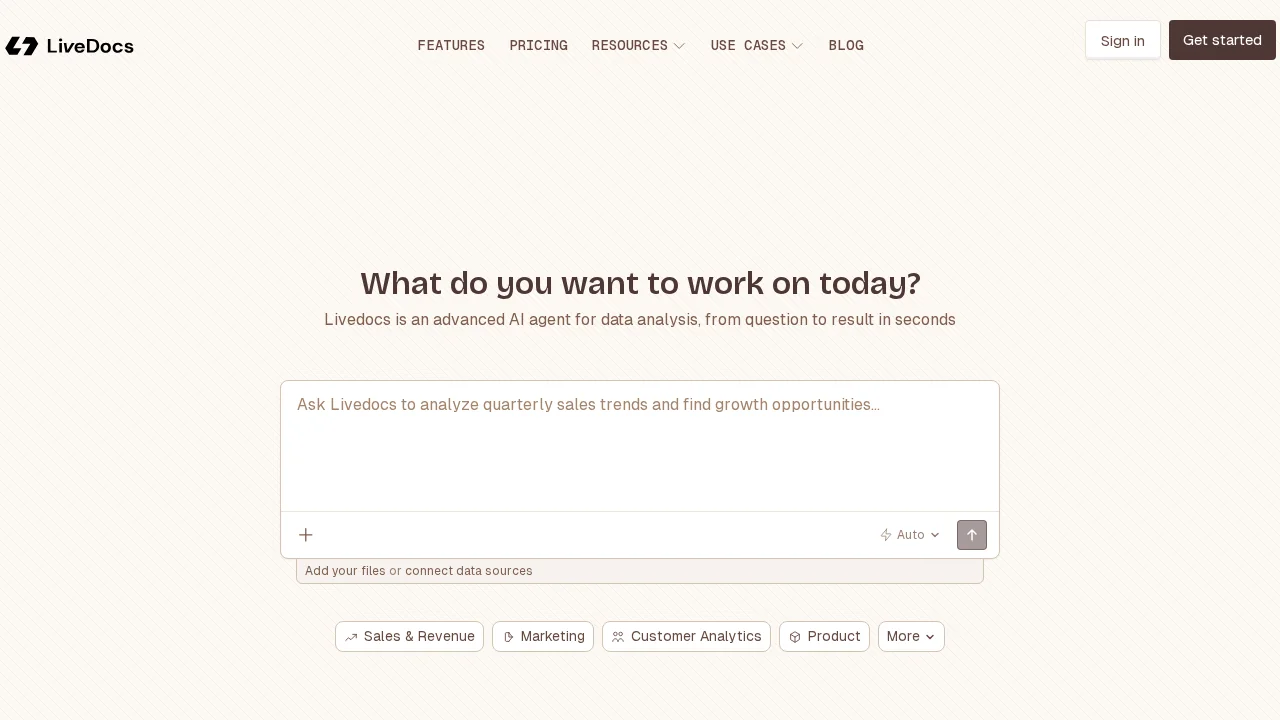
Livedocs is an AI data scientist platform enabling teams to analyze, visualize, and deploy data applications collaboratively.
Livedocs at a glance
- Pricing
- Free — from $65/month
- Rating
- ⭐ 4.0/5 · 3 reviews
- Key strengths
- Combines notebooks and app-building in one collaborative platform · Advanced analytics without coding through AI model integration · Full code transparency showing Python, SQL, and reasoning behind results
Screenshots
About Livedocs
Livedocs combines the flexibility of notebook environments with application-building capabilities, creating a unified workspace where data teams can explore datasets, test hypotheses, and transform insights into interactive applications. The platform eliminates unnecessary complexity by streamlining workflows that typically require switching between multiple tools. Users can manipulate and understand data through an intuitive interface, then seamlessly transition to building production-ready data apps.
The platform excels at enabling non-coders to perform advanced analytics through built-in support for natural language processing, embeddings, and machine learning without requiring coding expertise. Teams can leverage collaborative Python and SQL environments running on powerful hardware, with optimized performance through Polar and DuckDB query execution. This accessibility democratizes data science across organizations, allowing business analysts and domain experts to conduct sophisticated analysis independently.
Livedocs integrates leading AI models including OpenAI, Anthropic, and Gemini, providing context-aware capabilities that draw from diverse data sources. The platform maintains transparency by displaying underlying code behind every result, fostering trust in AI-driven outputs and giving users complete control over their analytical work. This code-visibility approach helps teams understand exactly how results are generated and debug issues when needed.
The versatile platform supports multiple use cases from rapid exploratory analysis to building interactive dashboards and executing complex financial modeling. Common applications include investment analysis, market research, earnings analysis, and forecasting, though the flexible architecture accommodates custom workflows across industries. Teams can publish and share results as visualized narratives, enabling stakeholders to understand data stories without technical knowledge.
Pros
Cons
Alternatives to Livedocs
Analytify - A GenBI Platform
DealNavigator.Ai
GA4.so
Hanalyzer.ai
MyReport
SportBot AI
Wandercrafted