Macrohard
Macrohard is an AI agent system that automates computer tasks by observing screens and executing real-time actions.
Macrohard at a glance
- Pricing
- Freemium
- Rating
- ⭐ 5.0/5 · 1 reviews
- Key strengths
- Real-time screen observation and action execution for continuous automation · Combines reasoning and execution in one system for complex workflows · Cost-efficient hardware strategy designed for enterprise scalability
Screenshots
About Macrohard
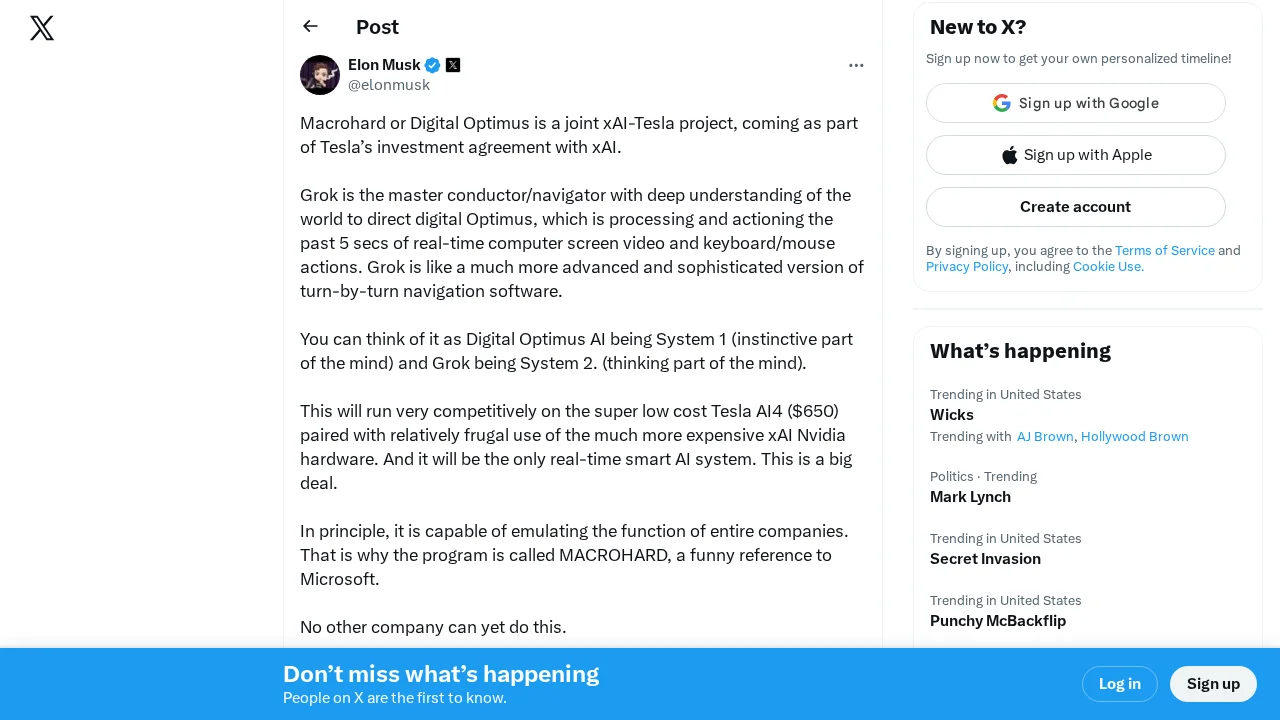
Macrohard, also known as Digital Optimus, represents a shift in AI automation by combining high-level reasoning with real-time desktop interaction. Rather than operating as a traditional chatbot or static workflow tool, it functions as a continuous digital worker capable of observing on-screen activity, understanding context, and executing commands through mouse and keyboard inputs. This approach bridges the gap between intelligent planning and practical task execution in live computing environments.
The system architecture pairs Grok's reasoning capabilities with a responsive execution layer designed for moment-to-moment desktop control. This dual-layer design enables faster response times and more natural interaction patterns compared to conventional agent platforms. By leveraging this structure, Macrohard aims to handle complex workflows that span multiple applications and business systems without requiring manual intervention between steps.
The infrastructure is engineered for enterprise-scale automation, using a cost-efficient hardware strategy that relies on Tesla's AI4 processors for standard inference while reserving more expensive Nvidia compute for demanding reasoning tasks. This approach targets continuous operation and lower latency, making it suitable for workflows requiring real-time responsiveness and minimal delay in decision-making. The system is positioned as foundational automation infrastructure for knowledge work environments where speed and reliability matter.
Pros
Cons
Alternatives to Macrohard
KiloClaw
Nanoswarm: OpenClaw App
TaskFire
Clico
MyClaw.Host
88Agents
Tars