Octopoda
Octopoda provides persistent memory infrastructure for AI agents, enabling knowledge retention and semantic search across complex systems.
Octopoda at a glance
- Pricing
- Free — from Free
- Rating
- ⭐ 4.8/5 · 6 reviews
- Key strengths
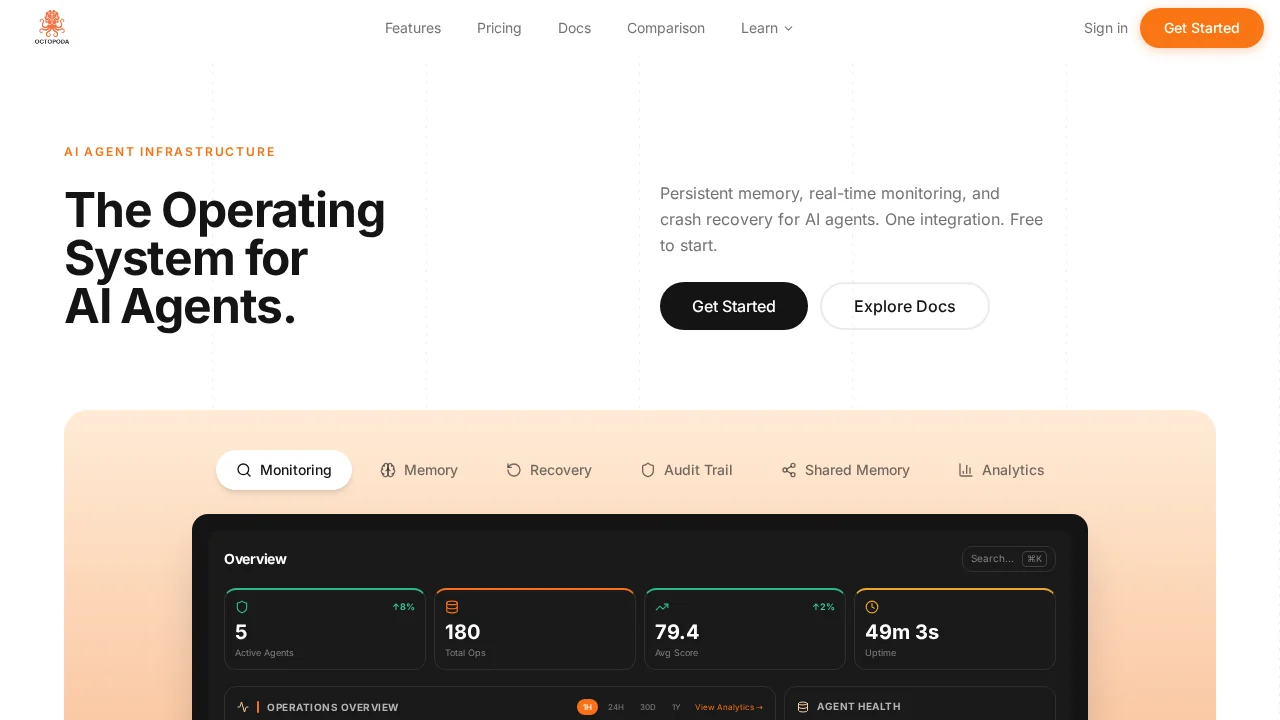
- Semantic search enables natural language queries for intuitive data access · Comprehensive audit trails support accountability and regulatory compliance · Crash recovery protects data integrity and minimizes operational downtime
Screenshots
About Octopoda
Octopoda is a memory management platform designed for AI agents that need to retain and access information reliably across multiple interactions. By serving as a centralized memory reservoir, it allows AI systems to build contextual understanding and recall relevant data when needed, eliminating the limitations of stateless AI interactions. This architecture proves particularly valuable in complex environments where multiple agents must coordinate and share learned information.
The semantic search functionality transforms how AI agents access stored data by leveraging natural language processing. Instead of rigid keyword matching, agents can query information using conversational language, making data retrieval intuitive and efficient. This bridge between human language and machine-readable data reduces friction in AI system design and improves the quality of agent responses.
Reliability and accountability are built into Octopoda through comprehensive audit trails that track agent decision-making processes. These logs are essential for debugging AI behavior, understanding system decisions, and meeting regulatory requirements that increasingly govern AI deployments. Organizations can confidently monitor what their AI systems are doing and why.
System resilience is another core strength, with crash recovery capabilities that protect stored data and minimize downtime during infrastructure failures. This ensures that valuable learned knowledge and interaction history remain intact even when unexpected system issues occur, maintaining continuity in AI operations.
Pros
Cons
Alternatives to Octopoda
Knowledge Plane
Aiqbee
Memdex
Alma by Olivares.AI
SureThing.io
Reedle
Vivgrid