
Open Knowledge Maps
Open Knowledge Maps is an AI-powered scientific literature search engine that visualizes research topics and surfaces relevant papers.
Open Knowledge Maps at a glance
- Pricing
- Free — from Free
- Key strengths
- Visual mapping makes complex research landscapes intuitive to navigate · Free, open-access platform removes institutional and financial barriers · Embeddable components allow integration into existing discovery systems
Screenshots
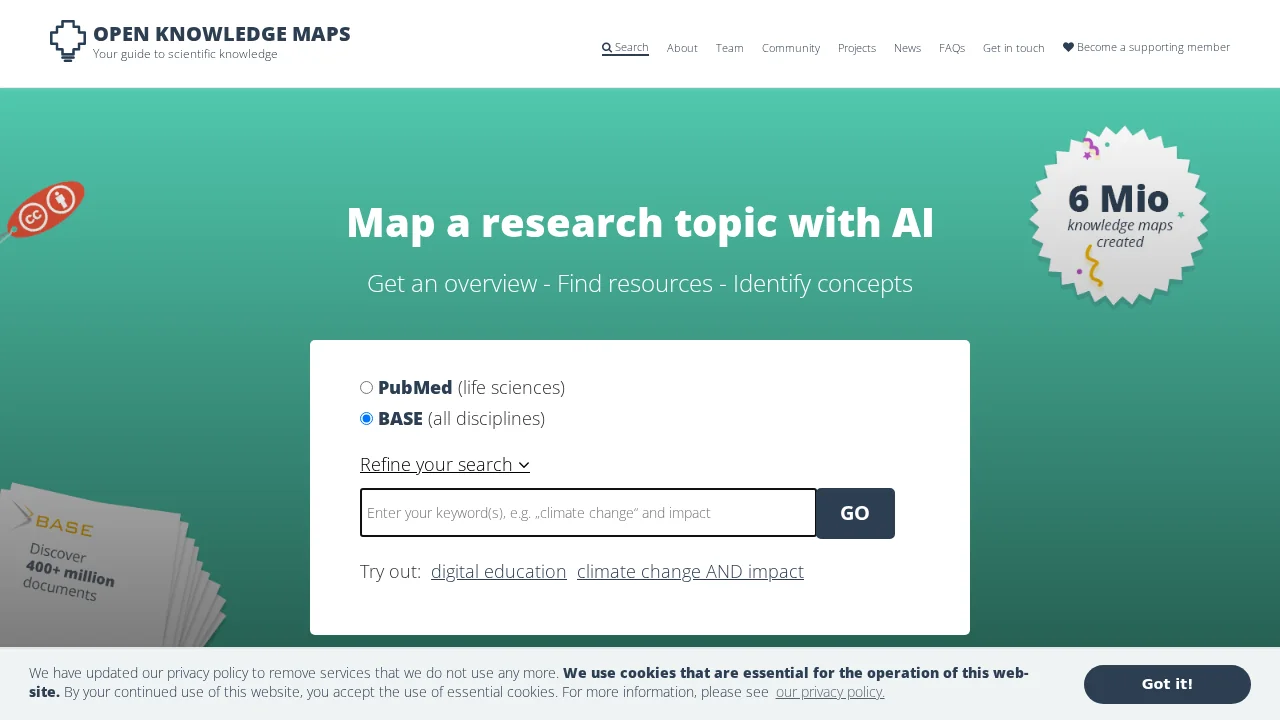
About Open Knowledge Maps
Open Knowledge Maps transforms how researchers discover and understand scientific literature through interactive visual mapping. The platform automatically organizes research topics into intuitive, graphical representations that reveal connections between papers, concepts, and key findings. Users can explore complex subject areas without overwhelming information overload, making it easier to grasp the landscape of existing knowledge in any field.
Built on open science principles, Open Knowledge Maps serves as a free, inclusive infrastructure accessible to researchers, academics, and science enthusiasts worldwide. The non-profit model ensures equitable access to scientific knowledge regardless of institutional affiliation or geographic location. This commitment to openness extends beyond passive consumption—the platform actively invites community participation in building better discovery systems for future research.
The tool functions as both a research discovery engine and an embedding solution for organizations seeking to integrate advanced literature mapping into their own systems. Institutions can seamlessly incorporate Open Knowledge Map components into existing platforms, extending the reach and functionality of their knowledge infrastructure. By combining AI-driven organization with human-centered design, the platform makes scientific discovery faster, more intuitive, and more collaborative than traditional search methods.
Pros
Cons
Alternatives to Open Knowledge Maps
InstantMind
Flowova AI
Qonqur