OpenHands Daytona
OpenHands is an AI coding agent that autonomously handles developer tasks, accelerating refactoring, migration, and troubleshooting work.
OpenHands Daytona at a glance
- Pricing
- Freemium
- Rating
- ⭐ 5.0/5 · 2 reviews
- Key strengths
- Autonomously handles code refactoring, migration, and debugging tasks · Unified workspace eliminates tool-switching overhead · Scales across infrastructure without environment constraints
Screenshots
About OpenHands Daytona
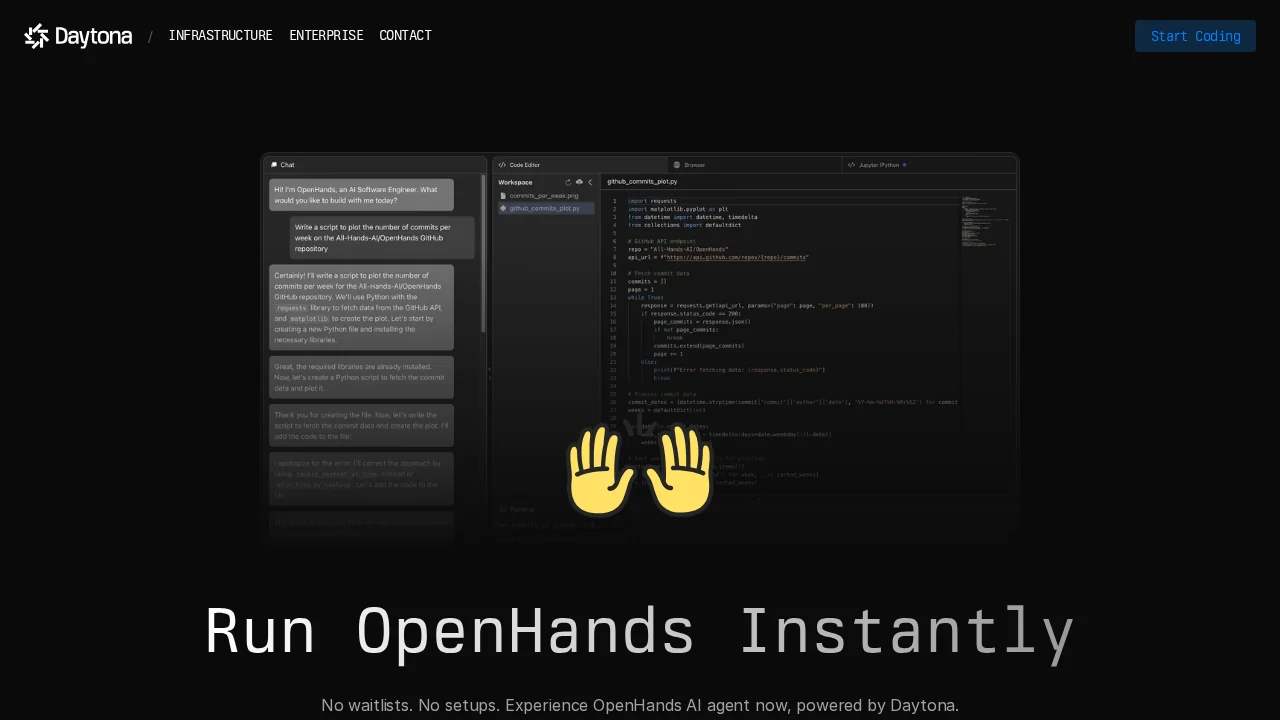
OpenHands is an autonomous AI coding agent designed to work alongside human developers, handling routine and complex programming tasks in parallel with your team. It excels at code refactoring, system migration, and debugging—tasks that typically consume significant developer time. The agent can autonomously navigate codebases, implement changes, run tests, and resolve issues without manual intervention, making it particularly valuable for teams managing large-scale projects with intricate dependencies and workflows.
The platform provides an integrated workspace that consolidates everything developers need: an embedded shell, web browser, code editor, and task planner. This unified environment eliminates the friction of switching between tools, enabling end-to-end work within a single interface. Developers can focus on higher-level decision-making while OpenHands handles repetitive coding tasks and infrastructure concerns.
OpenHands runs on Daytona, an agent-agnostic infrastructure middleware that ensures compatibility across different environments and systems. This architecture provides secure sandbox management, horizontal scaling capabilities, and intelligent task allocation—critical features for enterprise deployments. The platform supports natural language collaboration, making AI-assisted development accessible to both technical developers and non-technical team members who need to contribute to coding workflows.
The combination of OpenHands and Daytona's infrastructure delivers enterprise-grade reliability with compliance support and seamless integration into existing development stacks. Teams can scale autonomous coding assistance across projects without rearchitecting their infrastructure, reducing operational overhead while maintaining security and performance standards.
Pros
Cons
Alternatives to OpenHands Daytona
Notis
remio: Your Personal ChatGPT
SureThing.io
TheLibrarian.io
Supernormal App
Base44 Superagents
Caret