Universal-3 Pro by AssemblyAI
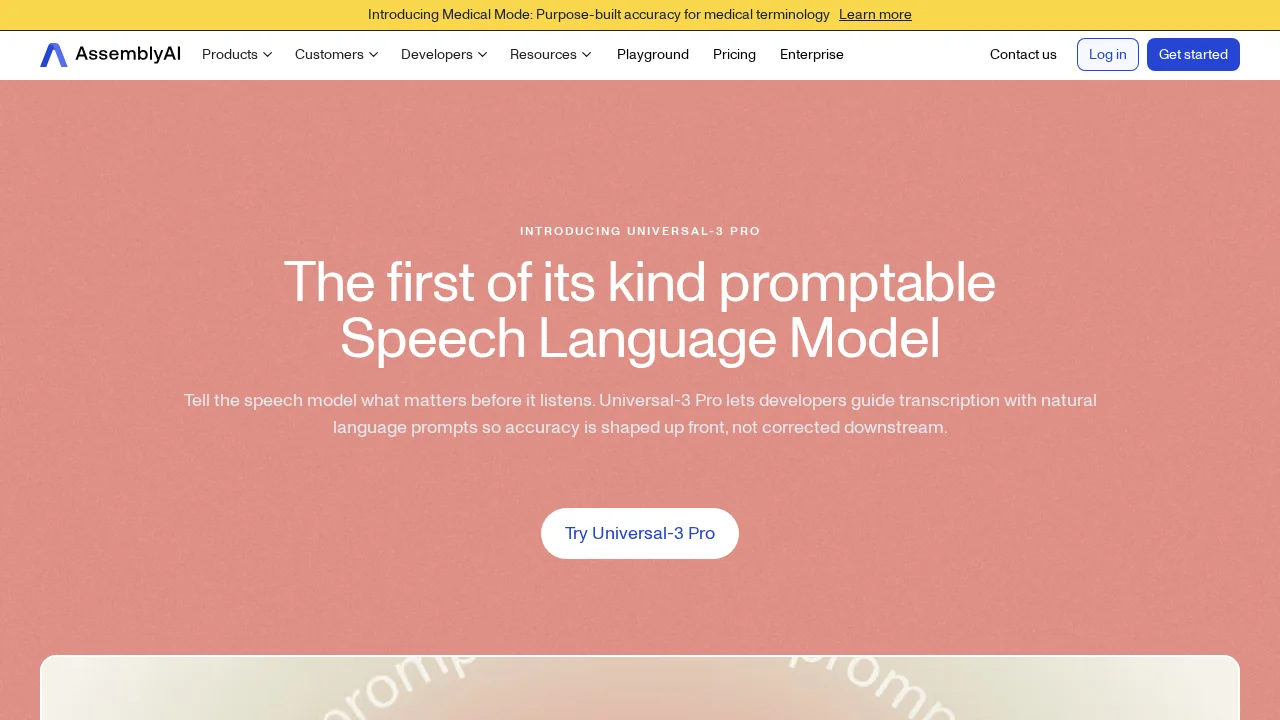
Universal-3 Pro by AssemblyAI is a promptable speech language model that delivers highly accurate transcriptions through contextual understanding.
Universal-3 Pro by AssemblyAI at a glance
- Pricing
- Free — from $0.15/unit
- Key strengths
- Contextual prompts improve transcription accuracy for domain-specific content · Handles complex speech patterns including disfluencies and code-switching · Distinguishes speaker roles and tags non-speech audio events
Screenshots
About Universal-3 Pro by AssemblyAI
Universal-3 Pro represents a fundamental shift in speech recognition technology by incorporating contextual prompts before processing audio. This approach enables the model to understand speaker intent, terminology, and domain-specific language with greater precision than traditional automated speech recognition systems. By accepting prompts that guide transcription behavior, the tool adapts intelligently to your specific use case rather than applying one-size-fits-all processing.
The model excels at handling complex speech scenarios that challenge conventional systems. It preserves verbatim transcriptions for clinical settings, accurately identifies and tags non-speech audio events, captures natural disfluencies and informal dialogue, and distinguishes between multiple speaker roles. This nuanced approach proves invaluable in regulated industries and conversational contexts where precision matters.
Code-switching support allows the model to seamlessly handle multilingual speech, preserving natural transitions between languages like English and Spanish without forcing artificial segmentation. This capability addresses real-world communication patterns where speakers naturally blend languages. The tool's flexibility extends across diverse applications including conversation intelligence platforms, medical transcription workflows, and contact center operations, where capturing the full complexity of human speech directly impacts business outcomes and compliance requirements.
Pros
Cons
Alternatives to Universal-3 Pro by AssemblyAI
Video to Text.net
autokeyworder
Sleekio
FastlyConvert
VoxTap
Velma Transcribe by Modulate
FastScribeX