VanceAI
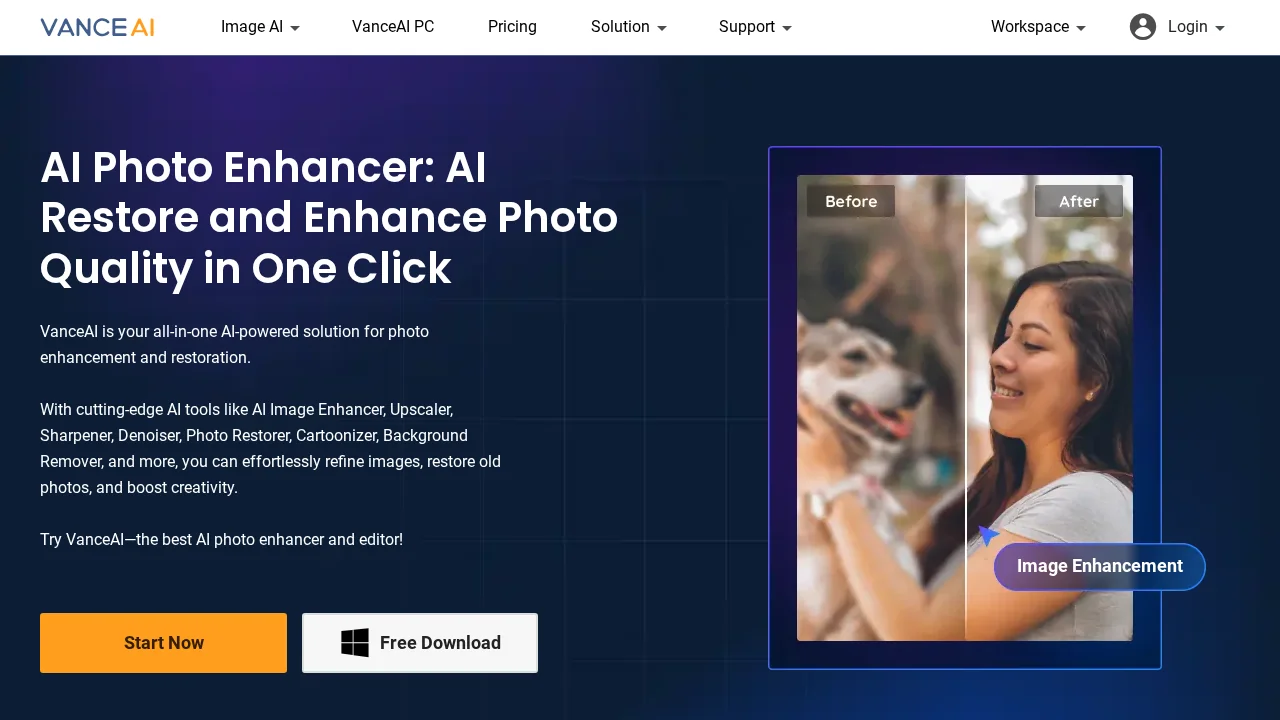
VanceAI delivers one-click AI photo enhancement and editing tools powered by deep learning technology.
VanceAI at a glance
- Pricing
- Free — from $4.95/unit
- Rating
- ⭐ 1.0/5 · 1 reviews
- Key strengths
- One-click processing with minimal user input required · Available as both web application and downloadable Windows software · Real-time preview functionality for instant visual feedback
Screenshots
About VanceAI
VanceAI provides intelligent photo enhancement and editing solutions built on Deep Convolutional Neural Networks trained across millions of images. Rather than relying on traditional mathematical algorithms, the platform uses advanced deep learning to analyze and process images with precision, preserving real details while improving overall quality. This approach enables faster processing and more nuanced results across a diverse range of photo editing tasks.
The platform offers comprehensive tools for image upscaling, sharpening, denoising, background removal, old photo restoration, and retouching. Users can access these capabilities through an online interface or download the Windows desktop application, with both options supporting real-time previews in a sandboxed workspace. This flexibility allows photographers, graphic designers, and e-commerce professionals to choose their preferred workflow without sacrificing functionality.
Beyond core enhancement features, VanceAI includes specialized tools like a passport photo maker, image compressor, image generator, and dedicated photo editor. The combination of online and offline processing capabilities makes the platform suitable for various use cases, from professional photography to product imaging for retail. By automating repetitive enhancement tasks, VanceAI helps users streamline their workflow and focus on creative decisions rather than technical adjustments.
Pros
Cons
Alternatives to VanceAI
SellShots
VisualGPT
Hireable Headshots
Mintshot
VibePaint.ai
GPT Caricature
AvatarStyle