AgentID is an AI agent operating system that gives autonomous agents a persistent identity, shared memory, and portable skills across every platform they touch. It targets developers, AI builders, and organizations running multi-agent workflows who are tired of watching context vanish every time a task crosses a tool boundary. Currently in public beta, it's free to claim with a 3-day Pro trial and no credit card required. Run a solo automation or coordinate a fleet of agents across Claude, Cursor, and OpenClaw simultaneously — AgentID aims to be the connective tissue that keeps them coherent.
What is AgentID?
AgentID sits in the emerging category of agent identity and memory infrastructure — a layer above individual AI models and tools that provides a stable reference point for who an agent is and what it knows. Instead of configuring each AI tool separately and re-injecting context every session, AgentID lets builders define an agent's personality, voice, rules, and skills once under a single @handle. Every connected tool — Claude, ChatGPT, Cursor, Codex, Windsurf, Copilot, Gemini, or any MCP-compatible system — automatically inherits that identity. The positioning is deliberate: AgentID wants to be the operating system layer for the multi-agent era, cutting the fragmentation that makes large-scale agent deployments expensive and hard to manage.
Key features
One @handle, universal identity inheritance
The core primitive in AgentID is the @handle — a permanent address for an agent that carries its name, voice, tone, beliefs, rules, and visual appearance. Connect any AI tool to that handle and it inherits the full identity specification without copy-pasting prompts or touching settings again. This matters most in polyglot stacks where a single workflow touches Claude Code on a server, Cursor on a local machine, and an HTTP API agent in the cloud — all needing to behave as the same coherent entity. The platform also generates a live, rotatable 3D identity card driven by the agent's color palette and character profile.
Persistent shared memory graph
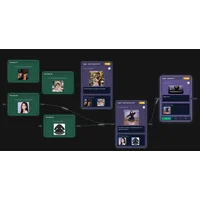
AgentID maintains a shared memory pool that all agents on an identity can read from and write to in real time. Facts, decisions, preferences, and context from one session are immediately available to every other agent on the same handle. No re-explaining. No manual state passing. The Studio displays a live memory graph that updates as agents work, giving builders a visual map of what their agents collectively know. For teams building vibe-coded applications where multiple autonomous agents collaborate on a single project, that kind of persistent context is a real step up from stateless API calls.
Multi-agent task coordination
AgentID's task system lets any agent on an identity declare a shared mission, broadcast live status updates, and hand off work to other agents with structured summaries and explicit next steps. The protocol works across all integration modes — MCP tools for Claude Code and Cursor, HTTP API for SDK-based agents, and system-prompt injection for fully autonomous setups. Four dedicated MCP tools (start_mission(), update_status(), handoff(), read_mission()) make coordination programmatic and auditable. According to the MCP specification, this kind of standardized tool interface is what enables interoperability across diverse agent runtimes.
Token compression and cost savings
One of AgentID's most practically compelling claims is automated system-prompt compression. A single toggle per identity enables compression that the platform says reduces prompt size by approximately 70%, translating to the headline 65% reduction in token overhead cited across the product. Lower token counts mean lower API costs on every call — real savings when complex multi-step workflows burn through thousands of tokens per task. The compression requires no prompt engineering; AgentID handles it transparently across all connected integration types.
Pricing and plans
AgentID is free to start with no credit card required. Every new account gets a 3-day Pro trial, after which the platform drops to a free-forever tier. The product is in public beta, so pricing tiers beyond the free plan haven't been fully detailed publicly. Given that the platform is positioned around reducing API costs for high-volume deployments, paid tiers focused on memory limits, connected agent counts, or analytics depth seem likely — but as of this review, the only barrier to entry is signing up. The AgentID website confirms no payment information is needed to claim a handle and start experimenting.
Pros and cons
AgentID takes a genuinely differentiated approach to multi-agent infrastructure. Here are the main strengths we identified:
There are some limitations worth knowing before committing to an integration:
Alternatives on HyperStore
EZClaws is worth considering if your priority is getting a private AI agent running with minimal setup rather than coordinating multiple agents under a shared identity. It emphasizes one-click deployment and simplicity, making it a better fit for builders who want a single capable agent without the orchestration overhead.
For teams that need to track how their AI agents are actually performing in production, Tokyo offers real-time analytics and AI interaction tracking with enterprise-grade security and zero-code integration. Where AgentID focuses on identity and memory, Tokyo focuses on observability and insight — the two could complement each other in a mature agent stack.
VoooAI's Vibe Flow takes a natural-language-first approach to building complex AI workflows, letting you describe what you want agents to do rather than configuring it manually. If AgentID's workflow builder appeals to you, VoooAI scratches a similar itch from a different direction.
Developers building agent-powered applications on top of enterprise data should also look at IngestAI, a secure AI integration platform that simplifies generative AI application development for larger organizations. It addresses the data ingestion and security side of the agent infrastructure puzzle that AgentID's identity layer doesn't cover.
Frequently asked questions
What AI tools does AgentID work with?
AgentID is compatible with Claude, ChatGPT, Cursor, Codex, Windsurf, Copilot, Gemini, OpenClaw, Hermes, and any tool that supports MCP or can accept a system prompt. The platform lists 58+ native connectors and access to over 3,000 MCP tools. Connection methods include MCP server URL, HTTP API, SDK, and direct system-prompt export.
Is AgentID really free?
Yes — free to start, no credit card required. All new accounts get a 3-day Pro trial automatically. After the trial, a free-forever tier remains available. Paid plans beyond the Pro trial haven't been publicly detailed yet, as the product is in public beta.
How does AgentID reduce token costs?
AgentID automatically compresses your agent's system prompt when you enable the compression toggle on an identity. The platform claims this reduces prompt size by approximately 70%, translating to roughly 65% less token overhead per API call. The compression is applied transparently across all integration modes without any manual prompt engineering on your end.
What is the @handle and why does it matter?
An @handle is AgentID's term for a permanent address that holds an agent's complete identity specification — name, voice, tone, beliefs, skills, and rules. Any AI tool connected to a handle inherits all of those properties automatically. Define your agent once and it behaves consistently whether it's running inside Claude Code, Cursor, or a custom HTTP API agent.
Can multiple agents share the same identity and coordinate tasks?
Yes. Multiple agents connected to the same @handle share a common memory pool and can participate in structured multi-agent tasks. One agent can start a mission, others broadcast their status in real time, and a finished agent hands off to the next with an explicit summary. The coordination protocol works across MCP, HTTP API, and system-prompt-based integrations simultaneously.
How does AgentID differ from simply writing a good system prompt?
A system prompt is static and local to a single tool session — it disappears when the session ends and must be re-injected every time. AgentID's identity layer persists across sessions and across tools, accumulates memory over time, and distributes that context to every connected agent automatically. It also adds a real-time monitoring dashboard, task coordination primitives, and prompt compression that a static prompt can't provide.
AgentID is tackling a problem that anyone who has built a multi-agent workflow has felt acutely: context is fragile, and maintaining it across tools is expensive in both time and tokens. The free-to-start model makes it genuinely low-risk to test whether the shared memory and identity layer maps onto your specific stack. If you're running complex agent automation at any meaningful scale, it deserves a serious look during its current public beta window.