AI Tools for Customer Support 20 apps
Customer support covers every interaction a team has with a customer who needs help, from answering "where is my order" to resolving a billing dispute or walking someone through a setup. Teams handle it across email, live chat, social media, phone, and self-service portals, often juggling dozens of conversations at once. AI changes this picture by taking on the high-volume, repetitive tier of those requests, surfacing relevant context to human agents, and routing conversations intelligently, so the people on your team can focus on the cases that actually need a human touch. This guide walks through how AI fits into a modern support stack, what to look for when evaluating a platform, and the best AI tools for customer support currently listed on HyperStore.
How AI helps with customer support
At the front line, conversational AI agents and chatbots answer common questions instantly, drawing on your help center, product docs, and past tickets to produce replies that feel on-brand. Behind the scenes, AI handles triage, categorizing incoming messages, detecting urgency, and routing them to the right queue or agent. For human agents, copilots suggest replies, summarize long ticket histories, and pull up relevant articles mid-conversation, which compresses handle time. Across all of this, analytics layers spot trends in customer feedback, flag at-risk accounts, and identify knowledge gaps where new help articles would prevent repeat tickets. The net effect is a support operation that can scale conversation volume without linearly scaling headcount.
What to look for
Quality of answers and source control
The single most important factor is how accurately and safely the AI responds. Look for platforms that ground answers in your own content (help center, internal docs, past tickets) rather than generating free-form replies, and that make it easy to review, edit, and pin approved sources. Strong tools expose confidence scores, let you set escalation triggers, and provide a clear path to a human when the model is uncertain.
Channels, languages, and routing
Your customers are not all in one place, so the tool should meet them where they are: web chat, email, in-app messaging, social DMs, WhatsApp, voice, and so on. Multilingual support is essential for global teams. Equally important is how the tool hands off to humans, with full context, so the customer never has to repeat themselves.
Integrations with your stack
A support AI is only as useful as the data it can reach. Check for native integrations with your helpdesk (Zendesk, Freshdesk, Intercom and so on), CRM, e-commerce platform, and order management system. Webhooks and a clean API matter if you have custom workflows, and a built-in knowledge base or a smooth way to ingest existing articles is a major time-saver during setup.
Pricing, analytics, and admin controls
Pricing models vary widely: per-resolution, per-conversation, per-seat, or flat platform fees. Match the model to your volume and predictability. On the admin side, look for role-based permissions, audit logs, conversation review tools, and reporting on deflection rate, CSAT, and time-to-resolution so you can prove ROI to stakeholders.
Best AI tools for customer support

CoSupport AI is a customizable customer service platform that automates support with AI agents and intelligent reply suggestions. It is positioned for teams that want to tune the AI closely to their own voice and processes rather than rely on a one-size-fits-all bot. As a free offering on HyperStore, it is a low-risk way to explore agent-assist and automated reply workflows.

Customerly AI transforms customer service with intelligent automation that learns, adapts, and handles support at scale. It focuses on combining live chat, helpdesk, and AI in a single workflow so conversations, tickets, and customer context live in one place. Teams that already use Customerly's broader suite will find the AI layer slots in naturally alongside their existing channels.

Forethought's SupportGPT automates customer support with AI-powered responses, triage, and agent assistance across all channels. Its Triage feature classifies and routes incoming tickets before an agent sees them, while its suggested-reply and summarization capabilities speed up handling time. A freemium tier makes it accessible to smaller teams that want to test enterprise-grade routing logic.

Help Center is an AI-powered customer support platform that delivers instant responses and reduces support tickets through intelligent knowledge base automation. It leans heavily on self-service, turning a static FAQ into a conversational surface that can actually answer questions. Teams looking to deflect a high share of inbound volume without building custom search infrastructure will find this approach attractive.

Helpx.ai automates customer service with AI chatbots that deliver instant, personalized support across multiple languages and channels. Multilingual capability is a standout here, making it relevant for brands serving customers across regions. It is a free entry point, which suits startups testing AI support for the first time.

Torri.AI is an AI chatbot that automates customer support by learning from your website and knowledge base. Setup is intentionally light: point it at your existing content and it builds a conversational layer on top. This is a paid tool, aimed at teams that want a fast path to a working bot without a long implementation project.

Zendesk AI Agents uses reasoning-based AI to resolve customer issues autonomously across all channels. Because it sits inside the broader Zendesk ecosystem, it inherits mature ticketing, routing, and reporting. It is a paid offering, and the strongest fit is for organizations already standardized on Zendesk who want to add autonomous resolution on top.

Aide is an AI support tool that accelerates customer issue resolution with intelligent suggestions and inbound analytics. It pairs reply suggestions with analytics on incoming themes, helping teams spot which issues are spiking and what knowledge gaps exist. The free tier makes it a practical option for small teams that want both an agent copilot and lightweight trend analysis.
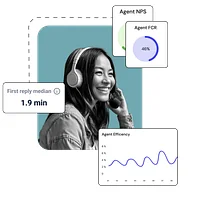
BlueTweak's AI Omnichannel Customer Support Platform unifies email, chat, social media, and phone into one intelligent system. The value proposition is consolidation: a single workspace across every channel with AI applied consistently to routing, replies, and reporting. It is a paid platform, best suited to mid-market and enterprise teams whose biggest pain is channel fragmentation.

AssistLoop is an AI platform that powers customizable customer support agents trained on your data. The emphasis is on training: you bring the content, and the platform builds agents that reflect your products, policies, and tone. The free tier makes it approachable for teams that want fine-grained control over how the agent behaves.

Asyntai is an AI-powered live chat solution that delivers 24/7 instant customer support and eliminates missed sales opportunities. It is purpose-built for always-on live chat, which makes it a strong fit for e-commerce and SaaS sites that lose conversions when no one is online. Being free, it is easy to trial on a single site before rolling out more broadly.

Conversed.ai is an AI agent optimization studio that automates customer service and sales through intelligent conversational automation. The "optimization studio" framing means the platform is built not just to deploy agents but to refine them over time using conversation data. A freemium tier lets teams start with core automation and expand into the optimization features as they grow.
How to choose
If your priority is deflection through a strong self-service layer, start with Help Center or Torri.AI. For omnichannel consolidation across email, chat, social, and voice, BlueTweak and Zendesk AI Agents are the heavier-duty choices. Smaller teams that want a free, fast-to-launch chatbot should look at Asyntai, Helpx.ai, or AssistLoop. If routing, triage, and agent-assist are your main bottleneck, Forethought and Aide are built for that. Teams that want a customizable, data-trained agent will feel at home with CoSupport AI, and those optimizing existing agents over time should evaluate Conversed.ai. For a full-stack helpdesk plus AI, Customerly AI keeps everything in one suite.
More AI tools to explore

SupportAI
SupportAI delivers custom AI-powered chatbots that transform customer interactions and drive business growth.

Jotform AI Agents
Jotform AI Agents deliver instant, scalable customer service automation that reduces response times and boosts satisfaction.

CustomGPT.ai
CustomGPT.ai uses AI agents to automatically resolve 93% of customer service inquiries without coding.

Verloop.io
Verloop.io automates customer support with conversational AI that delivers efficient, engaging support across multiple channels.

Infinity AI Tools
Infinity AI Tools is a 24/7 virtual sales assistant that drives conversions through real-time customer engagement and lead generation.

Minion AI
Minion AI revolutionizes customer service with intelligent, automated omnichannel support across email, chat, and social media.