


Best NotebookLM Alternatives 7 apps
Compare the top alternatives to NotebookLM — pricing, features, and ratings.
NotebookLM helps people work through source materials with AI-assisted answers and summaries. Someone may look for NotebookLM alternatives when they need a different research workflow, broader media coverage, easier note capture, a preferred platform, or a lower-cost starting point. The best fit depends on whether your work centers on documents, audio and video, market research, or everyday productivity. The options below are comparisons by use case, so staying with NotebookLM can still be sensible if its source-based approach matches your needs.
Why look for a NotebookLM alternative?
NotebookLM is a strong choice when you want AI assistance grounded in a defined set of sources, but no single research tool covers every workflow equally well. A document-focused assistant may be preferable for private or open-source deployments, while a research agent may better suit open-ended questions, and a note-capture tool may reduce friction after conversations. Price and access also matter: a free or freemium model can make experimentation easier, but the practical value still depends on source handling, output quality, and how easily results fit into existing work.
Before switching, review the current capabilities and source guidance on Google's official NotebookLM site, then compare alternatives against the material and workflow you use most.
What to look for in a NotebookLM alternative
Source types and retrieval
Start with the material you actually need to search. Documents, videos, podcasts, market interviews, and live web research create different requirements, so check whether a tool works across those sources and whether it returns the passage, timestamp, or citation you need to verify an answer.
Evidence and trust
Prefer workflows that make it easy to inspect supporting evidence instead of treating a polished response as proof. Citations, exact timestamps, source boundaries, and clear handling of uncertainty are useful signals; the NIST AI Risk Management Framework is a useful reference for thinking about reliability and risk when AI supports important work.
Research depth and output
Decide whether you need fast answers from a known collection or a broader investigation that breaks a question into multiple threads and produces a report. The latter can save time on exploratory work, while the former may be easier to audit and reuse in a focused project.
Cost, security, and workflow fit
Compare the listed free and freemium options by the work they support, not just by their price label. Also consider how you capture notes, assign tasks, share findings, and protect sensitive material, since a tool that fits your existing process can be more useful than a broader tool that creates extra steps.
The best NotebookLM alternatives

ConceptSeek is a better fit than NotebookLM when your source set includes videos, podcasts, and research documents and you want to find concepts across them. Its exact timestamps and citations support quick verification, making it useful for media-heavy research and evidence-led review. It is listed as free, so it is a practical place to start if cost is a priority.

DocsGPT is more directly centered on getting instant answers from documents, so it suits readers whose work is primarily document Q&A rather than mixed research. Its open-source positioning and enterprise-grade security make it worth considering for teams that prioritize control and security in a document assistant. It is listed as free.

LuminixAI takes a broader business-research approach: it breaks complex questions into multiple parallel investigations for comprehensive market insights. Compared with NotebookLM's source-based workflow, it may suit users exploring a market question who want an agent organized around separate lines of inquiry. It is listed as free.

Nexus Seek is aimed at generating comprehensive research reports on any topic in minutes. It is a stronger match for open-ended topic research and report creation than for a narrowly bounded document collection, while NotebookLM may remain preferable when your own sources are the center of the task. Nexus Seek is listed as free.
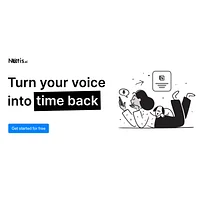
Notis addresses a different problem from NotebookLM: it captures voice messages across messaging apps and auto-syncs structured notes and tasks to Notion. It suits people who need conversations turned into organized follow-up work rather than a source-grounded research notebook. It is listed as free.
Outset is designed for qualitative research at enterprise scale, automating research and uncovering customer insights. It is a better fit for teams running customer or market research programs than for individuals who mainly want answers from a personal source set. Outset is listed as freemium, so evaluate its available access against the scale and governance needs of your work.

SurfMind is a free AI browser extension for contextual insights during research and productivity work. It suits users who want help in the flow of browsing, rather than a dedicated workspace for a fixed collection of documents. If browser context is the deciding factor, SurfMind offers a simpler alternative to consider; it is listed as free.
How to choose
Stay with NotebookLM if your priority is asking questions across a defined source set. Choose ConceptSeek for timestamped media discovery, DocsGPT for document answers, LuminixAI or Nexus Seek for broader research, Notis for voice-to-Notion follow-up, Outset for enterprise qualitative research, and SurfMind for browser-based context. Start with the workflow that causes the most friction, then test evidence quality, export or handoff steps, and the listed free or freemium access.