This Analytify vs THEO comparison puts two very different "intelligence" tools side by side, and that contrast is the whole story. Analytify is a generative business intelligence platform aimed at operations, finance, and analytics teams who want to query their own data in plain English. THEO is a positioning intelligence platform aimed at brand, strategy, and consulting teams who need to map a competitive category before making market decisions. They overlap on the word "intelligence," but solve different problems.
At a glance
The core difference is direction: Analytify looks inward at your own operational data, while THEO looks outward at your competitive landscape. One answers "what is happening in our numbers?" and the other answers "where does our brand sit versus everyone else?"
What each tool does
Analytify
Analytify is a GenBI platform built by StratApps that turns natural-language questions into dashboards, charts, and analytical answers without SQL or code. Its GenieAIQ engine and Genie Dashboard combine multiple AI modules to interpret queries, pick the right visualization, and surface patterns from connected sources. The platform ships with self-service reporting, adaptive dashboards, interactive world map analytics, and 40+ data connectors covering warehouses, databases, and SaaS apps. Enterprise features include SSO, RBAC, SOC 2 alignment, and self-hosting, which makes it usable for regulated teams in financial services, healthcare, and SaaS.
THEO
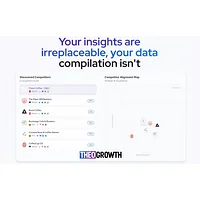
THEO is a positioning intelligence platform from THEO Growth that produces verified, sourced category reads for brand and strategy teams. Instead of pulling from your internal databases, THEO scans websites, wider web sources, and social channels to map who owns what in your category, where the white space sits, and how the landscape is converging. Outputs are organized around 15 structured sections — Positioning Territories, Visual Identity Analysis, Buyer Segments, Strategic Actions, and Positioning North Star, among others — built on the proprietary CLEAR™ methodology. The result is an AI-ready, context-engineered brief that can be dropped directly into ChatGPT or Claude for follow-up reshaping.
Feature comparison
Question interface and input
Analytify is built around ad-hoc natural-language queries against your connected data, with an emphasis on conversational exploration once a dashboard exists. THEO is built around a one-time "define the category" intake — you share your website and target region — after which the platform does the structured research on your behalf. Both use plain-English interfaces, but Analytify is interactive and ongoing while THEO is project-based and produces a complete artifact per run.
Output format and structure
Analytify outputs dashboards, KPIs, charts, and share-ready insights that update as your underlying data updates. THEO outputs a static positioning brief with 15 fixed sections, visual maps, archetype clusters, and buyer segment breakdowns designed to be defensible in a boardroom. If your team needs a living dashboard, Analytify wins; if your team needs a one-shot strategy document, THEO wins.
Methodology and source transparency
Analytify relies on standard BI semantics over your own data warehouse, so "accuracy" is really a function of your data quality and query clarity. THEO's differentiator, by contrast, is explicit methodology: full-page reads with citations, proprietary positioning frameworks, and the same depth applied on every re-run — a contrast the company draws against MIT Sloan-style "AI search" tools that return snippet-level answers. For competitive research buyers, that methodological transparency is a meaningful plus.
Integrations and ecosystem
Analytify plugs into 40+ warehouses, databases, and SaaS apps, plus enterprise security layers like SSO, RBAC, and SOC 2. THEO is narrower on integrations by design — its primary "integration" is with your existing AI chat clients (ChatGPT and Claude) so your team can reshape outputs in the tools they already use. Choosing between the two largely comes down to whether you need data-pipeline integration or workflow integration.
Pricing
Analytify lists a free pricing model on its directory profile, making it accessible for teams that want to pilot natural-language BI without committing budget upfront. THEO is a paid platform with pricing available on request from THEO Growth, reflecting its positioning as a research deliverable rather than a self-serve SaaS tool. For buyers comparing total cost, factor in that THEO's price typically covers structured category research that would otherwise require senior analyst hours, while Analytify's free tier shifts cost into data-source setup and onboarding time.
Pros and cons
Analytify
- Natural language queries eliminate SQL and coding requirements
- Auto-generates dashboards and visualizations instantly
- Reduces analytics bottlenecks and speeds decision-making
- Democratizes data access across non-technical teams
- Requires integration setup with existing data sources
- Accuracy depends on data quality and query clarity
- May require domain expertise to interpret complex results
THEO
- Verified and structured competitor intelligence from your brand's perspective
- Profiles include rationale explaining competitive strategies and positioning moves
- Helps identify defensible market territories and strategic directions
- Supports team alignment with evidence-backed competitive narratives
- Requires manual input and interpretation of strategic implications
- Value depends on quality and relevance of source data available
- Best suited for brands with defined market categories and competitors
Which should you pick?
If your bottleneck is internal — analysts buried in SQL tickets, dashboards that lag by days, business users who can't self-serve — Analytify is the more relevant tool. Its natural-language layer and adaptive dashboards directly attack the BI backlog problem, and the free pricing model lowers the barrier to a pilot. Teams in financial services, e-commerce, SaaS, healthcare, manufacturing, and logistics are the named target audiences.
If your bottleneck is external — entering a new market, prepping a pitch, rebranding, or arguing about where the white space sits — THEO is the more relevant tool. It replaces days of desk research and unreliable AI search summaries with a sourced, structured brief that consultants, agencies, and in-house brand teams can defend in a boardroom. It is less useful for companies without a clearly defined category or competitor set.
The honest verdict in any Analytify vs THEO matchup is that they are complementary more than competitive. A growing mid-market company could plausibly use Analytify to monitor its own KPIs while commissioning THEO research ahead of a brand repositioning. Pick by problem, not by category label.
Other alternatives on HyperStore
For teams exploring adjacent categories, Kanwas centralizes product knowledge and uses AI agents to draft strategies and PRDs — a useful complement to either tool. MoClaw automates ongoing research and market monitoring, which pairs naturally with THEO's one-shot briefs. For broader AI tooling decisions, ChatComparison.ai offers side-by-side evaluations of leading AI chatbot models.
Frequently asked questions
Is Analytify better than THEO for data analysis?
Yes, for your own internal data. Analytify is purpose-built for natural-language BI over your warehouses and SaaS sources, while THEO is built for external competitive research. They solve different problems, so "better" depends on whether you need internal analytics or market positioning.
Does THEO replace business intelligence tools like Analytify?
No. THEO produces strategic positioning briefs sourced from public web and social data; it does not connect to your internal data warehouse or generate operational dashboards. For KPIs, revenue tracking, or cohort analysis, you still need a BI tool such as Analytify.
How does Analytify pricing compare to THEO?
Analytify is listed as free in the HyperStore directory, while THEO is a paid platform with custom pricing from THEO Growth. Total cost of ownership differs in kind as well: Analytify shifts spend into integration setup, whereas THEO's price typically substitutes for senior analyst research hours.
Which tool is better for non-technical teams?
Analytify is the stronger fit for non-technical users who need to query internal data, since natural-language input removes the SQL barrier. THEO is also no-code on the surface, but its outputs are strategic narratives best interpreted by people with brand, marketing, or consulting context.
Can Analytify and THEO be used together?
Yes. A common pattern is to use Analytify to monitor your own performance metrics while using THEO to inform brand and category strategy. Many agencies and brand teams run them in parallel, since one tracks internal truth and the other frames external positioning.
Both tools earn their place in different workflows, and choosing between Analytify vs THEO really comes down to whether your current decision is data-led or strategy-led. For a deeper look at how generative BI is reshaping analytics teams, see Gartner's research on AI in analytics; for the broader competitive intelligence category, Forrester's CI coverage offers useful context.