Best AI Tools for Startup Founders 20 apps
If you're a startup founder, your runway is short, your week is chaos, and most of your decisions get made on about 40% of the information you'd like to have. One day you're rewriting a landing page. Next you're modeling cash flow. By Thursday you're prepping for a customer call you almost forgot about. That's the reality. The best AI tools for startup founders have started to sit right in the middle of this mess, acting like an always-on co-founder for research, writing, outreach, and figuring out what to do next. Below: where AI genuinely helps, what to look for, and which apps on HyperStore are actually worth your time right now.
Why founders reach for AI
Founders don't have one job. They have twelve, and they change every morning. AI compresses the slow parts. It can turn a vague hunch into a structured competitive scan in a few minutes, draft a pitch email so you're editing instead of staring at a blank page, and pull patterns out of a stack of customer call notes that you'd otherwise forget existed.
There's a second effect that's less obvious. A two-person team can ship a content engine, a market scan, and a rough prototype in the time it used to take to write a single investor update. You don't work fewer hours. You just spend them on the calls only you can make.
What to look for
Speed to first useful output
You can't afford a tool that needs two weeks of onboarding before it does anything. The good ones let you ship a draft, a list, or a decision inside an hour. Look for tools that respond to a simple prompt or a short form, not ones that want you to learn a new mental model first.
Pricing that fits early-stage reality
Runway is finite. Freemium and cheap tiers matter more than enterprise features do right now. Pick tools where the free plan covers the core use case, so you're upgrading only after the tool has clearly paid for itself.
Integrations with the rest of your stack
Your stack is probably a docs tool, a CRM, a calendar, and a deploy platform. AI tools that connect via API, Zapier, or native integrations save the copy-paste work that quietly eats half a day a week. If you think you'll ever build internal automations, check for an API or webhook up front.
Privacy, data ownership, and the ability to leave
Founders paste sensitive stuff into AI tools: customer transcripts, financial models, code. Check how each provider handles data, whether your inputs get used for training, and how painful it is to export your work later. Enterprise customers will ask you the same questions, so build the habit now.
Best AI tools for startup founders

ValidatorAI is built for the very earliest stage, when the only real question is whether your idea is worth the next three months of your life. It uses AI analysis plus real market data to score viability and flag the risks you're too close to see. For first-time founders, getting an outside-in read before you quit your job is cheap insurance.

Ideas AI goes the other direction. Instead of validating your idea, it spits out thousands of startup concepts ranked by 1.9M+ user votes. It's a decent starting point when you're still browsing for a problem worth solving, or when you want to gut-check your concept against what real people have already responded to.
Buildpad
Buildpad walks you from a rough concept to a launched product through a 10-phase framework, with AI validation at each step. It fits non-technical founders who want a clear sequence of milestones instead of an open-ended to-do list. If you've ever felt stuck between "I have an idea" and "I have a v1," this is the bridge.
Scopy.me
Scopy.me helps founders build out strategy fast, using data-driven insights and ready-made frameworks. It's a good fit when you need a go-to-market plan, a positioning doc, or a pricing strategy without paying a consultant. The output is a first draft you can argue with, which is exactly what early strategy work needs.
Socap.ai
Socap.ai is an AI networking platform for founders and investors who need to be deliberate about intros. It tracks relationships, prioritizes warm paths into a fund or a candidate, and surfaces the intros you'd otherwise forget to make. When your next round hinges on five specific conversations, this is leverage.
Tinker
Tinker is a free AI creative suite from Shopify that generates video, images, and 3D models on iOS and Android. Founders use it to spin up launch assets, ad creatives, and pitch visuals without booking a designer every time. Especially useful when you need a hero image for a landing page by end of day.
Averi AI
Averi AI is an AI content engine built to help startups publish content that ranks on Google and pulls in early customers. It fits the founder who's accepted that content is part of distribution but doesn't have a content lead yet. Pair it with a simple keyword list and a posting cadence and you've got a working content engine by week one.
Creaitor
Creaitor plans, generates, and optimizes on-brand content with an eye toward both traditional SEO and AI-search visibility. The API access makes it a good pick for founders who want to bake content generation into internal tools, like auto-drafting release notes or product descriptions. It's a step up from a basic writing assistant once brand consistency starts to matter.
fast.ai
fast.ai makes deep learning practical through free courses and open-source libraries aimed at working coders. It's the right pick for technical founders who want to ship AI features into the product instead of just using AI as an outside service. The open-source libraries and API-friendly design mean you can move from tutorial to production without rewriting your stack.
GetSpiced
GetSpiced is an AI mentoring platform that learns your goals and preferences to boost daily productivity for entrepreneurs and creators. It works well as a thinking partner for the unstructured parts of the job: weekly planning, decision journaling, forcing yourself to stick to priorities. Think of it as a lightweight chief of staff that costs nothing.
Huntr
Huntr streamlines a job search with AI resume optimization and application tracking. It's on this list because hiring is one of the most overlooked founder tasks, and because some founders are job hunting while their company takes shape. Even founders who aren't looking use it to tighten up their investor bios.
MimicPC
MimicPC gives you instant browser-based access to 20+ AI apps with nothing to download. For founders who want to try several models side by side without junking up their laptop, it's the lowest-friction option. Also handy on a borrowed laptop at a coworking space when you need to demo something in five minutes.
How to choose
Still at the idea stage? Start with ValidatorAI or Buildpad to pressure-test the concept, then use Ideas AI as a comparison set. Once you've got a direction, layer in Scopy.me for strategy and Averi AI or Creaitor for distribution. If you're fundraising or hiring, add Socap.ai to the mix. Technical builders will get the most out of fast.ai. For quick creative assets and experiments, keep Tinker and MimicPC in your back pocket, and run GetSpiced as a daily planning layer. Huntr rounds out the stack for the rare weeks when your own career, not the company's, is the priority.
More AI tools to explore

Foundor.ai
Foundor.ai is an AI-powered business planning platform that accelerates startup creation with instant templates and branding tools.

StarterPilot
StarterPilot is an AI cofounder that guides you from startup ideation through launch with validation and planning tools.

StartupNameGenerator
StartupNameGenerator uses AI to create unique, brandable startup names tailored for tech founders in seconds.

StartKit
StartKit.AI is a full-stack boilerplate that accelerates AI startup development with pre-built infrastructure and OpenAI integration.

Imagine.bo
Imagine.bo acts as your AI tech co-founder, turning product visions into production-ready code without the overhead of dev shops.
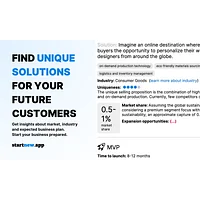
StartNew
StartNew is an AI business planning tool that helps entrepreneurs create strategies and launch ventures quickly.
FoundersPlan.ai
FoundersPlan.ai generates investor-ready business plans in minutes using AI and market analysis.

CatDoes
CatDoes uses AI agents to transform your app ideas into production-ready mobile applications.

Create
Create transforms your ideas into functional apps using AI-powered code generation from plain text and images.

Blink.new
Blink.new is an AI app builder that creates production-ready mobile, web, and SaaS applications from plain English descriptions—no coding required.

HeyBoss AI
HeyBoss AI is an AI-powered no-code builder for creating websites and apps in minutes with integrated business tools.

aiOS
aiOS turns your business website into a texting AI employee that handles marketing, content, and leads across every major channel.

AiAgent.app
AiAgent.app lets you create autonomous AI agents that break down complex goals into actionable tasks and execute them automatically.

AIdea Catalyst
AIdea Catalyst is an AI-powered startup planning platform that transforms business ideas through iterative testing and lean methodology.

Stratup.ai
Stratup.ai generates personalized startup ideas powered by AI market trend analysis and real-time data insights.

Automate your startup fundraising with AI
Evalyze AI automates startup fundraising by analyzing pitch decks and matching founders with qualified investors.