Atomic Mail is a privacy-focused email service that emphasizes encrypted communication, anonymous sign-up, and ad-free inbox management for users who want to step away from mainstream providers. People tend to look for Atomic Mail alternatives when they want stronger AI-assisted drafting, deeper automation, or better handling of the daily flood of newsletters and routine messages. The tools below take different angles on inbox overload, from AI reply generation to voice-to-task capture and digest summaries.
Why look for an Atomic Mail alternative?
Atomic Mail appeals to readers who value privacy and a clean interface, but it is not built as an AI-first inbox. Users who write a high volume of replies, manage many subscriptions, or want proactive triage often find they need a layer of intelligence on top of their mailbox. Pricing, feature scope, and platform coverage also play a role: some readers want a tool that lives inside Gmail or Outlook rather than replacing the underlying service. The good news is that none of these alternatives require abandoning your existing address.
What to look for in an Atomic Mail alternative
AI reply quality and personalization
The strongest differentiator in this category is how convincingly a tool drafts in your voice. Look for assistants that learn from your sent folder and prior conversations rather than producing generic templates. For a deeper primer on how AI email assistants are evaluated, the Nielsen Norman Group has published guidance on writing email that holds up even when automation is involved.
Workflow integration
An assistant that lives inside Gmail, Outlook, or your browser is far easier to adopt than one that forces a new client. Check whether the tool installs as an extension, a sidebar, or a standalone app, and whether it preserves your existing folders, labels, and signatures.
Privacy and data handling
Email bodies are sensitive, so it is worth confirming how each provider stores prompts, training data, and message content. Privacy-focused readers should look for transparent retention policies and the option to disable model training on their messages.
Pricing and free tier
Several tools in this space offer meaningful free tiers, while others charge per seat or per month for full features. Match the pricing model to your actual volume of outbound mail so you do not overpay for capability you will not use.
The best Atomic Mail alternatives
Ellie - Your AI Email Assistant
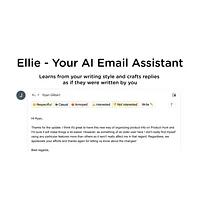
Ellie is a free AI email assistant that learns your writing style from past replies and drafts personalized responses you can review before sending. Compared with Atomic Mail's privacy-first but minimal inbox, Ellie layers intelligence on top of whatever mailbox you already use, which makes it a good fit for users who want AI drafting without migrating email providers.
Eloquens AI
Eloquens AI is a free intelligent email assistant that automates routine replies and surfaces urgent messages around the clock. Where Atomic Mail emphasizes encryption and a quiet inbox, Eloquens focuses on prioritization and auto-reply, which suits people whose main pain point is triage rather than privacy. This multi-model approach is the main differentiator versus Atomic Mail, which does not offer built-in AI drafting at all, and it appeals to users who care about flexibility and model choice.
Notis
Notis is a free AI intern that captures voice messages across messaging apps and auto-syncs structured notes and tasks to Notion. It sits outside the email client entirely, which makes it complementary rather than overlapping with Atomic Mail, especially for readers who handle most of their follow-ups in chat and need a reliable place to land action items.
Remy - Newsletter summarizer
Remy is a free AI newsletter summarizer that condenses multiple email subscriptions into a single daily digest. For Atomic Mail users drowning in newsletters, Remy tackles the inbound problem directly by reducing volume, while Atomic Mail itself focuses on the storage and privacy layer underneath. Pairing the two is a realistic path for readers who want both encryption and a quieter inbox. For context on how newsletter overload has grown industry-wide, Statista's e-mail usage research tracks the rising volume of consumer and business mail.
How to choose
If your priority is keeping your current mailbox and adding AI drafting, start with Ellie or hi ai. If urgent message triage is the bigger pain, Eloquens AI is the closest fit. Readers who live in messaging apps and need a place to capture action items should look at Notis, while anyone buried in subscriptions will get the most immediate relief from Remy.
Frequently asked questions
Is there a free Atomic Mail alternative?
Yes. Ellie, Eloquens AI, Notis, and Remy all offer free tiers that cover core functionality, so you can test them before committing to a paid plan.
What is the best Atomic Mail alternative overall?
For most readers the strongest pick is Ellie, because it adds AI drafting on top of your existing mailbox rather than asking you to migrate. Power users who want model flexibility often prefer hi ai instead.
Do these alternatives replace my current email provider?
Most of them work alongside Gmail, Outlook, or any IMAP mailbox, including Atomic Mail. Notis is the exception, since it focuses on voice messages in chat apps rather than email itself.
Can I keep using Atomic Mail for privacy while adding AI features?
Yes. Tools like Remy and Ellie can be configured to read from a connected mailbox, and you can keep Atomic Mail as your storage layer for sensitive correspondence while routing high-volume work elsewhere.
Which alternative is best for newsletter overload?
Remy is purpose-built for newsletter summarization and is the most direct answer if subscription email is your main source of inbox stress.
Each of these tools targets a different inbox problem, so the right pick depends on whether you want smarter replies, better triage, or simply fewer emails to read. Start with the free options, send a few real messages through them, and keep the one that feels closest to how you already work.