BotX is an AI agent platform that helps teams build, deploy, and manage automated workflows and chatbots without deep engineering work. It suits users who want a single dashboard for connecting models, data, and channels. Even so, some teams look elsewhere for cheaper entry tiers, broader platform support, hosted infrastructure, or specialized capabilities such as persistent memory or high-volume inference.
Why look for a BotX alternative?
BotX covers a lot of ground, so most switching decisions come down to fit rather than a missing core feature. Some teams need deployment and security handled for them instead of configured manually. Others want a Telegram-first experience, raw model access for custom pipelines, or infrastructure designed specifically for long-running memory across agents. Pricing models also vary: per-seat SaaS fees, per-token inference, or one-time paid tools each appeal to different budgets.
It is worth comparing alternatives because the AI agent space is fragmented. A platform optimized for sales workflows may not suit a developer building bespoke multi-agent systems, and vice versa. The right alternative depends on whether you value convenience, specialization, or control more.
What to look for in a BotX alternative
Deployment model
Decide whether you want a self-service builder like BotX, a fully hosted agent platform where infrastructure is managed for you, or a lower-level service such as an inference API or memory layer. Each model trades control for convenience differently. Per Gartner's coverage of AI agents, enterprise buyers increasingly prefer platforms that abstract operational concerns while keeping data flows transparent.
Channel and surface area
If your agents primarily live in Telegram, Slack, Discord, or a custom web embed, choose a platform that targets that surface natively. Tools built for a specific channel generally ship with better defaults than general-purpose builders retrofitted to it.
Pricing transparency
SaaS subscriptions, pay-per-token inference, and one-time paid apps behave very differently at scale. Look for clear per-unit pricing and a free tier or trial so you can validate the workload before committing. According to Forrester, unpredictable inference costs remain one of the top causes of AI project budget overruns.
Extensibility and integrations
Check for the integrations you already use: vector databases, CRMs, ticketing, webhooks, and SDKs in your preferred language. A platform with a clean API and sensible defaults usually outlasts one with a flashy demo but shallow connectors.
The best BotX alternatives
KiloClaw
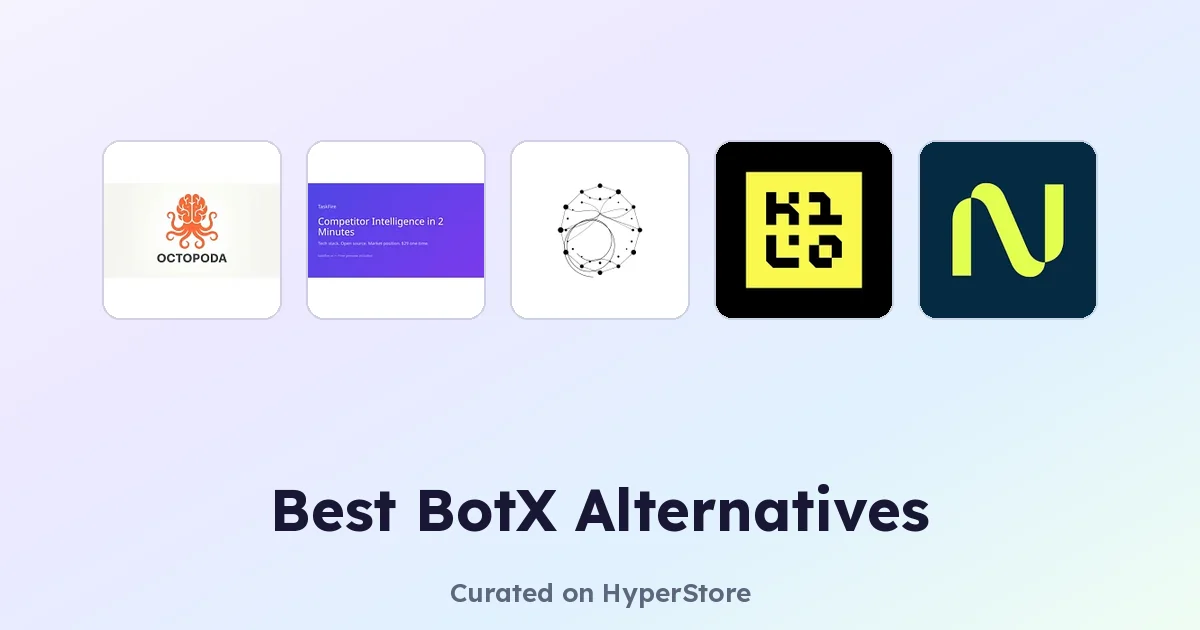
KiloClaw is a hosted AI agent platform that deploys OpenClaw with automated infrastructure, security patching, and updates handled for you. Where BotX gives you a builder to assemble agents yourself, KiloClaw removes the operational layer entirely, which suits teams that want production agents running quickly without managing servers. It is a paid service, so cost-conscious hobbyists may prefer a free alternative, but for lean teams the trade-off in exchange for managed hosting is often worth it.
Nanoswarm: OpenClaw App
Nanoswarm: OpenClaw App creates personalized AI agents for Telegram with a one-click setup and room for advanced customization. Compared to BotX, it is narrower in scope but deeper where it matters: if your community lives in Telegram, the onboarding path is faster and the defaults are tuned for chat rather than for general workflow automation. It is free to use, making it a strong pick for community-run projects and small teams exploring agent ideas.
Nebius Token Factory
Nebius Token Factory delivers enterprise-grade LLM inference with transparent per-token pricing and autoscaling throughput. It is not a builder like BotX, so it suits engineering teams that already know how to wire agents together and simply need a reliable inference backend. The transparent pricing and autoscaling make it a good fit when usage is spiky or hard to forecast, and a free tier is available for evaluation.
Octopoda
Octopoda provides persistent memory infrastructure for AI agents, with knowledge retention and semantic search across complex multi-agent systems. Where BotX handles agent orchestration at a higher level, Octopoda solves a specific problem BotX users often hit: agents that forget context between sessions or across agents. It is free to try and slots neatly underneath any agent platform that exposes a memory hook.
TaskFire
TaskFire is an AI-powered service for rapid competitor analysis, SEO briefs, and data cleaning, delivered as outputs rather than conversational chat. Compared to BotX's generalist approach, TaskFire is opinionated and task-focused, which suits marketing and research teams that want finished deliverables instead of an agent to talk to. It is a paid tool, so the value holds up best for teams running these workflows weekly rather than occasionally.
How to choose
If you want managed infrastructure and faster time-to-production, KiloClaw is the closest fit. For Telegram-native communities on a free budget, go with Nanoswarm. Engineering teams that already build their own orchestration should look at Nebius Token Factory for inference and Octopoda for memory. Finally, if your priority is finished research and SEO outputs rather than chat, TaskFire is the more specialized pick.
Frequently asked questions
Is there a free BotX alternative?
Yes. Nanoswarm: OpenClaw App, Nebius Token Factory, and Octopoda all offer free tiers or free usage on HyperStore, depending on your workload and scale.
What is the best BotX alternative?
It depends on your scenario. KiloClaw is the strongest pick for managed hosting, Nebius Token Factory for raw inference, and Octopoda for persistent agent memory.
Which BotX alternative is best for Telegram?
Nanoswarm: OpenClaw App is built specifically for Telegram and is the most direct fit if your agents live in that channel.
Do these alternatives require coding?
KiloClaw, Nanoswarm, and TaskFire aim for low-code or no-code users. Nebius Token Factory and Octopoda are more developer-oriented and work best with custom integration code.
Can I combine more than one alternative with BotX?
Yes. Many teams pair BotX with a specialty service such as Octopoda for memory or Nebius Token Factory for inference, using each tool where it is strongest.
BotX remains a capable all-rounder, but the alternatives above each address a specific weakness: hosting, channel fit, inference cost, memory, or task automation. Skim the criteria, pick the tool that maps to your biggest pain point, and try the free options before committing.