Chattitude is an AI chatbot platform that helps businesses automate conversations with their customers, typically across web or messaging channels. Many teams start with Chattitude for its straightforward setup, then look for alternatives when they need deeper integration options, different pricing tiers, a more specialized use case (such as lead routing or knowledge retrieval), or simply want to compare capabilities before committing to a long-term vendor.
Why look for a Chattitude alternative?
The most common reasons teams evaluate Chattitude alternatives are pricing and value. Chatbot platforms vary widely in how they charge per conversation, per user, or per integration, and a setup that felt affordable at launch can become expensive as volume grows. Feature gaps are another driver: some teams want richer analytics, multilingual support, voice channels, or deeper CRM connectors that their current tool doesn't expose.
Beyond price and features, some shoppers simply want a more focused product. General-purpose chatbot builders compete with niche tools aimed squarely at lead capture, appointment booking, customer support, or internal knowledge management, and those purpose-built options often do their one job better than a swiss-army-knife alternative. Compatibility with existing stacks (WhatsApp, Shopify, HubSpot, custom CRMs) and data-residency requirements also push teams to compare options before renewing.
What to look for in a Chattitude alternative
Deployment channels and integrations
Make sure the tool supports the channels your customers actually use. A web widget is table stakes; check whether the platform also extends to WhatsApp, SMS, Instagram, Messenger, or mobile apps. Equally important are the integrations on the back end — your CRM, helpdesk, calendar, or e-commerce platform. The best chatbot tools offer native connectors rather than demanding custom API work, and they publish a clear integrations roadmap.
No-code builder and ease of editing
If your team isn't engineering-heavy, the visual builder matters more than raw model flexibility. Look for drag-and-drop flows, version history, preview environments, and the ability for non-technical teammates to update copy and intents without a redeploy. Platforms that expose a clean testing console reduce the risk of shipping broken conversations.
Pricing transparency and usage limits
Chatbot pricing often hides the real cost in conversation caps, seat fees, or per-resolution charges. Compare what's included at each tier, what counts as a "conversation" or "session," and how overage is billed. A cheaper headline price can be costlier than a pricier plan once you model realistic traffic.
AI quality and control
Not all AI chatbots are built on the same underlying models or with the same guardrails. Look for tools that let you choose or swap models, ground answers in your own knowledge base, and show citations or confidence scores when accuracy matters. For regulated industries, audit logs and data-handling documentation are essential.
The best Chattitude alternatives
88Agents
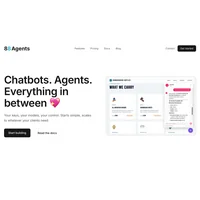
88Agents focuses on multi-channel AI chatbot deployment with flexible model selection, making it a strong Chattitude alternative for teams that want to plug different LLMs into different bots. It suits organizations with varied use cases — sales, support, internal IT — that need each assistant tuned to its own model rather than a one-size-fits-all setup. If your main frustration with Chattitude is being locked into a single model provider, 88Agents' flexibility is worth evaluating.
AccuChats
AccuChats is built for teams that care more about answer accuracy than conversation flair. It delivers cited responses with confidence scoring, which makes it well suited to support-heavy sites, internal knowledge portals, and any use case where I'm not sure" is a more valuable answer than a confident hallucination. Compared with Chattitude, it's a better fit when factual precision and traceability outweigh conversational personality.
BabyMealBot
BabyMealBot is a specialized WhatsApp assistant that validates and adapts baby food recipes from social media into safe, nutritionally sound meal suggestions. It's a niche tool, but it shows how focused single-purpose chatbots can outperform general platforms inside their domain. If Chattitude feels too generic for a very specific audience you're trying to serve, a vertical product like BabyMealBot is the kind of bet worth testing.
Recall
Recall is less a customer-facing chatbot and more a personal knowledge layer: it automatically summarizes online content and builds a searchable knowledge base so you can retain and connect information over time. It suits researchers, analysts, and knowledge workers who need an AI companion for their own reading rather than a widget on a website. Consider Recall alongside Chattitude if your real goal is internal knowledge management dressed up as "chatbot."
Site2CRM
Site2CRM leans hard into one job: turning website conversations into qualified CRM contacts. It automates lead capture and synchronizes data with AI-powered intelligence, so conversations don't end at the chat window. For sales-led teams frustrated that Chattitude captures chats but not clean pipeline data, Site2CRM is the more revenue-focused swap.
Suppa
Suppa is a no-code AI chatbot builder that deploys assistants across web and mobile without writing code. Its strength is the visual authoring experience, which is friendly to marketers and ops folks who need to iterate on flows themselves. If Chattitude's editor feels too developer-oriented for your team, Suppa is worth a hands-on test.
TalkWiz.ai
TalkWiz.ai automates lead appointment booking through AI-powered SMS conversations that qualify and schedule meetings around the clock. It's purpose-built for service businesses — agencies, clinics, consultants — where the bottleneck is getting prospects onto a calendar, not answering FAQs. Compared with Chattitude's broader scope, TalkWiz.ai trades flexibility for a tighter booking funnel.
How to choose
Map your pick to the problem that actually pushed you off Chattitude. If pricing or model lock-in is the issue, start with 88Agents for LLM flexibility. If factual accuracy matters most, try AccuChats. For sales pipelines, Site2CRM and TalkWiz.ai are the most revenue-focused options; pair them depending on whether you need CRM sync or appointment booking. If your team is non-technical, Suppa offers the smoothest no-code path. And for internal knowledge work rather than customer chat, Recall solves a different problem entirely — confirming it's the right category is worth doing first.
Frequently asked questions
Is there a free Chattitude alternative?
Several options on this list are free to start, including 88Agents, AccuChats, Site2CRM, Suppa, and TalkWiz.ai. "Free" usually means a working tier with usage limits; expect paid plans once conversation volume, seats, or advanced features come into play.
What is the best Chattitude alternative?
It depends on what you're optimizing for. For general customer chat, Suppa and 88Agents are the closest all-rounders. For revenue-focused teams, Site2CRM or TalkWiz.ai will beat a generic builder.
Which Chattitude alternative is best for no-code teams?
Suppa is built explicitly for no-code deployment across web and mobile. If your team has zero engineering support, it's the lowest-friction swap.
Which Chattitude alternative is best for lead capture?
Site2CRM is purpose-built for automated lead capture and CRM sync. If appointment booking is the real goal, TalkWiz.ai is the more specialized choice.
How do Chattitude alternatives handle AI model choice?
Most expose at least one default LLM, and a few — notably 88Agents — let you select different models per bot. If model flexibility is non-negotiable, that's the most important question to ask any vendor before signing up.
Whichever direction you go, run a short pilot with real conversations from your own traffic before committing to an annual contract. The best chatbot platform is the one your customers actually finish a conversation on, and that's hard to judge from a demo alone.