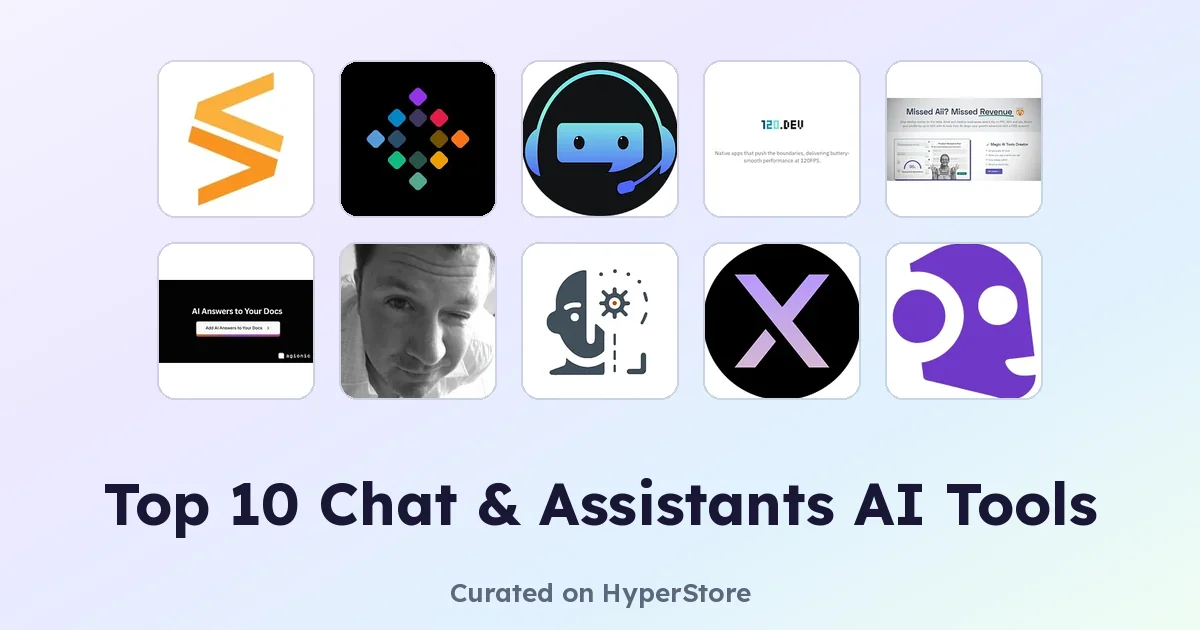
Automation and agent-based AI tools are reshaping how teams ship work, from fully autonomous coding assistants to no-code chatbot builders that handle customer interactions around the clock. The best automation & agents AI tools on HyperStore span enterprise ML platforms, agent identity layers, documentation assistants, and omnichannel support systems, so there is genuinely something here for engineers, product teams, and support leaders alike. This ranking reflects what is most popular and best rated by the HyperStore community right now, not a paid promotion. Every entry below is currently live and free or freemium to try, which makes the list a practical starting point for evaluation.
How we ranked them
We sorted these automation and agent tools by a blend of HyperStore popularity signals (installs, active users, recent traffic) and verified user ratings, then broke ties using category relevance. Tools that combine strong reviews with a generous free tier floated toward the top, since accessibility matters when you are still comparing options. No vendor paid for placement, and the order you see is the order they qualified for.
The top automation & agents AI tools
1. Abacus
Abacus is an applied AI platform focused on automating the building of AI agents and predictive systems at scale, which is why it takes the number one slot. It targets teams that want production-grade ML and agent orchestration without hand-stitching every pipeline, and it ships with a freemium tier so smaller teams can experiment before committing. The combination of predictive systems and agent workflows under one roof is what separates it from the narrower tools further down the list.
2. Agen
Agen is a fully autonomous AI coding agent that writes, tests, and deploys code without requiring a local setup or IDE intervention. It earns the second spot because developer-facing automation has the highest demand signals on HyperStore, and Agen's zero-install promise removes the friction that usually blocks adoption. For solo developers and small engineering teams, it is one of the closest things to handing a ticket off to a colleague.
3. AgentID
AgentID gives AI agents a persistent identity and shared memory layer that works across platforms, and it advertises up to a 65% reduction in token overhead. That infrastructure angle is increasingly important as enterprise agent deployments grow, because without shared state you end up re-prompting the same context repeatedly. Its free tier and developer-friendly positioning push it into the top three.
4. Agentplace
Agentplace is a no-code platform for building AI-powered interactive websites using GPT-4o conversational intelligence, which means non-technical teams can launch agent-driven sites in an afternoon. It lands at number four because the no-code site-builder niche is crowded, and Agentplace stands out by combining GPT-4o with a publishing flow aimed at interactive sites rather than a sidebar chat widget. If your automation goal is a public-facing agent experience without engineering help, it is a strong starting point.
5. Agent.so
Agent.so lets you build and train custom AI agents through a drag-and-drop interface, making it accessible to operators who have never written a prompt chain. It ranks fifth because usability carries real weight in a category dominated by developer tooling, and Agent.so keeps the learning curve gentle. Teams that need bespoke agents for internal workflows will appreciate how quickly they can iterate.
6. AgentX
AgentX is a no-code AI chatbot builder focused on letting users create, customize, and deploy intelligent agents in minutes. It earns sixth by zeroing in on the most common agent use case, customer-facing chat, and executing it cleanly. Pricing is free to start, which keeps it competitive against bigger platforms with slower onboarding.
7. Agionic
Agionic turns your existing documentation into an intelligent AI assistant, with instant deployment and live content synchronization so the agent never drifts out of date. Documentation-driven agents are a fast-growing segment because they turn knowledge bases into self-service tools, and McKinsey's research on applied AI consistently highlights support and knowledge retrieval as the highest-ROI entry points. Agionic's live sync is the differentiator that earned it this slot.
8. Aii
Aii embeds AI-powered chatbots and forms directly into your website to lift conversions and capture leads, which is the classic growth-team automation play. It ranks eighth because conversion-focused chat is a well-served niche, but Aii keeps the integration light and the free tier usable for small businesses. If your automation priority is pipeline rather than support deflection, this one belongs on your shortlist.
9. AI Omnichannel Customer Support Platform by BlueTweak
BlueTweak's AI Omnichannel Customer Support Platform unifies email, chat, social media, and phone into a single intelligent system, which is why it earns ninth despite being a paid tool. Support automation is one of the most measurable agent categories, and omnichannel routing is exactly what growing operations need once chat alone stops scaling. It is the only fully paid entry in the top ten, but the breadth justifies the spend for serious support teams.
10. AI Phone Number | ChatOdyssey
AI Phone Number by ChatOdyssey provides intelligent phone number service with AI-powered call handling and round-the-clock availability, rounding out the list at number ten. Voice-based agent automation is the newest frontier in this category, and ChatOdyssey is one of the earlier accessible entries on HyperStore. It is a useful pick for small businesses that want to sound bigger than they are without staffing a 24/7 phone team.
How to choose
Start with the workflow you want to automate rather than the tool. Engineers building software should look first at Agen and AgentID for agent infrastructure, while growth and marketing teams will get the fastest return from Aii or Agentplace. Support leaders running multi-channel operations should shortlist BlueTweak and ChatOdyssey, and teams buried in documentation will find Agionic almost purpose-built. If you want breadth across ML, predictive systems, and agents under one roof, Abacus is the most general-purpose choice on the list.
Frequently asked questions
What are automation and agents AI tools?
Automation and agents AI tools are software that uses large language models and other AI techniques to complete tasks, make decisions, or carry conversations with minimal human supervision. Unlike classic RPA bots, modern agent tools can reason about goals, use other tools, and adapt their behavior as context changes.
Are these tools safe to use in production?
Most tools in this category are used in production today, but safety depends on your data handling, identity, and access controls. Look for platforms that offer role-based permissions, audit logs, and clear data retention policies before connecting them to customer-facing systems.
Do I need to know how to code to use these tools?
Several entries on this list, including Agent.so, AgentX, and Agentplace, are explicitly no-code and target non-developers. Others, like Abacus and AgentID, are aimed at technical teams building agent infrastructure. Pick based on whether your bottleneck is engineering capacity or business process design.
How is this list different from a general AI tools ranking?
This ranking is scoped to automation and agents specifically, so writing assistants, image generators, and standalone LLMs are excluded even if they rank highly elsewhere. Every tool here is judged on how well it performs work or carries out a task with limited human input.
Will these tools replace human workers?
In practice they tend to absorb repetitive, high-volume tasks and free people up for exceptions, judgment calls, and creative work. The strongest deployments pair agents with humans rather than substituting one for the other entirely.
That wraps up our ranked look at the best automation & agents AI tools available on HyperStore right now. Bookmark the list, run a quick pilot with two or three picks from your shortlist, and let real usage data decide which one earns a permanent seat in your stack.