MiniMax Agent is an autonomous AI assistant that plans and executes multi-step tasks, from research and file handling to web browsing and code generation, through a single conversational interface. Many readers start exploring MiniMax Agent alternatives once their needs outgrow a generalist agent: tighter pricing, deeper integrations with a specific channel, or a tool built around one workflow. The list below covers the top alternatives currently listed on HyperStore, mixing free browser-side helpers, hosted agent platforms, and specialized task services.
Why look for a MiniMax Agent alternative?
Like most generalist agents, MiniMax Agent makes tradeoffs by design. Heavy users hit subscription tiers faster than they expected, and teams that already live inside one app (a browser, a messenger, a project board) often want an agent that lives there too rather than a separate chat surface. Some teams also want specialized depth: a writer's assistant baked into every textbox, a competitor-analysis engine that skips the chat step entirely, or a hosted deployment of a specific open-source agent like OpenClaw.
Others simply prefer not to be locked to one vendor's roadmap. Pricing changes, model swaps, and shifts in tool-use capabilities are all common reasons readers start browsing the alternatives category, and most options below offer a meaningfully different shape of product rather than a near-clone.
What to look for in a MiniMax Agent alternative
Channel and integration fit
Decide where the agent needs to live before you compare feature lists. A browser extension surfaces help inside every textbox on the web, while a hosted agent platform gives you an API and dashboard for embedding automation into a product. Messenger-native tools drop into Telegram or Slack where your team already works. Picking the right surface usually matters more than raw model quality, because the best agent is the one your team actually opens.
Pricing model and usage ceilings
Per-seat subscriptions, usage-based token charges, and flat-rate hosting each create very different cost curves. A freelancer running a few prompts a week has different economics than a business running thousands of agent calls per day. Look past the headline monthly fee and check what counts as a task, whether model selection is included, and what happens when you exceed limits.
Customization and model flexibility
Some alternatives lock you to a single model, while others let you route between providers or fine-tune behavior. If you already have a preferred model or want to swap as the market shifts, prioritize platforms that expose model selection. If you would rather not think about models at all, a curated single-model tool will feel simpler. For broader context on how teams are adopting and mixing models, Gartner's AI research tracks enterprise adoption patterns over time.
Setup, hosting, and ownership
Browser extensions install in seconds and run locally. Hosted agent platforms take minutes and run on the vendor's infrastructure. VPS-deployed agents give you full control but require you to manage updates and security. Match the deployment model to your team's capacity, since an unmanaged server is rarely worth the savings if nobody has time to patch it.
The best MiniMax Agent alternatives
88Agents
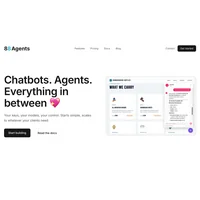
88Agents is positioned as a multi-channel chatbot builder rather than a single chat-surface assistant, making it a better choice when you need an agent that lives across web, messaging, and social touchpoints at once. Flexible model selection keeps you from being tied to one provider, which is useful for teams that want to mix strengths across tasks. Compared with MiniMax Agent, it trades the all-in-one chat interface for an orchestration layer that fits customer-facing deployments. Pricing on HyperStore is listed as free, which suits smaller deployments and trials.
Clico
Clico is a lightweight browser extension that brings AI writing assistance directly into the textboxes you already use, from email and docs to social posts and forms. It suits users who want help while they type rather than a separate chat app to switch into, and the install is essentially friction-free. Against MiniMax Agent, Clico gives up multi-step autonomous workflows in exchange for being available everywhere you write. It is listed as free on HyperStore, which makes it a low-risk starting point.
KiloClaw
KiloClaw hosts OpenClaw as a managed service, handling the infrastructure, security patches, and updates so you do not have to run your own server. It is a better fit than MiniMax Agent for teams that specifically want OpenClaw's agent framework but lack DevOps time to maintain it. Pricing is listed as paid, which funds the managed infrastructure and ongoing maintenance. If your bottleneck is getting OpenClaw running in production quickly, KiloClaw removes most of the setup work.
MyClaw.Host
MyClaw.Host is similar in spirit to KiloClaw but focuses on one-click VPS deployment, so you keep an actual server under your account while skipping the manual provisioning steps. It suits users who want the control of a VPS with root access, dedicated resources, and predictable performance, but who do not want to handle cold-start setup themselves. Compared with MiniMax Agent, it is a more technical product aimed at developers and small teams. Pricing is listed as paid, with the VPS subscription bundled into the service.
Nanoswarm: OpenClaw App
Nanoswarm takes OpenClaw and packages it as a one-click Telegram agent with customization options layered on top. It is a good fit for individuals or communities who already coordinate in Telegram and want an agent that responds inside that chat. Versus MiniMax Agent's web-first chat surface, Nanoswarm trades dashboard depth for native messaging presence and a lower-friction setup. It is listed as free on HyperStore, which lowers the cost of trying a Telegram-native workflow.
TaskFire
TaskFire skips the chat interface entirely and delivers finished deliverables such as competitor analyses, SEO briefs, and data cleaning as on-demand services. It suits readers who treat AI as a contracted service rather than a conversation partner, especially marketers and analysts who want a clean output rather than a transcript. Compared with MiniMax Agent, you give up the back-and-forth editing in exchange for a more opinionated, output-first workflow. Pricing is listed as paid, which covers the human-in-the-loop review that gives the deliverables their polish.
How to choose
If you need an agent everywhere you already write, start with Clico. If you want a hosted OpenClaw deployment without managing infrastructure, pick between KiloClaw for fully managed and MyClaw.Host for one-click VPS. For Telegram-native agents, Nanoswarm is the most direct fit. For multi-channel chatbot deployments, 88Agents is purpose-built. And if you prefer finished outputs over chat sessions, TaskFire is the closest match to that workflow.
Frequently asked questions
Is there a free MiniMax Agent alternative?
Yes. Clico is free and runs as a browser extension, Nanoswarm offers a free Telegram agent, and 88Agents is listed as free on HyperStore. Each covers a narrower use case than MiniMax Agent, so the right pick depends on where you want the help to appear.
What is the best MiniMax Agent alternative?
There is no single best alternative because the products serve different shapes of work. For hosted OpenClaw, KiloClaw and MyClaw.Host are the closest matches. For writing help in any textbox, choose Clico. For Telegram, Nanoswarm. For multi-channel chatbots, 88Agents. For finished deliverables, TaskFire.
Can I self-host a MiniMax Agent alternative?
Yes. The OpenClaw-based options on this list (KiloClaw, MyClaw.Host, and Nanoswarm) are all built around the OpenClaw framework, which is designed for self-hosting. MyClaw.Host gives you the most direct VPS route, while KiloClaw handles the server work for you.
How do MiniMax Agent alternatives handle pricing?
Models vary. Clico, 88Agents, and Nanoswarm are listed as free on HyperStore, while KiloClaw, MyClaw.Host, and TaskFire are listed as paid. Always check the current pricing page on each listing, since free tiers often have usage caps and paid tiers usually scale by tasks, seats, or infrastructure.
Are these alternatives secure?
Security posture varies by deployment model. Browser extensions like Clico run client-side, while hosted platforms like KiloClaw and VPS deployments like MyClaw.Host shift responsibility to the vendor or your own server config. Review each tool's security documentation and data-handling policy before sending sensitive data through any agent.
The agent market is moving quickly, so it helps to track independent analysis like McKinsey's AI insights when comparing vendor roadmaps over time.