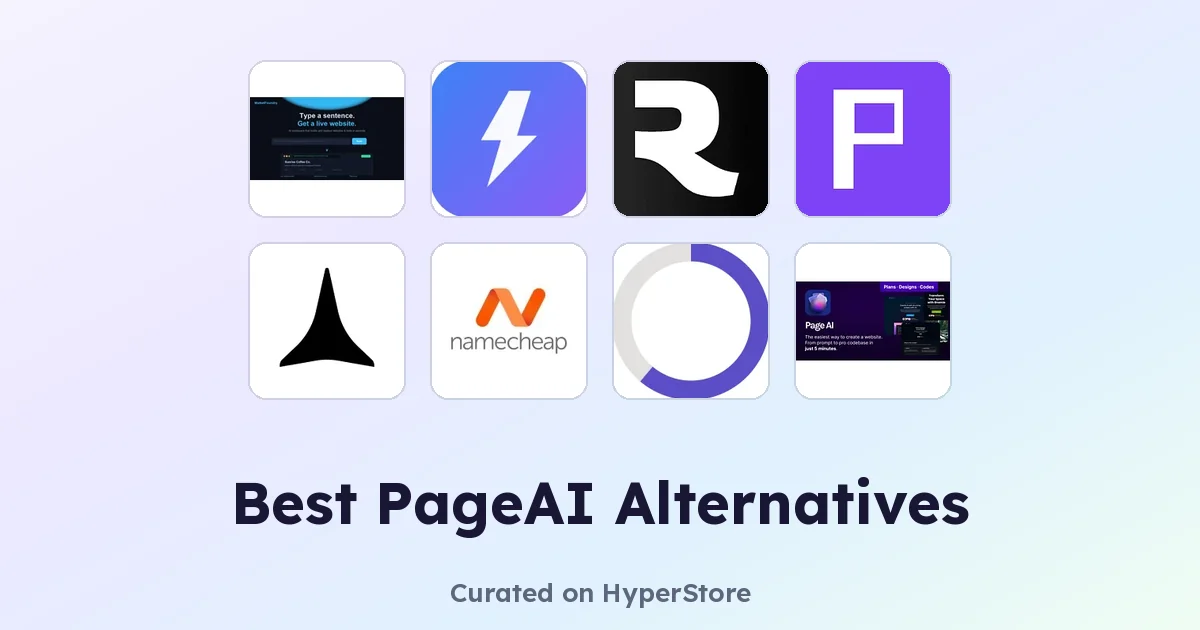
PageAI is an AI-powered platform that turns written prompts into working websites and lightweight apps, letting non-developers ship a product without touching a framework. It works well for quick prototypes, but builders often start weighing PageAI alternatives when pricing tiers grow faster than the project, when they need capabilities the core tool doesn't offer, or when the platform's output doesn't match the kind of site they're trying to ship. The right swap depends on whether you want a generalist builder, a marketing site generator, or something more specialized.
Why look for a PageAI alternative?
Most people arrive at PageAI for the same reason they try any AI builder: speed. The tool takes a few sentences and turns them into a deployed, interactive surface, which is a genuinely useful shortcut. The cases where teams look elsewhere usually fall into a few predictable buckets, like needing hosting and domain handling in one step, wanting better SEO defaults baked in, or hitting ceilings on database-driven features once the project gets past a prototype.
A second reason is fit. AI app builders are not interchangeable. Some are tuned for landing pages and marketing copy, others for full-stack apps with user accounts, and others for static, fast-loading sites that rank well in search engines. Knowing which scenario you're actually solving for matters more than which tool has the slickest demo.
What to look for in a PageAI alternative
Generation model and output quality
The "AI" in AI builder is not all the same engine. Some platforms lean on chat-style iteration, others on structured prompts that produce clean static HTML. Look at what the output actually is: a single-page prototype, a multi-page site, or a deployable app with routes and a database. The clearer the contract, the less you'll have to rewrite later.
Hosting, domains, and deployment
A builder that ends at code forces you to find your own host. A builder that ships with hosting and domain integration gets you from prompt to production in one step. The no-code development platform category has grown rapidly precisely because deployment depth, not just generation capability, is now a baseline expectation.
SEO, performance, and analytics
Generation is half the job. The other half is whether the result ranks, loads fast, and can be measured. Static HTML output, structured metadata, and lightweight, often cookie-free analytics have become differentiators that matter the moment you go public with a site. Mozilla Developer Network publishes widely used guidance on performance and accessibility defaults that any AI builder should respect.
Pricing and lock-in
Free tiers are common; what differs is what stays free after launch. Look for transparent limits on hosting bandwidth, custom domains, and number of projects, and confirm that you can export your code or content if you decide to move platforms. Builders that make exporting a paid feature tend to be the ones you most wish you'd left earlier.
The best PageAI alternatives
Base44
Base44 is an AI-powered platform that simplifies app development by allowing users to create functional applications with natural language descriptions. Where PageAI focuses on conversational site building, Base44 leans into full app generation from prompts, which suits builders who want logic and interactivity without wiring up a backend themselves. It's a good fit for solo founders prototyping internal tools or simple SaaS ideas before committing engineering hours.
MarketFoundry AI Workspace
MarketFoundry AI Workspace instantly generates professional websites and digital presence without coding or design skills required. It pairs well as a PageAI alternative when the goal is a polished marketing surface, not an interactive app. Small businesses and consultants who need to stand up a credible web presence quickly will get more value here than from a developer-oriented builder.
Pagesmith.ai
Pagesmith.ai is an AI agent that builds SEO-optimized, production-ready websites using clean static HTML for instant load times. While PageAI handles general-purpose generation, Pagesmith is opinionated about static output and search visibility, which makes it a strong swap for content-led sites that need to rank. Performance-minded teams tired of bloated AI sites will appreciate the focus on lean output and structured metadata.
Rocket
Rocket transforms a single prompt into a fully functional, production-ready application with integrated backend and database. It's the heavier alternative on this list, closer to PageAI's full-app ambitions but with more infrastructure included out of the box. Choose Rocket when you know you'll need authentication, persistent data, and a real backend from day one rather than retrofitting them later.
RYPL
RYPL automates Facebook Page management with AI-powered replies, sentiment analysis, and smart moderation to boost engagement. It isn't a like-for-like PageAI replacement; it's a focused tool for social media operations. Reach for it once your site is live and you need to keep a Facebook Page responsive without staffing it manually.
Sleek Analytics
Sleek Analytics is a lightweight, privacy-first web analytics platform that tracks visitors without cookies or consent banners. It complements rather than competes with PageAI, but many users adopt a dedicated analytics tool the moment they ship a generated site. It's the right pick if you've just launched and want traffic insight without the GDPR overhead of a heavyweight analytics suite.
WebZum
WebZum transforms AI-generated website concepts into fully deployed, production-ready sites with built-in hosting and domain integration. As a PageAI alternative, it's strongest when you want one tool to take a site all the way to a custom domain, with no separate hosting decisions to make. Marketers and small teams who value prompt-to-live-URL in a single step will find WebZum's model appealing.
How to choose
Pick the alternative whose center of gravity matches your project. For SEO-heavy marketing sites, Pagesmith.ai or MarketFoundry AI Workspace are the most direct swaps. For full apps with backends, Rocket is the closest sibling. Choose Base44 if you're prototyping internal tools, WebZum if end-to-end deployment matters most, Sleek Analytics if your main gap is measurement, and RYPL once social moderation becomes the bottleneck.
Frequently asked questions
Is there a free PageAI alternative?
Yes. Several PageAI alternatives on HyperStore, including Base44, MarketFoundry AI Workspace, Pagesmith.ai, Rocket, RYPL, and WebZum, are available as free tools, though usage caps, project limits, or feature restrictions typically apply on free tiers.
What is the best PageAI alternative?
There is no single winner. For general app building, Rocket and Base44 are the strongest PageAI alternatives because they handle interactive apps with backends. For content-first sites, Pagesmith.ai is hard to beat.
Which PageAI alternative is best for SEO?
Pagesmith.ai is built specifically around SEO-optimized static HTML output, which gives it an edge over more general PageAI alternatives for search performance. Pairing it with Sleek Analytics' cookie-free tracking covers measurement without consent banner overhead.
Can I switch from PageAI without losing my site?
In most cases yes, because the underlying code or exported HTML can typically be moved to another host. Before switching, confirm that your chosen PageAI alternative supports importing your existing content, themes, or code so you don't have to rebuild from scratch.
Do PageAI alternatives support custom domains?
Hosting and domain handling vary by tool. Platforms like WebZum include domain integration out of the box, while lighter builders may leave you to configure DNS yourself. Treat domain support as a checklist item when comparing, rather than assuming it ships by default.
The right builder is the one that matches where your project actually sits today, whether that's a landing page, a content site, or a full web app. Shortlist two or three of the alternatives above and prototype the same idea side by side; the comparison will quickly make the right fit obvious.