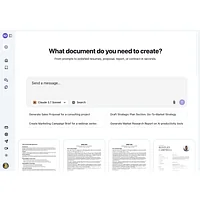
Safe Appeals is an AI-powered writing assistant built to help users draft appeal letters for denied insurance claims, medical bills, and similar disputes. It focuses on a narrow but high-stakes job: turning a denial into a well-argued letter without staring at a blank page. People shopping for Safe Appeals alternatives usually want broader drafting power, lower subscription cost, or tools that handle more than just appeals.
Why look for a Safe Appeals alternative?
Most users find Safe Appeals after a denial arrives and they need to act quickly. The tool does a credible job on appeals, but that same narrow focus can become a constraint. If your week also includes meeting notes, contract reviews, client emails, or internal memos, an appeals-only assistant leaves gaps that force you to juggle multiple subscriptions.
Price is another common reason. A specialty tool that addresses one recurring need still costs the same each month as a general AI document platform that covers appeals plus dozens of other tasks. Platform fit matters too: some users want a browser extension, a desktop editor, or a tool that plugs into Google Drive rather than a standalone web app.
What to look for in a Safe Appeals alternative
Scope of writing tasks
Decide whether you only need appeal letters or also handle meeting notes, contracts, cover letters, and client communications. A narrow tool is easier to learn; a broad one can replace several subscriptions and consolidate your drafting workflow.
Quality and tone control
Look for tools that let you set tone, formality, and length, and that produce drafts you can edit rather than accept verbatim. According to Gartner's research on generative AI for content production, output quality varies widely between vendors even when they rely on similar underlying models.
Pricing and free tiers
Confirm whether the free tier actually produces a usable document, whether paid tiers meter by words, documents, or seats, and whether team pricing fits your situation before you commit.
Integrations and platform support
Check that the tool supports the platforms you already use, whether that means a Gmail plugin, a Chrome extension, native desktop apps, or an API. A tool that lives where your documents live removes friction from the writing process.
The best Safe Appeals alternatives
DocNexus
DocNexus is an AI-powered writing platform that collaborates with you to produce professional documents efficiently. Where Safe Appeals narrows in on appeal letters, DocNexus positions itself as a general-purpose drafting partner, making it a stronger fit if appeals are one of many writing tasks you handle each month. A free entry tier makes it easy to evaluate quality before committing to a paid plan.
Kolva
Kolva captures, transcribes, and summarizes meetings directly in your browser at $0.25 per hour of audio. While Safe Appeals starts from a written prompt, much of the real input for an appeal comes from a phone call or recorded conversation with an insurer, and Kolva turns those into structured notes you can paste into your letter. It suits users who need to mine calls for evidence before drafting.
NextDocs.io
NextDocs.io is an AI-native document editor that generates professional slides and documents instantly from simple descriptions. Compared with Safe Appeals' appeal-first template approach, NextDocs.io leans on a description-to-document flow that works for appeals as well as reports, decks, and memos. The free tier suits occasional users who only draft a single appeal or two a year.
Renamer.ai
Renamer.ai intelligently renames bulk files using AI and OCR to transform document chaos into organized archives. It complements Safe Appeals rather than replaces it, since appeals usually require supporting paperwork like EOBs, denial letters, and medical records, and a clean file structure speeds up the drafting process. Worth pairing if your appeal folder has become unmanageable.
The Drive AI
The Drive AI is an AI-powered file system that creates, organizes, and analyzes documents through natural language commands. Where Safe Appeals concentrates on a single output, The Drive AI lets you search across stored documents and pull relevant context into a draft. Strong fit for users with large case folders who want each new appeal informed by past work and policy language.
How to choose
Pick Kolva if your input is a recorded call that needs to become notes before you write. Pick Renamer.ai or The Drive AI if document organization is the real bottleneck. Pick DocNexus or NextDocs.io if you want one tool that drafts appeals alongside other professional writing. Stay with Safe Appeals if you only write appeals and value its focused, single-purpose workflow.
Frequently asked questions
Is there a free Safe Appeals alternative?
Yes. DocNexus, NextDocs.io, and Renamer.ai all offer free tiers on HyperStore that cover basic drafting, generation, and file organization without a subscription.
What is the best Safe Appeals alternative?
For general business writing beyond appeals, DocNexus is a strong default. For document-heavy workflows, The Drive AI offers a file-system-level approach that Safe Appeals does not.
Can AI really write a successful appeal?
AI drafts the structure and language, but success still depends on accurate facts, supporting documents, and a clear statement of the dispute. Treat any AI draft as a starting point you review carefully, and follow the formal appeals process published by your insurer or, where relevant, the consumer guidance maintained by the Federal Trade Commission.
Which alternative is best for teams?
DocNexus and The Drive AI both support team plans with shared workspaces. For meetings-heavy teams that need shared transcripts, Kolva's per-hour pricing fits variable workloads.
Do these alternatives store my documents?
Storage and retention policies vary by vendor. Review each app's data handling and confirm it meets any compliance or privacy requirements before uploading sensitive claim files.
Safe Appeals handles its narrow job well, but the right alternative depends on whether your real friction is broader writing, document organization, or cheaper meeting transcription. Compare each option against the specific pain point in your current workflow before switching.