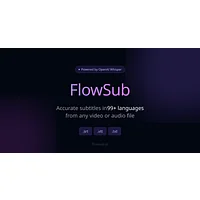
The FlowSub vs D-ID matchup compares two AI video tools that work from opposite ends of the production process. FlowSub is an AI subtitle generator for creators, podcasters, and educators who need captions in several languages from audio or video they already have. D-ID is an AI avatar platform for marketers, learning teams, and developers who want talking-head videos or conversational agents without filming a presenter. Both involve video, but FlowSub captions existing footage while D-ID creates the presenter.
At a glance
FlowSub turns spoken content into timed captions that you can export in several languages. D-ID turns a script or image into a photorealistic talking avatar that delivers the script on camera. Put simply, FlowSub helps finish footage you already shot, while D-ID helps produce footage you haven't shot yet.
What each tool does
FlowSub
FlowSub focuses on one task: generating subtitles from audio or video. Upload a podcast, lecture, or social clip, and its speech recognition returns timed captions that can be exported as SRT, VTT, TXT, or ASS files. Multilingual transcription and translation suit creators who repurpose content for global audiences, and the free tier lets you check accuracy with your own audio before choosing a paid plan. FlowSub is mainly an accessibility and discoverability tool for footage that's already in good shape.
D-ID
D-ID works in the other direction by creating the footage itself. Its Creative Reality Studio turns images or scripts into photorealistic AI avatar videos with lip-synced speech in more than 120 languages. It also supports AI Agents that add real-time conversations for customer support, training, and sales. Integrations with PowerPoint, Canva, and Google Slides, along with a developer API, make D-ID more of a production platform than a captioning tool.
Feature comparison
Core output
FlowSub produces a text file of timed captions for editing software, social uploads, or accessibility workflows. D-ID produces a rendered video or a live interactive agent, with subtitles generated separately or added by the user. FlowSub fits neatly at the end of an existing edit; D-ID can create a presenter for the edit itself.
Language support
Both tools support multilingual work, but they use language in different ways. FlowSub generates captions in several languages, while translation is available on its Pro tier for localization. D-ID creates avatars that speak in 120+ languages, which makes it the more relevant option when the narration needs an on-camera delivery rather than on-screen text.
Accuracy and quality inputs
FlowSub's subtitle quality depends heavily on audio clarity, background noise, and speaker diction. Noisy or poorly recorded audio tends to produce weaker captions. D-ID's avatar quality depends on the resolution of the source image and the effort put into customization. In both cases, clean inputs matter, but at opposite stages of the production process.
Workflow and integrations
FlowSub follows a focused three-step workflow: upload, transcribe, and export. D-ID covers more of the production chain, with slide-deck and design app integrations, an API, and conversational agents for customer-facing use cases. FlowSub makes sense for a quick captioning pass. D-ID is more useful to teams that want to standardize avatar-based communication across marketing, learning and development, and support.
Pricing
FlowSub uses tiered subscriptions and also offers a free tier for trying the platform. Its Pro plans unlock unlimited transcriptions, translations, and additional export options; exact prices are available on FlowSub's site. D-ID is free to start, with paid and enterprise plans based on video volume, agent usage, and API consumption. Its fact sheet notes that costs can be difficult for small businesses or freelancers. FlowSub's free tier is the safer starting point for a tight budget, while organizations comparing subscription fees with the cost of a traditional video shoot need to weigh D-ID's overall value.
Pros and cons
FlowSub
- Exports to SRT, VTT, TXT, and ASS for broad editor and platform compatibility
- Multilingual transcription expands potential audience reach
- Offers a free tier before a paid commitment
- Automates caption generation for a faster workflow
- Accuracy can fall with noisy or unclear audio
- Translation and heavier usage tiers require a Pro subscription
- Doesn't create on-camera video for users who need a presenter
D-ID
- Generates photorealistic talking avatars from images or scripts
- Supports 120+ languages for video and agent output
- Integrates with PowerPoint, Canva, and Google Slides, plus an API
- Supports conversational AI agents with custom knowledge bases
- Avatar customization and brand tuning take time to learn
- Output quality can depend on the input image's resolution
- Pricing may be difficult for small teams and solo freelancers
- Content generation has limited offline functionality
Which should you pick?
If you're a podcaster, educator, or social creator whose main bottleneck is captioning existing recordings, choose FlowSub. It exports subtitles in SRT, VTT, and TXT for YouTube, TikTok, or course platforms. The free tier also lets you check accuracy on your own audio before paying, and the export options fit into editors you may already use.
D-ID makes more sense for marketing, sales, or learning teams that need presenter-led video in many languages without booking a studio. It also works for teams planning to add a conversational agent to a website or product. Slide integrations and the API are especially useful for organizations building avatars into an existing workflow rather than creating one-off clips.
If you need both captions and an avatar, the tools can complement each other. Generate the presenter video with D-ID, then send the finished file through FlowSub to add accessible, translated subtitles before publishing.
Other alternatives on HyperStore
If FlowSub's subtitling focus is part of a wider content workflow, you might also look at HTML Email for templated content or Creative APIs by Picsart for the visual side of video production. Teams interested in D-ID's avatar and interactive approach may want to consider Astrocade, another AI-driven creation platform, while AI Dungeon applies conversational AI in a different setting. For an adjacent AI productivity tool, Superhuman focuses on fast, AI-assisted writing and email.
Frequently asked questions
Is FlowSub or D-ID better for adding subtitles to a video?
FlowSub. It is built for transcription and subtitle export in formats such as SRT and VTT. D-ID focuses on creating avatar video, so subtitles are typically handled separately.
Can D-ID create videos in multiple languages?
Yes. D-ID supports video and real-time agent interactions in 120+ languages, which suits global marketing, training, and support use cases.
Does FlowSub offer a free option?
Yes. FlowSub has a free testing tier. Paid Pro plans add unlimited transcriptions, translations, and more export options.
Which tool is more affordable for freelancers?
FlowSub's free tier and lower-priced entry points are generally easier on a solo budget. D-ID can be more expensive for small businesses or individual freelancers, although it may reduce the need for studio production.
Do FlowSub and D-ID integrate with the same tools?
Not directly. FlowSub centers on file exports for editors and platforms, while D-ID integrates with slide and design tools such as PowerPoint, Canva, and Google Slides and provides an API for custom workflows.
Both FlowSub and D-ID fill distinct roles in HyperStore's AI video category. Your choice depends on whether you need better captions for footage you already have or a virtual presenter for footage you don't.