TinyFish
TinyFish provides serverless AI web agent infrastructure for automating data extraction and workflows across multiple sites at scale.
TinyFish at a glance
- Pricing
- Free — from $15/month
- Rating
- ⭐ 5.0/5 · 2 reviews
- Key strengths
- Serverless architecture eliminates browser and proxy management overhead · Accesses authenticated content, logins, forms, and paywall-protected data · Scales to thousands of concurrent operations through single API
Screenshots
About TinyFish
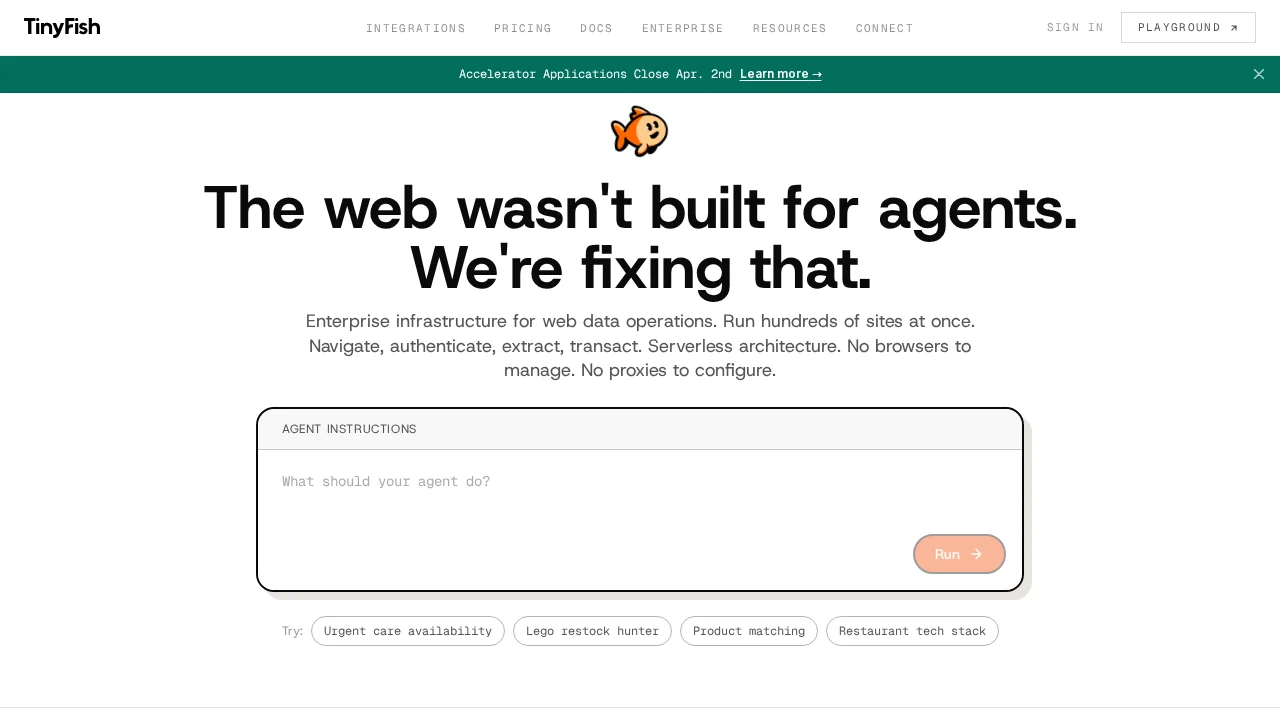
TinyFish delivers enterprise-grade infrastructure purpose-built for AI web agents to navigate, authenticate, extract data, and automate workflows across multiple websites simultaneously. The platform eliminates operational overhead by removing the need to manage browsers, configure proxies, or maintain traditional server infrastructure. Its serverless architecture allows businesses to deploy agents in the cloud and run them unattended while maintaining production-level reliability and performance.
The platform excels at accessing and extracting fresh, real-time data from live websites, including those protected by logins, forms, and paywalls. Unlike traditional web scraping tools, TinyFish combines speed with the ability to handle complex authentication flows and dynamic content. Users can orchestrate thousands of concurrent operations through a single API, making large-scale data collection and automation straightforward and cost-efficient.
TinyFish serves enterprises across healthcare, insurance, retail, financial services, and manufacturing sectors. Common use cases include competitive intelligence monitoring, price tracking, regulatory filing surveillance, and automated workflow execution. The platform's ability to handle authenticated access and paywall-protected content makes it particularly valuable for industries requiring access to restricted or premium web data sources.
Trusted by major enterprises including Google and DoorDash, TinyFish provides the scalable, agentic infrastructure needed to act on web data dynamically. The combination of serverless deployment, API-driven operations, and reliable performance makes it suitable for organizations requiring mission-critical web automation at enterprise scale.
Pros
Cons
Alternatives to TinyFish
ImageToTable.ai
UAE SmartTaxReceipt
docbatch.ai
Context.dev
XCrawl
DescribeThat
Parser by bix-tech.com