Abacus
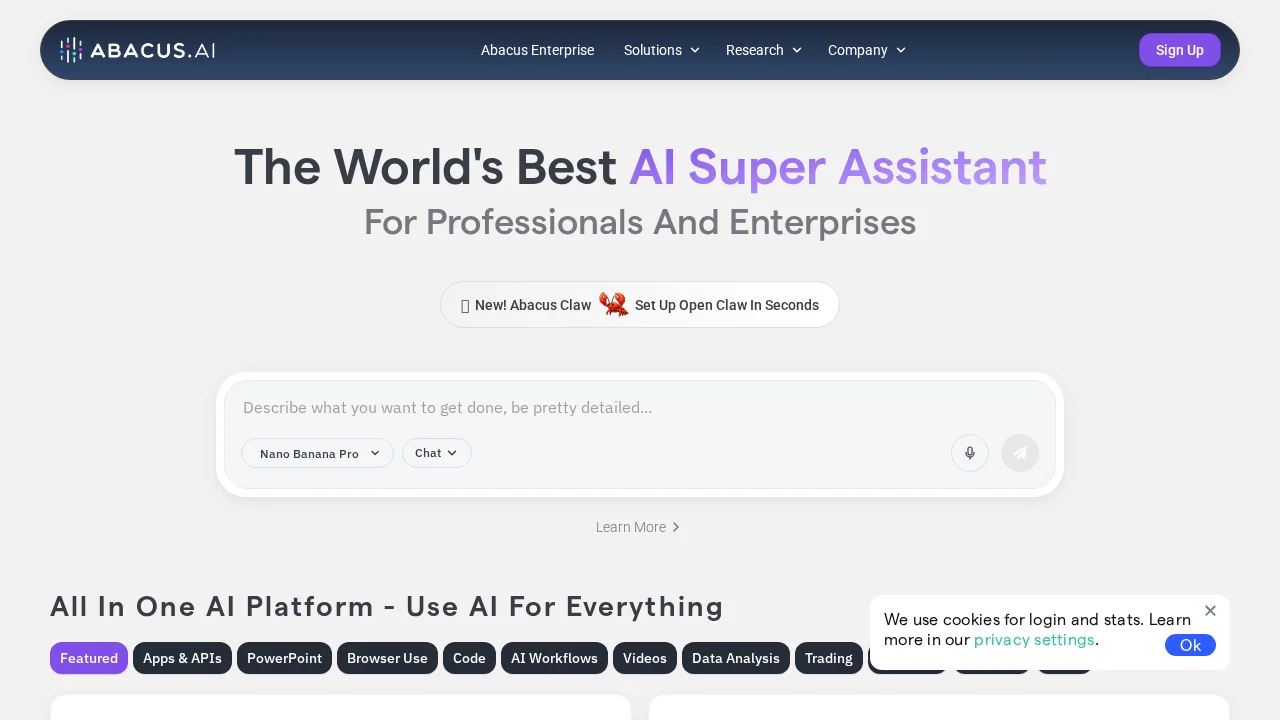
Abacus.AI is an AI platform that automates the building of applied AI agents and predictive systems at scale.
Abacus at a glance
- Pricing
- Freemium
- Rating
- ⭐ 5.0/5 · 3 reviews
- Key strengths
- Automates AI system building, reducing engineering time and expertise requiremen · Comprehensive MLOps stack with drift detection and model observability · Supports multiple AI application types from agents to predictive models
Screenshots
About Abacus
Abacus.AI enables organizations to deploy sophisticated AI applications without requiring extensive manual engineering. The platform leverages generative AI and advanced neural network techniques to construct language models, autonomous agents, and large-scale predictive systems. This approach accelerates time-to-value by letting AI handle the complexity of system design and optimization.
The platform offers comprehensive capabilities across multiple AI domains. Users can build intelligent agents that perform complex tasks, develop personalized experiences using behavioral data, create discrete optimization solutions, and construct end-to-end retrieval-augmented generation (RAG) systems. Fine-tuning of language models is supported, allowing customization for specific use cases and domains.
Operational excellence is built into Abacus.AI through integrated MLOps features. The platform provides model hosting, data pipeline management, drift detection, observability tools, and explainability functions—essential components for maintaining AI systems in production environments. Users can connect multiple data sources seamlessly and build customized interfaces tailored to business requirements.
Abacus.AI also contributes to the broader AI community through open-source research initiatives. The platform enables the creation of complex automated workflows, reducing manual intervention in repetitive business processes while maintaining transparency and control over AI-driven decisions.
Pros
Cons
Alternatives to Abacus
Analytify - A GenBI Platform
DealNavigator.Ai
GA4.so
Hanalyzer.ai
MyReport
SportBot AI
Wandercrafted