


Best Nanoswarm: OpenClaw App Alternatives 6 apps
Compare the top alternatives to Nanoswarm: OpenClaw App — pricing, features, and ratings.
Nanoswarm: OpenClaw App is a deployment and orchestration layer built around the OpenClaw agent framework, giving teams a structured way to run autonomous AI agents in production. Many users land here because they want one-click or fully managed OpenClaw hosting, while others hit walls around pricing, model flexibility, or scope. If any of that sounds familiar, it is worth looking at the wider ecosystem of nanoswarm: openclaw app alternatives on HyperStore before you commit.
Why look for a Nanoswarm: OpenClaw App alternative?
Nanoswarm works well for teams that want a turnkey OpenClaw setup, but it is not the only path to a working agent stack. Some users find the pricing tier that matches their usage is too steep once they scale beyond a handful of agents, while others want a tool that pairs OpenClaw with a broader workflow such as SEO briefs, browser-based writing, or chatbot deployment.
There are also platform-specific reasons to look elsewhere. Teams already running their own VPS may prefer a self-deployment option, and developers who want to swap foundation models on the fly may need an alternative with looser coupling between OpenClaw and the underlying LLM. None of these are dealbreakers on their own, but together they explain why a curated shortlist of alternatives is useful.
What to look for in a Nanoswarm: OpenClaw App alternative
Deployment model and hosting
Decide whether you want fully managed infrastructure, a hosted OpenClaw service, or a self-hosted VPS install. Managed options trade control for convenience, while VPS installs give you root access and the ability to tune the runtime. Tools like Featherless and KiloClaw lean toward the managed side of this trade-off, where MyClaw.Host sits closer to a one-click VPS deployment.
Model and framework flexibility
Check whether the alternative locks you to a single model provider or lets you route between OpenAI, Anthropic, open-source models, and local inference. If your team experiments with different models weekly, flexibility here will matter more than marginal differences in raw throughput. 88Agents is a notable option for teams that want explicit model selection across channels.
Scope beyond agent execution
Some alternatives stay laser-focused on running OpenClaw, while others bundle it with adjacent capabilities like SEO analysis, competitor research, or writing assistance. If your real bottleneck is not agent orchestration but content output or research turnaround, a tool that bundles that workflow may save you a stack of separate subscriptions. Clico and TaskFire both stretch well beyond pure agent hosting.
Pricing and lock-in
Pricing for OpenClaw-adjacent tools ranges from free browser extensions to monthly managed-service fees. Look at total cost of ownership including inference, not just the subscription line item, and check whether contracts are monthly or annual. According to Gartner's research on AI vendor pricing, buyers consistently underestimate inference costs when comparing platforms.
The best Nanoswarm: OpenClaw App alternatives
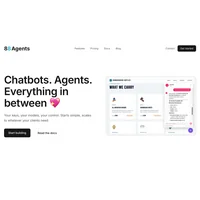
88Agents is a free option for businesses that want to build and deploy AI chatbots across multiple channels with flexible model selection. Compared with Nanoswarm, it trades OpenClaw's agent orchestration for a multi-channel chatbot surface area, making it a better fit for support, marketing, or sales teams that need to reach users on web, messaging, and social from one place. Pick this when model flexibility and channel coverage matter more than the OpenClaw runtime.

Clico is a free browser extension that brings AI-powered writing assistance directly into your text boxes. Where Nanoswarm is about running agents server-side, Clico lives inside the browser and helps individual writers draft, rewrite, and clean up copy without leaving their workflow. It suits content teams and solo writers who want a lightweight writing layer rather than a hosted agent platform.

Featherless OpenClaw is a paid service that eliminates AI agent hosting complexity with instant deployment and fully managed infrastructure. It is the closest "stay on OpenClaw, change the host" alternative to Nanoswarm, appealing to teams that like the framework but want simpler operations. Choose Featherless if you want OpenClaw semantics with less day-two infrastructure work.
KiloClaw is a paid, hosted AI agent platform that deploys OpenClaw with automated infrastructure, security, and updates. Compared with Nanoswarm, KiloClaw emphasizes an opinionated security and update pipeline, which is useful for teams that need to satisfy compliance requirements without building them from scratch. It fits engineering leads who want OpenClaw plus managed security defaults in one SKU.

MyClaw.Host is a paid hosting platform that enables rapid deployment of OpenClaw AI agents on VPS with one-click setup. It sits between fully managed services and full self-hosting: you get a fresh VPS with OpenClaw preinstalled rather than a shared multi-tenant cloud. Pick this when you want VPS-level isolation and root access without writing the install scripts yourself.

TaskFire is a paid, AI-powered service delivering rapid competitor analysis, SEO briefs, and data cleaning without conversation. It moves in a very different direction from Nanoswarm, replacing an agent runtime with a task-oriented API for research and content operations. According to Search Engine Roundtable, SEO teams are increasingly adopting task-style AI tools to bypass multi-turn chat interfaces, which is exactly the gap TaskFire targets.
How to choose
If you want to stay close to OpenClaw but reduce operational overhead, Featherless, KiloClaw, and MyClaw.Host each shift the hosting model in a slightly different direction. If you care more about model flexibility or multi-channel reach than the OpenClaw runtime, 88Agents is the obvious pick. For writing-focused users, Clico slots into the browser with no setup, and for SEO and research teams, TaskFire replaces chat-style agents with a direct task API.