Editing a podcast used to mean hours hunched over a timeline, trimming filler words, balancing levels, and manually transcribing every episode. Today, AI tools for podcast editing handle the tedious mechanical work, from cleaning up room noise to generating show notes, transcripts, and social clips in minutes. Whether you are a solo creator publishing weekly or a team producing a branded show, modern AI lets you spend more time on content and less on post-production.
This guide walks through what AI can do for your podcast workflow, the criteria that actually matter when picking a tool, and the best AI tools for podcast editing available on HyperStore right now.
How AI helps with podcast editing
AI now touches nearly every stage of podcast post-production. Noise reduction and voice enhancement tools can clean up recordings made in untreated rooms, removing hum, echo, and background chatter that would otherwise require a trained audio engineer. Speech-to-text models transcribe full episodes in minutes, with timestamps that let editors jump straight to specific moments. Once an episode is transcribed, language models can draft show notes, chapter markers, blog posts, tweet threads, email newsletters, and short video captions without a human writer in the loop.
Beyond cleanup and writing, AI is increasingly used for content repurposing, turning one long-form conversation into a week's worth of social content, and for production tasks like stem separation, filler-word detection, and automatic leveling. According to Edison Research, the number of weekly podcast listeners has grown steadily, and AI-driven production helps smaller teams keep up with demand without scaling headcount.
What to look for
Audio quality and noise handling
The single biggest differentiator between podcast editing tools is how well they clean up imperfect recordings. Look for tools that use modern speech enhancement models rather than simple noise gates, and check whether they handle room echo, plosives, and inconsistent mic distance. A tool that saves you a re-record is worth more than one that offers a dozen flashy features.
Transcription accuracy and language support
If you produce a show with multiple speakers, accents, or technical jargon, transcription accuracy matters enormously, because nearly every downstream feature (search, chapters, repurposing) depends on the transcript. Look for tools that publish word error rate benchmarks and support the languages and accents your show actually uses.
Output formats and integrations
Consider where the finished files need to land. Some tools export directly to podcast hosts like Buzzsprout or Transistor, others sync to DAWs like Adobe Audition or Descript, and many push transcripts into Google Docs, Notion, or your CMS. The fewer manual file moves, the faster your workflow. For a sense of what a complete production stack looks like, Podcast Insights maintains useful comparisons of modern creator toolchains.
Pricing model and usage limits
AI tools for podcast editing range from fully free to enterprise subscriptions, and most charge based on minutes of audio processed. Estimate your monthly upload volume and check whether the plan's limits, export rights, and commercial use terms match your show's needs before committing.
Best AI tools for podcast editing
Adobe Podcast
Adobe Podcast is a web-based audio workspace aimed squarely at spoken-word creators, with AI-powered recording, transcription, and a one-click "Enhance Speech" filter that strips out room noise and echo. It is a strong fit for podcasters who want browser-based editing without installing a full DAW, and the freemium tier makes it easy to test on a single episode before committing.
Podcast
Podcast is an AI-driven audio product that generates ready-to-listen episodes on a range of topics each week, useful for creators studying format and pacing or for listeners who want always-fresh content. It is less of an editing tool and more of a reference point for what fully AI-generated podcasting looks like in production today.
Castmagic
Castmagic takes a finished audio file and turns it into a content library: transcripts, show notes, summaries, quotes, social posts, and long-form articles generated automatically from the conversation. It is one of the best AI tools for podcast editing when your bottleneck is not audio cleanup but the writing and distribution work that follows.
Koolio.ai
Koolio.ai is a browser-based audio editor that lets creators record, edit, and publish from a single interface, with AI assistance for transcription and content generation layered on top of the timeline. The free tier and approachable UI make it a good starting point for podcasters who have outgrown basic recorders but do not want to learn a professional DAW.
PoddyHost.com
PoddyHost.com is built for authors and thought leaders who already have written material and want to convert it into professional audio. While it is not a traditional timeline editor, it fits the broader AI podcast editing workflow by handling the production step of turning text into publishable episodes.
AI Audio Kit
AI Audio Kit is a macOS app that uses OpenAI's Whisper API to transcribe audio and video across more than 70 languages, which makes it a strong choice for multilingual shows or international interview series. It is a paid, focused utility rather than an all-in-one editor, so it pairs well with a separate DAW for the actual mixing work.
AI Photo Editor.ai
AI Photo Editor.ai is primarily an image tool, but it earns a place on this list for podcasters who need quick cover art and promotional graphics to accompany new episodes. For a creator handling both audio and visual assets on a tight schedule, consolidating editing tasks in a single AI toolkit has real appeal.
Capsho
Capsho is designed for creators who treat each episode as raw material for a full marketing campaign, automatically generating show notes, blog posts, social captions, email copy, and YouTube descriptions from a single upload. It is one of the best AI tools for podcast editing when your goal is to maximize reach from every episode without hiring a content team.
Coolo.ai
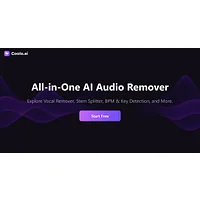
Coolo.ai focuses on the audio engineering side, offering AI-powered vocal removal, stem splitting, and music analysis. For podcasters who incorporate music, sound design, or interview excerpts that need isolating from background tracks, it solves problems that traditional editors handle with much more manual effort.
DeVoice
DeVoice converts audio and video into accurate text and includes built-in noise removal, making it a practical two-in-one option for podcasters who need transcripts and cleaner audio in a single step. The free tier is a useful entry point for indie creators testing out AI-assisted workflows before scaling up.
Eddie AI
Eddie AI takes interview footage and prompts and turns them into polished video edits, with interactive editing controls and multi-format exports. For podcasters producing companion video clips for YouTube and social channels, it extends the AI podcast editing workflow beyond audio into short-form video production.
Hello Humans
Hello Humans generates private, on-demand podcasts on any topic, with built-in accuracy checks designed to build user trust. It is a paid, AI-first creation tool best suited to teams that want bespoke audio content produced automatically rather than editing human-recorded conversations.
How to choose
Start by identifying your biggest time sink. If raw recordings sound bad, prioritize Adobe Podcast, Koolio.ai, Coolo.ai, or DeVoice for audio cleanup. If writing and distribution are the bottleneck, Castmagic and Capsho will save more hours. Multilingual shows should look at AI Audio Kit, and creators expanding into video should consider Eddie AI. Match one strong tool to your real workflow rather than stacking overlapping apps.
Frequently asked questions
What is the best AI tool for podcast editing overall?
There is no single winner, because editing breaks into distinct tasks. For audio cleanup, Adobe Podcast and Koolio.ai are widely used. For turning episodes into written content, Castmagic and Capsho lead the category. Most serious podcasters combine two or three specialized tools rather than relying on one all-in-one platform.
Can AI really replace a human podcast editor?
AI handles the mechanical work extremely well, including noise reduction, transcription, filler-word trimming, and first-draft show notes. Creative decisions like story pacing, music choices, and narrative structure still benefit from a human editor. For most independent shows, AI replaces several hours of grunt work per episode rather than the editor's role entirely.
How much do AI podcast editing tools cost?
Pricing varies widely. Several tools on this list, including Koolio.ai, Coolo.ai, and DeVoice, offer free tiers suitable for hobbyists. Professional tools typically charge per minute of audio processed, ranging from a few dollars per hour of audio on entry plans to custom enterprise pricing for high-volume shows. Always check commercial-use rights if your podcast is monetized.
Do AI podcast editors handle multiple speakers?
Modern transcription models differentiate between speakers and label them in the transcript, which is the foundation for editing multi-host and interview shows. Accuracy with overlapping speech and accents is improving rapidly, but it is still worth testing a tool with a sample of your own audio before relying on it for a full season.
Will AI-edited podcasts sound robotic or processed?
The best current tools, including Adobe Podcast's Enhance Speech, are remarkably transparent, and most listeners cannot tell an AI-cleaned track from a studio recording. Heavier processing, such as aggressive filler-word removal, can introduce audible artifacts, so it is worth A/B-testing results before publishing.
Pick the tool that solves your slowest step, run a real episode through it, and you will quickly see where AI fits into your production process. The best AI tools for podcast editing are the ones you actually use every week, not the ones with the longest feature lists.