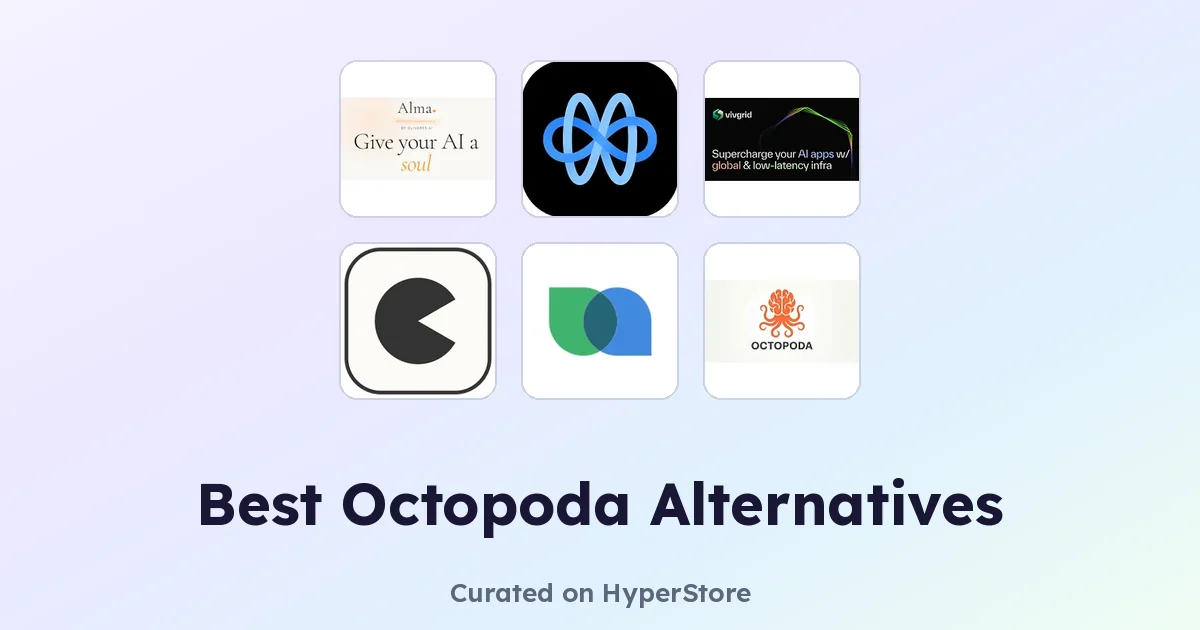
Octopoda is an AI memory and context management tool designed to help users carry knowledge and conversation state across workflows. Like any specialized tool, it works well for some and leaves others wanting different trade-offs in pricing, integrations, or scope. People typically search for Octopoda alternatives because they need a tighter focus on one workflow, broader cross-tool memory, or a different deployment model. This guide compares the top alternatives currently on HyperStore, framed around the situations where each one fits best.
Why look for an Octopoda alternative?
The most common reason people explore alternatives to Octopoda is fit for a specific workflow. Octopoda is built for general AI memory continuity, which is powerful but can feel overbuilt if your core need is, say, retaining what you read or deploying AI agents in production. Pricing models also vary widely across the category, and a free or usage-based plan can matter when memory volumes grow.
Other switchers cite platform and ecosystem preferences. Some want a memory layer that plugs into every AI tool they use; others want a tool that owns a narrower job, like a reading companion, and does it well. None of these are criticisms of Octopoda itself; they reflect the diversity of how people work with AI today.
What to look for in an Octopoda alternative
Scope of memory and recall
Decide whether you want a general-purpose memory layer that spans every AI app or a focused memory tool tied to one workflow. Alma and Memdex are aimed at the broad, cross-tool case, while Reedle narrows memory to reading content. For background on why persistent memory matters in modern LLM applications, see this survey on memory augmentation for large language models.
Privacy and data control
Memory tools handle a lot of personal and contextual information. Look at how each option stores, encrypts, and lets you export or delete your data. Local-first and encrypted options give you more control than tools that lock memory behind proprietary indexes. The NIST AI Risk Management Framework is a useful reference when evaluating how tools handle sensitive context.
Integrations and ecosystem
Check whether the alternative plugs into the AI tools you already use, including chat clients, IDEs, note apps, and agent frameworks. Vivgrid targets developers building agents, while SureThing.io focuses on bridging repos to deployed skills. A tool that does not connect to your existing stack will collect dust regardless of how clever its memory model is.
Pricing at your scale
Many memory and context tools price on storage, queries, or seats. Make sure the model fits your expected volume so a great tool does not become expensive once you depend on it. All five alternatives below are listed as free on HyperStore, which is a strong starting point for testing.
The best Octopoda alternatives
Alma by Olivares.AI
Alma focuses on preserving conversational continuity, automatically capturing facts, summaries, and behavioral patterns so your AI tools remember you across sessions. Compared to Octopoda's broader memory scope, Alma is more opinionated about how memory is structured, which suits users who want hands-off context retention rather than manual curation. Its free HyperStore listing makes it an easy first stop if Octopoda's manual side feels heavy.
Memdex
Memdex positions itself as a unified, encrypted memory bank that works across multiple AI tools, similar in spirit to Octopoda but with a stronger emphasis on cross-app portability and encryption. If you switch between chat clients, note apps, and coding assistants, Memdex's cross-tool approach may match your workflow better. The free tier on HyperStore makes it straightforward to test against your current setup.
Reedle
Reedle is a much narrower tool than Octopoda, acting as an AI reading companion that helps with comprehension and retention through intelligent insights and spaced repetition. It will not replace a general memory layer, but it is a strong alternative if your primary Octopoda use case is keeping what you read and learn organized. Choose Reedle when depth in one workflow beats breadth across many.
SureThing.io
SureThing.io addresses a different problem than Octopoda: turning starred or saved AI repositories into actually deployed skills and agents. It suits builders who want to move from discovery to execution without leaving their workflow. This is a more specialized alternative, so it is only a fit if your Octopoda usage is tied to AI agent development rather than personal memory.
Vivgrid
Vivgrid is an infrastructure platform for developers building, testing, and deploying intelligent agents at scale, sitting below the layer where Octopoda operates. It is the right pick if your switch is not really about memory at all, but about standardizing how you ship AI agents to production. Consider Vivgrid when your priority shifts from context retention to reliable deployment.
How to choose
If your main issue with Octopoda is manual memory management, start with Alma. If you want one encrypted memory layer across every AI app, try Memdex. If you only need to remember what you read, Reedle will feel lighter and more focused. For developers moving from experimentation to deployment, SureThing.io and Vivgrid are the relevant alternatives, with Vivgrid better for production-scale infrastructure and SureThing.io better for turning saved repos into live skills.
Frequently asked questions
Is there a free Octopoda alternative?
Yes. All five alternatives in this guide are listed as free on HyperStore, though some may add paid tiers for higher usage or team features. Memdex and Alma both emphasize free-tier access to their core memory features.
What is the best Octopoda alternative?
There is no single winner; it depends on your workflow. For general cross-tool memory, Memdex and Alma are the closest peers to Octopoda. For reading-focused retention, Reedle is a better fit. For developer infrastructure, look at Vivgrid or SureThing.io.
Which Octopoda alternative is best for developers?
Vivgrid is the strongest match if you are building and deploying AI agents, and SureThing.io is a useful complement when you want to turn starred open-source repos into running skills. The other three alternatives are more end-user oriented.
Can I use these Octopoda alternatives alongside Octopoda?
In many cases, yes. Memory tools like Memdex are designed to sit alongside existing setups, and developer tools like Vivgrid do not overlap much with personal memory layers. Check each tool's integration list before committing to a single workflow.
How do I switch from Octopoda without losing my data?
Export any memory or context entries Octopoda lets you access, then import them into the alternative where supported. Memdex and Alma both emphasize portability, which makes them safer migration targets for ongoing projects.
Octopoda remains a solid choice for general AI memory management, and the right move may simply be to stay with it. If a specific friction, whether pricing, scope, workflow fit, or deployment needs, is pushing you to look elsewhere, the alternatives above each address a different version of that friction. Try one or two against your real workload before deciding.