FlowSub vs Sora compares two AI video-and-audio tools: the former is for content creators, podcasters, educators, and video producers who need automated subtitles, while the latter is for creators, filmmakers, educators, and marketers who want to generate video from text. They solve different stages of a media workflow rather than offering interchangeable versions of the same product. FlowSub turns uploaded audio or video into multilingual captions and exportable subtitle files. Sora creates short, realistic video from written prompts, making it more relevant to ideation, prototyping, and storytelling.
At a glance: FlowSub vs Sora
FlowSub is an audio/video-to-subtitle service focused on transcription, translation, accessibility, and export flexibility. Sora is a text-to-video generator focused on creating new visual material, with outputs up to 60 seconds; the better fit depends on whether you already have media to caption or need visuals to generate.
What each tool does
FlowSub
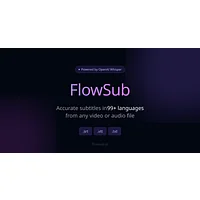
FlowSub accepts video or audio uploads and uses speech recognition to produce studio-quality subtitles and searchable text in numerous languages. It exports SRT, VTT, TXT, and ASS files, so creators can move captions into editing software, media players, or online platforms. Its free tier supports testing, while Pro plans add unlimited transcriptions, subtitle translation, and additional export options.
Sora
Sora turns written descriptions into dynamic, cinematic videos up to one minute long. Users can describe scenarios, visual styles, and movement, and the system is designed to interpret physical-world interactions and realistic motion. That makes it useful for concept visualization, short-form storytelling, education, and marketing without traditional filming or animation expertise.
Feature comparison
Inputs, outputs, and workflow
FlowSub starts with an existing video or audio file and returns transcriptions and subtitle files in SRT, VTT, TXT, and ASS; VTT is a web-oriented text-track format documented in the W3C WebVTT specification. Sora starts with a text prompt and generates a new video up to 60 seconds. In practical terms, FlowSub belongs in the captioning or post-production stage, while Sora belongs in the visual-creation stage.
Language, accessibility, and reach
FlowSub has the clearer fit for multilingual publishing because it supports transcription in numerous languages and adds subtitle translation on Pro. Captions can also support accessible media workflows covered by guidance such as the W3C Web Content Accessibility Guidelines. Sora's supplied facts emphasize visual generation and do not list transcription, subtitle, or translation features, so it is not a like-for-like choice when captions are the main deliverable.
Creative control and reliability
FlowSub's results depend heavily on clear audio, limited background noise, and speakers who are easy to distinguish. Sora instead depends on clear, detailed prompts and may need refinement for highly specific or niche scenarios. FlowSub is therefore more predictable when the source recording is usable and the goal is faithful text, while Sora offers more creative latitude but requires prompt iteration for a precise visual result.
Pricing
FlowSub: The directory lists FlowSub under a paid pricing model, with a free tier for testing. Pro plans unlock unlimited transcriptions, subtitle translation, and additional export options, but no exact prices or tier amounts are provided here. Sora: Sora is listed as free, with no further tier breakdown supplied. The side-by-side takeaway is that FlowSub has a paid upgrade path around higher-volume captioning, while Sora's listed model does not require a stated subscription to begin.
Pros and cons
FlowSub
Pros
- Supports SRT, VTT, TXT, and ASS exports.
- Transcribes in numerous languages.
- Offers a free tier for testing.
- Automates subtitle generation from audio or video.
Cons
- Quality can fall with noise or unclear speakers.
- Translation and other advanced features require Pro.
- Accuracy is closely tied to recording quality.
Sora
Pros
- Generates videos up to 60 seconds.
- Handles realistic motion and physical-world dynamics.
- Helps reduce the need for filming or animation expertise.
- Supports concepting, prototyping, and visual storytelling.
Cons
- Video output is limited to one minute.
- Needs clear, detailed prompts for the best results.
- Highly specific or niche scenarios may need refinement.
Which should you pick?
Choose FlowSub when you already have interviews, lessons, podcasts, social clips, or other recordings and need captions, searchable text, multilingual reach, or flexible subtitle exports. It is the more direct fit for accessibility and localization work, provided the source audio is reasonably clear.
Choose Sora when the main challenge is creating new visual footage from an idea, especially for short concepts, story scenes, marketing visuals, or educational demonstrations. Its one-minute limit and need for prompt refinement matter if you need tightly specified or longer-form production.
If a project needs both generated visuals and captions, the tools can occupy complementary stages rather than compete directly. Treat them as separate workflow decisions, and confirm the current file handoff and export options before planning an automated pipeline.
Other alternatives on HyperStore
Pipio is worth exploring if you want AI video creation with digital actors and voiceovers rather than Sora's prompt-led cinematic generation.
AUX MACHINA is an adjacent option for AI-powered image editing and customization when your project starts with still visuals instead of audio or text prompts.
Frequently asked questions
Is FlowSub better than Sora for subtitles?
For subtitle creation, FlowSub is the direct fit: it transcribes uploaded audio or video, supports multiple languages, and exports common subtitle formats. Sora's supplied feature set focuses on generating video and does not list captioning.
Is Sora better than FlowSub for making new videos?
Yes, for the specific task of generating new video from written prompts. Sora can create short visual sequences with realistic motion, whereas FlowSub works from media that already exists and focuses on its spoken content.
Does FlowSub have a free plan?
FlowSub has a free tier for testing, although its directory pricing model is paid. Pro plans add unlimited transcriptions, subtitle translation, and additional export options; exact prices are not supplied in the fact sheet.
Is Sora free to use?
Sora is listed with a free pricing model in the supplied directory facts. No plan limits, paid tiers, or detailed usage terms are provided here, so check the current offering before relying on it for ongoing production.
Do FlowSub and Sora integrate directly?
No direct integration is documented in the supplied fact sheets. FlowSub supports video and audio uploads plus subtitle-file exports, so any workflow connecting the tools should be validated as a manual handoff unless current product documentation confirms otherwise.
The practical choice is simple: start with FlowSub when the asset is spoken media that needs captions, and start with Sora when the asset still needs to be created from a prompt.