AI Tools for SQL Queries 20 apps
Writing SQL used to mean memorizing dialect quirks, hunting through schema docs, and rewriting joins every time a stakeholder asked a new question. Today, the best AI tools for SQL queries let analysts and business users describe what they want in plain English and get back runnable, often optimized, SQL. According to PostgreSQL project documentation and broader industry analysis on data analytics, natural-language interfaces are now a standard layer in modern data stacks, not a novelty.
How AI helps with SQL queries
Modern AI SQL assistants do more than autocomplete a SELECT. They interpret a user's intent, map it to the right tables and columns using the live schema, and produce dialect-correct SQL for warehouses like BigQuery, Snowflake, Postgres, or MySQL. Many tools can explain the generated query, fix syntax errors on the fly, suggest indexes, and surface follow-up questions the user might want to ask next.
For teams, this collapses the round trip between a business question and a data answer. A marketer can ask "what was conversion rate by channel last quarter" and get both the query and a chart without filing a ticket. At the same time, engineers use these tools to scaffold boilerplate, refactor messy CTEs, and document legacy SQL, freeing hours every week.
What to look for
Dialect and warehouse support
SQL is not one language. The right tool should support your specific dialect — BigQuery, Snowflake, Postgres, MySQL, SQL Server, or DuckDB — and ideally let you switch without relearning prompts. Tools tightly coupled to one warehouse often produce better, more idiomatic SQL for that environment.
Schema awareness
A good AI SQL tool reads your live schema, including column types, foreign keys, and table descriptions, so it generates joins that actually exist. Generic tools trained only on public data will hallucinate tables; production-grade tools let you connect a real database or upload sample DDL for grounded results.
Transparency and explainability
Look for tools that show the generated query, explain the logic in plain English, and let you edit before running. Trust matters: analysts need to verify joins and filters before shipping numbers to leadership, and audit trails are increasingly required by governance teams.
Integrations and workflow fit
Consider where you actually work. The strongest options plug into notebook environments, BI platforms like Metabase or Hex, IDEs, or chat surfaces like Slack. Native integration with your data warehouse, version control, and team collaboration tools matters more than a flashy demo.
Best AI tools for SQL queries
AI2SQL converts natural-language prompts into SQL across several dialects and is geared toward users who have never written a query. The freemium tier covers basic generations and an API, making it easy to embed into internal dashboards or support bots when ad-hoc access isn't enough.
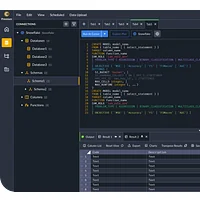
Coginiti positions itself as an AI co-developer for analytics teams, offering intelligent query assistance, performance recommendations, and reusable components. It shines in collaborative environments where consistent SQL style, documentation, and shared best practices matter as much as raw generation speed.

Analyst Intelligence focuses specifically on Google BigQuery, which is its strength and limitation. Non-technical analysts can describe a question and receive BigQuery SQL that respects the warehouse's specific functions, slotting into an existing GCP-native data workflow.


Genie goes a step further than SQL generation by letting business users query and visualize data without writing code at all. The output is usually a chart or table, with SQL available behind the scenes, which makes it useful for stakeholder self-service.


Metabot AI lives inside Metabase, the popular open-source BI tool, so any team already using Metabase can ask questions in natural language and get SQL-backed answers. For Metabase shops, it is the path of least resistance to AI-assisted querying.




Jam SQL Studio is an AI-powered SQL IDE with multi-database support, intelligent coding assistance, and built-in schema management. It appeals to engineers and analysts who want a dedicated workspace rather than a chat-style tool, with AI as a coding companion.
How to choose
Pick Analyst Intelligence, Metabot AI, or Hex.tech if you are already committed to a specific warehouse or BI tool. For pure "English to SQL" experiences aimed at non-technical users, AI2SQL, Blaze SQL, DataLang, and FluentHQ are the natural starting points. Engineers and analysts who want a code-first environment should look at Coginiti or Jam SQL Studio. When the data lives in spreadsheets rather than a warehouse, QueryBox is the most direct option, and Genie or Fabi.ai fit teams needing richer visualization or multi-step analysis on top.
More AI tools to explore

Seek
Seek uses natural language processing to let you query databases in plain English and extract insights instantly.
SQLFlash
SQLFlash is an AI-powered SQL optimizer that eliminates bottlenecks and improves query performance automatically.

Querio
Querio is an AI-powered data analytics platform that lets anyone query and visualize data using natural language.

Rows AI
Rows AI is an AI-powered spreadsheet platform that transforms data analysis by converting natural language questions into instant insights.

Latitude
Latitude is an AI-powered data exploration platform that transforms raw data into actionable insights in minutes.

Monitr
Monitr is an AI-powered analytics platform that transforms how you query, visualize, and explore your data.