LangWatch is an LLM observability and evaluation platform that helps engineering and product teams monitor prompts, traces, model evaluations, and quality signals across AI applications. Teams often compare LangWatch alternatives because pricing scales quickly with trace volume, the integration surface assumes a specific framework, or they want coverage for adjacent problems like agent hosting, custom evaluation, or memory infrastructure that observability tools do not address.
Why look for a LangWatch alternative?
LangWatch is strongest for product teams that need structured evaluation alongside tracing, and its dashboard model is well suited to fast iteration. The reasons teams look elsewhere usually come down to scope rather than quality. Some teams need a platform that actually deploys and runs agents, not just observes them. Others want lighter-weight observability, broader hosting concerns like autoscaling and security handled for them, or a specialized stack for memory, inference, or growth workflows that sit outside the observability layer entirely.
Cost is another common driver: LLM observability pricing typically grows with the number of spans or traces ingested, which becomes punishing once a product reaches steady traffic. Teams also report friction when LangWatch's evaluation primitives do not map cleanly onto their custom eval pipelines, prompting a move toward platforms that expose more flexibility or that bundle observability into a wider agent stack.
What to look for in a LangWatch alternative
Scope: observation vs. execution
Decide whether you need a tool that watches what your LLM application is doing, or one that also runs and hosts the application. LangWatch sits firmly in the observation camp. If your team is also struggling with deployment, scaling, or agent lifecycle management, an alternative that bundles those capabilities will save more time than a pure observability swap.
Evaluation flexibility
LangWatch offers evaluators and custom scoring, but evaluate whether you need deeper support for offline eval suites, human-in-the-loop review, or domain-specific grading. The best LangWatch alternatives expose either richer eval APIs or a more opinionated workflow that fits your stack out of the box. Considerations like dataset versioning and regression testing across model upgrades are worth weighing.
Pricing model transparency
Trace-based pricing can produce surprising bills. Look for alternatives that publish clear per-event or per-token costs and make it easy to forecast spend at production volume. Platforms with autoscaling or pay-per-use inference tend to map more cleanly onto business metrics than per-seat observability seats.
Integration depth and ecosystem fit
The best platform is the one your team will actually wire in. Check for native support for your existing framework, vector store, and model provider, and confirm that the tool plays well with your CI/CD and data warehouse. A useful benchmark is how much custom instrumentation each option still requires.
The best LangWatch alternatives
KiloClaw
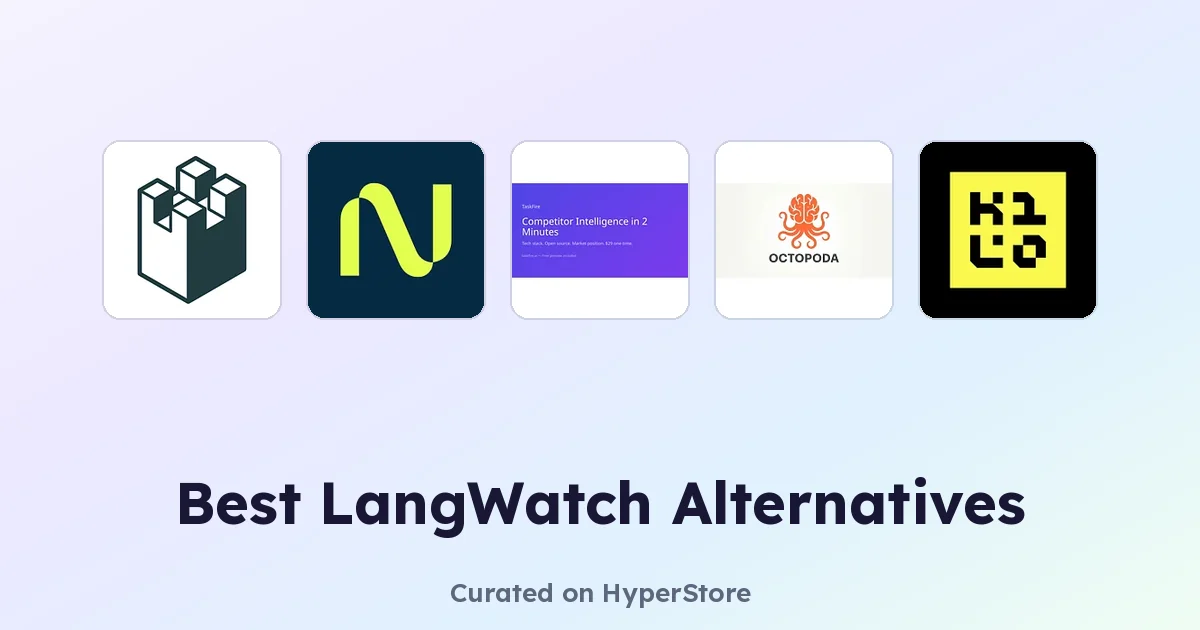
KiloClaw is a paid hosted AI agent platform that deploys OpenClaw with automated infrastructure, security patching, and updates handled for you. Where LangWatch focuses on observing traces your application already produces, KiloClaw takes responsibility for the runtime itself, which makes it a better fit for teams that want one provider for both deployment and monitoring. It suits engineering groups that would rather not run their own agent infrastructure while still wanting production-grade controls.
Nanoswarm: OpenClaw App
Nanoswarm: OpenClaw App is a free tool for creating personalized AI agents on Telegram with one-click setup and deeper customization options. Unlike LangWatch, which targets developers instrumenting production LLM systems, this app is aimed at non-technical users who want a deployable agent experience. It is a natural alternative when the underlying need is "give me an AI agent" rather than "give me a dashboard for my agents."
Nebius Token Factory
Nebius Token Factory is a free inference platform offering enterprise-grade LLM serving with transparent per-token pricing and autoscaling. It sits below the observability layer that LangWatch monitors; teams running large model workloads often pair it with eval tooling to keep cost-per-query predictable. According to industry reporting on cloud AI spend, transparent inference pricing has become a top procurement criterion, which is exactly where Nebius competes.
Octopoda
Octopoda provides persistent memory infrastructure for AI agents, with semantic search and knowledge retention across complex multi-agent systems. Where LangWatch tracks what an agent said, Octopoda decides what an agent will remember on the next turn, addressing the long-horizon context problem that raw tracing cannot solve. It is a strong alternative for teams whose bottleneck is memory quality rather than observability coverage, and it can complement a separate eval stack.
TaskFire
TaskFire is a paid AI service that delivers rapid competitor analysis, SEO briefs, and data cleaning without conversational overhead. It is the odd one out in this list and is not a direct observability replacement; teams turn to it when their daily work involves repeatable research or data tasks that distract from core LLM development. Research on developer productivity consistently shows that reducing context-switching is one of the highest-leverage efficiency wins, which is the gap TaskFire targets.
How to choose
If your primary pain is deployment and infrastructure rather than tracing, KiloClaw and Nanoswarm are the strongest fits. If LangWatch's pricing model is the issue, Nebius Token Factory's transparent per-token inference can reshape the unit economics of the application you are observing. Teams struggling with long-term agent memory should look at Octopoda, while smaller teams that just need to offload research and data cleaning tasks should consider TaskFire. The right pick depends on whether the missing piece is execution, cost, memory, or productivity.
Frequently asked questions
Is there a free LangWatch alternative?
Yes. Among the options on HyperStore, Nanoswarm: OpenClaw App, Nebius Token Factory, and Octopoda are free, though each addresses a different layer of the AI stack rather than replacing observability one-to-one.
What is the best LangWatch alternative?
For most teams, the answer depends on the bottleneck. KiloClaw is a strong all-in-one agent platform, while Nebius Token Factory is a good pick when inference cost is the main concern.
Do LangWatch alternatives support evaluations?
Evaluation depth varies. Some platforms focus on execution or memory and assume you will pair them with a separate eval layer; others, like LangWatch itself, treat evaluation as a first-class feature. Confirm eval API support before committing.
How do LangWatch alternatives handle pricing at scale?
Most alternatives move away from per-trace pricing toward per-token, per-request, or flat-rate hosted pricing. This usually benefits teams with high trace volume but predictable model usage.
Can I use multiple alternatives together with LangWatch?
Yes. A common pattern is to keep LangWatch for deep evaluation while using Octopoda for memory and Nebius for inference, with each tool owning one layer of the stack.
Whichever direction you choose, the strongest LangWatch alternatives are the ones that resolve the specific friction you have hit, whether that is cost, agent hosting, memory, inference pricing, or research overhead. Treat the switch as a scoped decision rather than a wholesale platform migration, and you will end up with a stack that is easier to operate and easier to budget.